
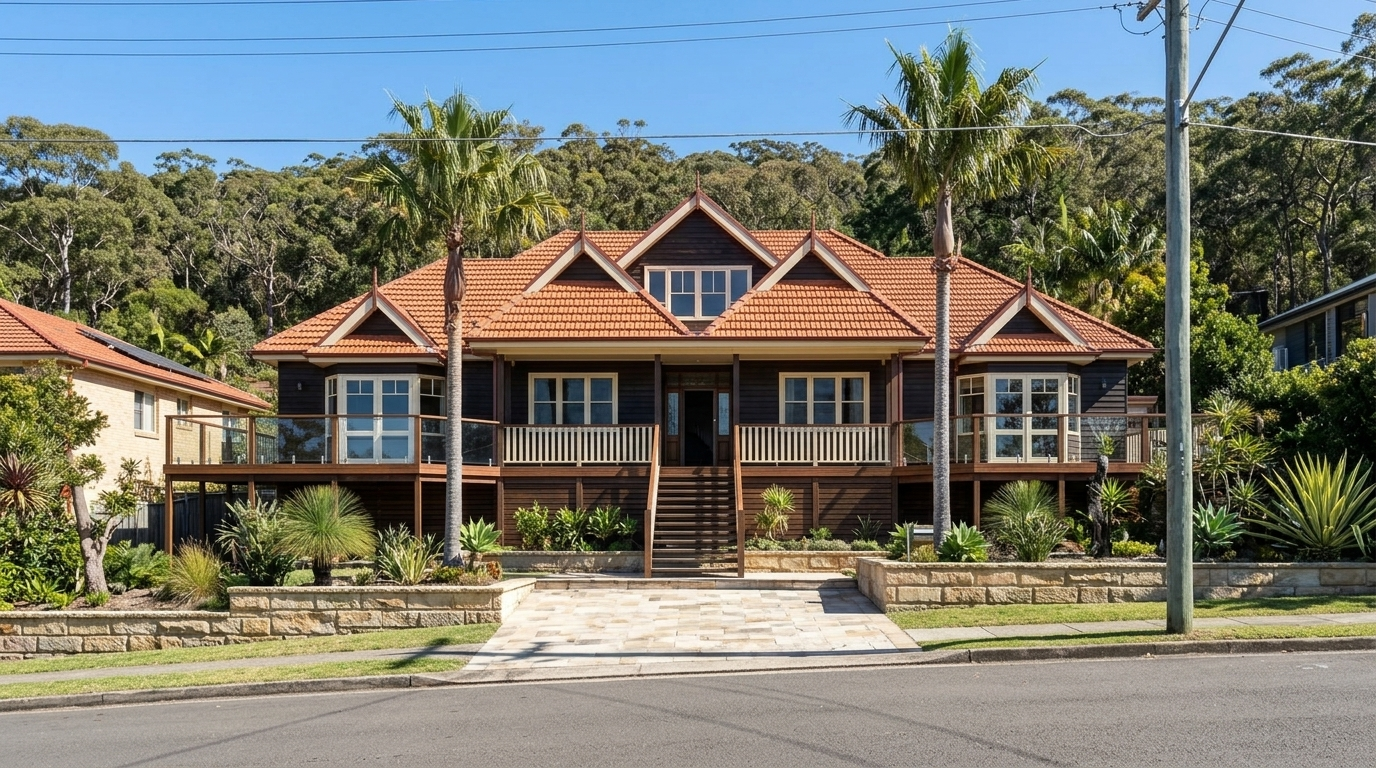
Blackwall is a waterfront suburb on the western shore of the Woy Woy Peninsula, about 81 kilometres north of Sydney. It covers barely 1.2 square kilometres and is home to just under 2,000 people. Brisbane Water runs along its western edge, the arch of the Rip Bridge spans the waterway, and Blackwall Mountain rises from the middle of the suburb with bushland walking trails and lookouts over the water toward Lion Island and Barrenjoey Head.
Blackwall combines quiet residential living with genuine water access, where fishing and boating are part of everyday life, and it is within commuting range of Sydney. Woy Woy Station is a 7-minute drive away and offers regular trains to Central in around 70 to 75 minutes. This combination of coastal living and city connectivity has attracted Sydney commuters, downsizers, and families, and it underpins steady rental demand. With property prices in Blackwall having risen more than 100% over the past decade, according to HTAG, the question for investors in 2026 is a practical one: does it make more sense to rent out an investment property here and bank the cash flow, or to buy and hold for the long-term equity play?
The Rental Market: Tight Vacancy and Rising Returns
If you’re leaning toward renting out a property, the numbers are encouraging. Blackwall’s vacancy rate sits at just 1.30%, according to RealEstateInvestar, well below the 2 to 3% range widely considered a balanced market. With only around 13 rental properties typically available at any time and approximately one in four households renting (25.75% of the population), the supply-demand equation strongly favours landlords.
Rents have been rising. Houses in Blackwall now rent for about $610 to $670 per week, while townhouses and villa units rent for $550 to $600 per week. Over the past 12 months, house rents have increased roughly 18%, in line with strong rental demand across the Woy Woy Peninsula, where the overall vacancy rate sits around 1.2%. For context, the median weekly rent at the 2021 Census was just $390. Rents have increased by roughly 56 to 72% in five years.
The tenant profile here is diverse and stable. You’ll find Sydney commuters who catch the train from Woy Woy three or four days a week, families drawn to the quiet, tree-lined streets and proximity to schools like Woy Woy Public School (a 7-minute drive), and downsizers who’ve sold larger homes elsewhere on the Coast and want a waterside lifestyle without the upkeep. This mix of tenant types helps smooth out demand across different property sizes and price points, from two-bedroom townhouses appealing to singles and couples to three- and four-bedroom houses attracting families.
Gross rental yields in Blackwall range from about 2.70% to 3.28% for houses and up to 3.85% for townhouses and units. These yields are competitive for coastal NSW, where capital growth has historically driven total returns. The low vacancy rate means the risk of extended empty periods between tenancies is lower than in many higher-yielding regional markets where demand can be less consistent.
Buying in Blackwall: Entry Points and Property Types
Blackwall’s housing stock is overwhelmingly houses and townhouses. According to the 2021 ABS Census, 65% of dwellings are separate houses, 21% are semi-detached or townhouses, and just 2% are apartments. That’s important for investors because it means the market is supply-constrained by geography: this is a small peninsula suburb with limited greenfield land, and low-rise character isn’t going anywhere.
For investors, the most accessible entry point is the two-bedroom townhouse or villa unit. Recent sales recorded by the NSW Valuer General show transactions like 2/11A Warwick Street at $570,000 (October 2024) and 3/43 Memorial Avenue at $760,000 (May 2026). Three-bedroom townhouses step up from there: 1/56 Commonwealth Avenue sold for $840,000 and 5/48 Gallipoli Avenue for $1,200,000, both in the first half of 2026. These properties typically carry lower maintenance obligations and appeal strongly to the downsizer and young-family tenant segments.
Standard houses on blocks of roughly 400 to 700 square metres form the core of the market. Entry-level houses can be found from around $940,000 to $1,050,000. Recent examples include 48 Warwick Street ($950,000) and 311 Blackwall Road ($1,050,000). Mid-range houses on blocks with good street appeal trade in the $1.15 million to $1.5 million band: 26 Springwood Street sold for $1,150,000 in May 2026, and 41 Gallipoli Avenue for $1,175,000 in March 2026.
At the upper end, the Orange Grove Road waterfront strip operates in a different league altogether, with deep-waterfront homes trading between $3.2 million and $6.9 million, a premium-tier market suited to high-net-worth investors rather than the typical rental play.
The long-term growth history anchors the buy-and-hold case. Blackwall has delivered a 10-year compound annual growth rate (CAGR) of 6.9% for all property types and 8.0% for houses specifically, according to AusPropertyInsights. The 36-year CAGR stands at 6.3%, which represents nearly four decades of consistent appreciation. The current market is assessed as being near fair value in early 2026, with prices broadly aligned with long-term trends.
The Numbers: Renting Out vs Buying to Hold
So how does the arithmetic actually stack up? Let’s walk through a realistic scenario.
Take a mid-range Blackwall house purchased for $950,000, which in today’s market might get you a solid three-bedroom home on a 480 to 500-square-metre block in one of the residential streets. Rented at $650 per week, that property would generate approximately $33,800 in annual gross rent. At the purchase price, that’s a gross yield of about 3.55%. That’s modest, but the 1.30% vacancy rate means the property is unlikely to sit empty for long.
Now consider the capital growth side. At the historical 6.9% CAGR, that same $950,000 property would add roughly $65,500 in equity in the first year alone, nearly double the gross rental return. Over five years, the compounding effect builds, and over ten, the equity gain outstrips what rental income alone can produce. The rent covers or nearly covers holding costs while the equity accumulates over time.
What strengthens this relative to a pure yield play in a regional centre is the structural undersupply. Blackwall has roughly 500 renter households competing for about 13 available rental properties at any given time. That imbalance supports both rent growth and reliable tenancy, and it’s reinforced by the geography of the Peninsula itself: water on one side, limited greenfield land, and a planning environment that favours low-rise infill over high-density development. Large-scale apartment development is unlikely given these constraints.
Rental income has also been strengthening. With the median rent moving from $390 per week at the 2021 Census to $610 to $670 per week in 2026, the rental component of total return is steadily improving. Purchase prices have moderated from their pandemic peak. For an investor holding over the medium to long term, both income and growth are contributing to total returns.
Where to Look: Streets and Property Types for Investors
Different streets in Blackwall suit different strategies, and it’s worth knowing which is which before you start inspecting.
For entry-level townhouses with accessible price points, start with Warwick Street, Warrigal Street, Gallipoli Avenue, and Memorial Avenue. These streets host clusters of modern townhouse developments, typically two- and three-bedroom configurations with low strata fees and good tenant appeal. Recent sales like 3/43 Memorial Avenue ($760,000) and 2/11A Warwick Street ($570,000) show there’s still value to be found, particularly in the two-bedroom segment. The yields here tend to be at the higher end of the suburb’s range (up to 3.85%), and the maintenance burden is lower, which suits a set-and-forget investment approach.
For mid-range houses with strong family-tenant appeal, focus on Commonwealth Avenue, Wallaby Street, and Inkerman Avenue. These streets offer houses on blocks of around 480 to 700 square metres. Recent sales include 23 Inkerman Avenue at $1,000,000 and 41 Gallipoli Avenue at $1,175,000, placing these streets in the $920,000 to $1,175,000 price band. Families renting in this bracket value the quiet streets, the proximity to Wallaby Reserve’s natural playground, and the short drive to Woy Woy’s shopping and schools.
For investors with an eye on development upside, some properties on larger R1-zoned blocks offer potential for dual-occupancy or townhouse redevelopment, subject to council approval. This adds a value-add dimension beyond the standard buy-and-hold approach, something to discuss with a town planner if you’re looking at blocks above 700 square metres.
As a general rule of thumb, streets closer to the Brisbane Water foreshore and those with elevation toward Blackwall Mountain sell at higher prices, and properties with even a partial water glimpse or mountain outlook attract stronger tenant interest and faster leasing. The Orange Grove Road waterfront is a separate market: premium prices, premium tenants, and a different investment calculus.
The Investor’s Verdict
If you’re weighing up renting out versus buying to hold in Blackwall, buying for the long term has the stronger case in the numbers. The suburb’s 106% price growth over the past decade and its 6.3% annual growth rate sustained across 36 years show property values compounding steadily over time. Rental income has been strengthening (up roughly 18% for houses in the past year), and the 1.30% vacancy rate provides tenancy security that many higher-yield markets do not offer.
Blackwall suits investors with a longer time horizon. It is a lifestyle location with limited supply: a small peninsula suburb with water on one side, bushland on the mountain, and little capacity for new development. The rental pool is tight and the tenant base is diverse: commuters, families, downsizers, and professionals who value the Central Coast lifestyle. Whether you start with a $570,000 two-bedroom townhouse or a $950,000 family home, both the rental and growth fundamentals are working in your favour.
Frequently Asked Questions
What is the median house price in Blackwall NSW?
The median house price in Blackwall is approximately $1,215,000 based on the 12 months of settled sales to early 2026, according to realestate.com.au. Listing medians sit closer to $1,250,000. Entry-level houses can be found from around $940,000 on the inland residential streets, while premium waterfront properties on Orange Grove Road trade in the $3 million to $7 million range.
What rental yield can investors expect in Blackwall?
Gross rental yields in Blackwall range from approximately 2.70% to 3.28% for houses and up to 3.85% for townhouses and villa units, according to data from RealEstateInvestar and Your Investment Property. These yields are competitive for coastal NSW, where capital growth has historically driven total returns. They have been improving as rents rise faster than purchase prices.
What is the vacancy rate in Blackwall?
The vacancy rate in Blackwall is currently 1.30%, well below the 2 to 3% healthy-market benchmark. Only around 13 rental properties are available at any given time, and with roughly one in four households renting, tenant demand consistently outstrips supply. This tight vacancy environment gives investors confidence in continuous tenancy and supports ongoing rent growth.
How much rent can I charge for an investment property in Blackwall?
Houses in Blackwall typically rent for $610 to $670 per week, while townhouses and villa units rent for $550 to $600 per week. Strong rental demand across the Woy Woy Peninsula pushed house rents up approximately 18% over the past year. The rent you can achieve will depend on the property’s size, condition, and proximity to the water or Blackwall Mountain.
Is Blackwall a good place for property investment?
Blackwall offers a strong long-term investment case. The suburb has delivered a 10-year compound annual growth rate of 6.9% and a 36-year CAGR of 6.3%, according to AusPropertyInsights. Combine that with a very tight 1.30% vacancy rate, rising rents, and strong tenant demand from Sydney commuters, downsizers, and families, and you have the fundamentals that support both reliable rental income and sustained capital growth.
What types of investment properties are available in Blackwall?
Blackwall’s dwelling mix is predominantly houses (65%) and townhouses (21%), with very few apartments (2%). Investors can choose from two- and three-bedroom townhouses and villa units ($570,000 to $1,200,000), standard houses on 400 to 700 m² blocks ($940,000 to $1,500,000), or premium deep-waterfront homes on Orange Grove Road ($3.2 million and above). The limited supply of apartments means less competition in the rental pool and a market defined by low-rise character.
What are the best streets in Blackwall for investors?
Warwick Street, Warrigal Street, Gallipoli Avenue, and Memorial Avenue host clusters of modern townhouses with accessible entry prices and strong rental demand, ideal for investors seeking lower-maintenance, higher-yield options. Commonwealth Avenue, Wallaby Street, and Inkerman Avenue offer mid-range houses on solid block sizes that appeal to family tenants. Recent sales include 23 Inkerman Avenue at $1,000,000. The Orange Grove Road waterfront strip suits premium-investment strategies with a different risk-return profile.
How does Blackwall compare to nearby suburbs for investment?
Blackwall sits between more expensive neighbours like Ettalong Beach and Booker Bay and the more affordable Woy Woy. Woy Woy offers slightly higher rental yields (approximately 3.02% for houses and 4.02% for townhouses, according to RealEstateInvestar) at generally lower purchase prices, while Blackwall offers premium waterfront positions, the bushland amenity of Blackwall Mountain, and a quieter residential character that attracts long-term tenants. For investors prioritising capital growth, Blackwall’s 6.9% 10-year CAGR compares well with other suburbs on the Peninsula.
Who rents in Blackwall: what is the tenant profile?
Tenants in Blackwall are a diverse mix: Sydney commuters who catch the train from Woy Woy Station (70 to 75 minutes to Central), families drawn to the quiet streets and proximity to schools like Woy Woy Public School, downsizers seeking a waterside lifestyle with less upkeep, and professionals who value the Central Coast’s blend of natural beauty and connectivity. The rental population accounts for 25.75% of households. This share reflects sustained investor interest in the suburb.
Should I buy a townhouse or a house for investment in Blackwall?
It depends on your strategy. Townhouses in Blackwall offer lower entry prices ($570,000 to $1,200,000), often stronger rental yields (up to 3.85%), and lower maintenance obligations, making them well-suited to investors prioritising cash flow and a hands-off approach. Houses offer greater land value and typically stronger long-term capital growth potential, given the scarcity of detached homes on the Peninsula. If your investment horizon is 10-plus years and you’re focused on equity, a house is likely the stronger choice. If you’re looking for better near-term returns with less upkeep, the townhouse route makes sense.