
If you follow Australian property, you have almost certainly heard “negative gearing” more than once. The conversation only intensified after the 2026 Federal Budget reshaped the rules. For investors on the Central Coast, and particularly in Blackwall, understanding these fundamentals matters.
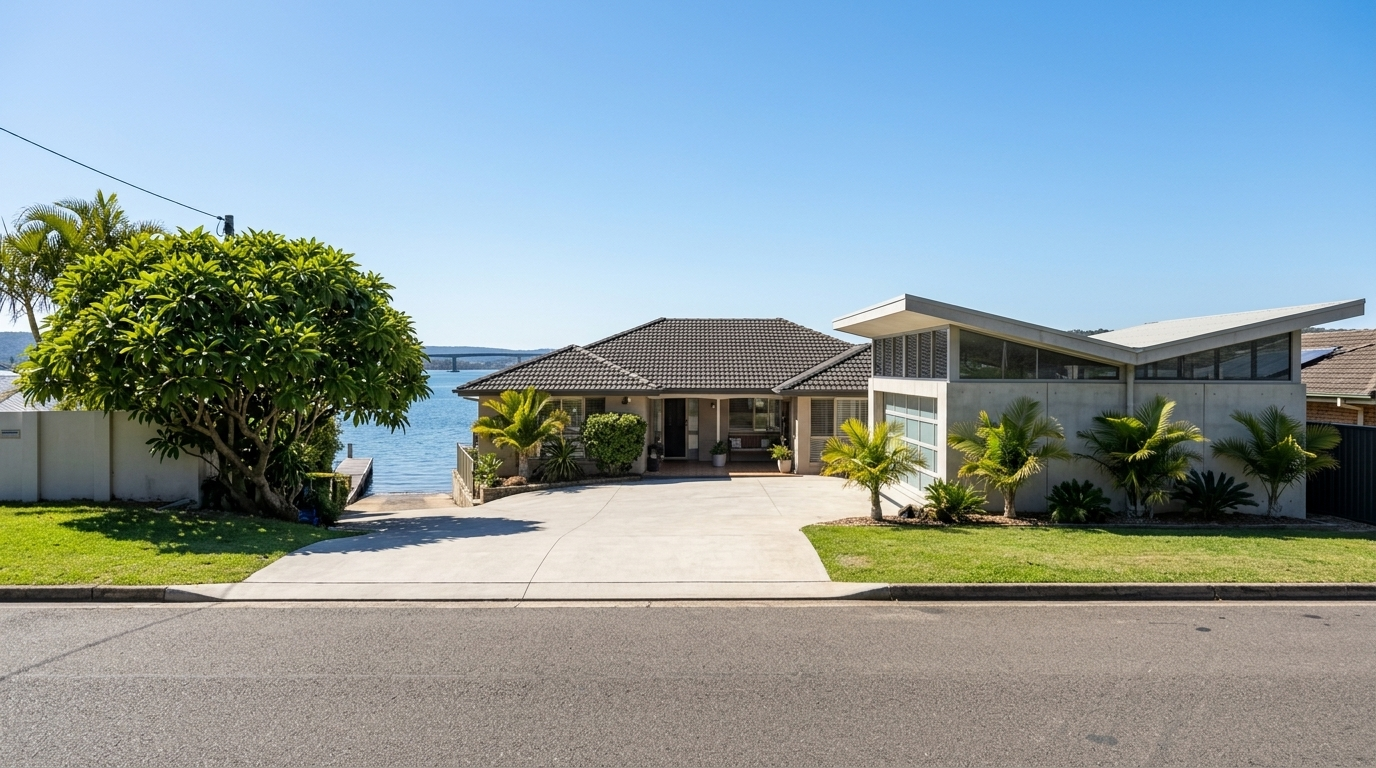
Blackwall is a quiet waterfront suburb on the Woy Woy Peninsula where about one in four households rents (RealEstateInvestar). Its 585 detached houses, 188 townhouses and semi-detached properties, and 21 apartments offer the kind of investment variety, from entry-level townhouses to architect-designed waterfront homes, that makes knowing the tax landscape useful.
What Is Negative Gearing?
“Gearing” means borrowing to invest. An investment is “negatively geared” when the costs of holding it, including mortgage interest, council rates, property management, maintenance, insurance, and depreciation, exceed the rental income it brings in (ABC News). The shortfall is a net rental loss.
Under Australia’s system, in place since 1936, that loss can be offset against your other taxable income, such as your salary, reducing your overall tax bill (Yahoo Finance). The strategy pairs with the 50% Capital Gains Tax discount, introduced in 1999, which means only half of any capital gain is taxed upon sale. Together they create the classic investor model: claim the annual loss against income, then realise a discounted gain on exit. Mortgage interest is almost always the largest deductible expense.
A Simple Worked Example
Theory is useful, but numbers bring it to life. Take a three-bedroom Blackwall townhouse, for instance 1/56 Commonwealth Avenue, sold in April 2026 for $840,000. At the townhouse median rent of $550 per week (RealEstateInvestar), gross annual rental income is roughly $28,600.
Now the costs. With a 20% deposit, borrowing $672,000 at 5%, annual mortgage interest comes to about $33,600. Add other holding costs: council rates (~$1,800), property management (~$2,000), insurance (~$1,500), maintenance (~$1,500), and depreciation. Total expenses: roughly $45,400. The net rental loss: about $16,800.
For an investor earning between $120,000 and $180,000 on the 37% marginal rate, that loss reduces the year’s tax bill by roughly $6,500. The property still costs more than it earns, because negative gearing is a cash-flow strategy, not a profit centre, but the tax refund softens the holding cost while you wait for growth. This is illustrative; every investor’s circumstances differ.
The 2026 Federal Budget Changes
The May 2026 Budget introduced sweeping changes to property taxation.
The headline is a cut-off date: properties purchased after 7:30pm AEST on 12 May 2026 (Budget night) are subject to the new rules (William Buck). The changes commence on 1 July 2027, creating a one-year transitional window.
For affected properties (established homes bought after the cut-off), the key shift: from July 2027, rental losses can no longer be deducted against salary or wages. Instead, losses can only offset residential rental income from other properties or future capital gains from rental property sales. Excess losses can be carried forward, so they are not lost, but the mechanism narrows considerably (Budget.gov.au).
Existing property owners are grandfathered. If you held a rental property, or were under contract, before 7:30pm on Budget night, you continue to access full negative gearing for as long as you own the property. Treasury expects grandfathered benefits to wash out over roughly a decade (The Guardian).
There is also a new-build exemption. Eligible newly built properties retain access to both negative gearing and the 50% CGT discount. To qualify, a property must genuinely add to housing supply: off-the-plan apartments, duplexes via knockdown rebuilds that increase the dwelling count, construction on previously vacant land, or newly built homes occupied for less than 12 months before their first sale. Extensions, one-for-one knockdown rebuilds, and granny flats do not qualify (William Buck).
What the Changes Mean for Blackwall Investors
So how does this land in Blackwall? A few key numbers define the suburb’s investment profile. The median house price sits at approximately $1,215,000, with entry-level houses trading between $940,000 and $1,050,000. As examples, 48 Warwick Street sold for $950,000 in April 2026, and 79 Memorial Avenue for $955,000. Premium Orange Grove Road waterfront properties have fetched between $3.2 million and $6.9 million (realestate.com.au). Townhouses offer a lower entry point: two-bedroom units from $570,000, three-bedroom townhouses from around $840,000.
Houses in Blackwall generate a gross yield of about 2.70%, with the overall suburb yield around 2.06% (HTAG). These modest yields mean most leveraged purchases will run at a rental loss. The vacancy rate, however, is a tight 1.30%, supporting reliable rental income (RealEstateInvestar).
For existing Blackwall investors, the news is straightforward: nothing changes. If you bought before Budget night, your negative gearing remains exactly as it was. With 10-year price movement of 106.48% and 8.0% growth over the past 12 months, many will be inclined to simply hold (realestate.com.au).
For prospective investors buying established Blackwall properties, the calculus has shifted. From July 2027, net rental losses on a post-cut-off purchase cannot reduce your salary tax. You would need to absorb the loss, offset it against other rental income, or carry it forward against a future capital gain. Strong growth and tight vacancy still support the case, but the near-term cash-flow benefit is no longer available for post-cut-off purchases.
The new-build pathway is more promising. Blackwall already has infill townhouse development along Warwick Street, Warrigal Street, Gallipoli Avenue, and Memorial Avenue. For an investor pursuing a qualifying new build, such as a duplex on a larger block or an off-the-plan townhouse, both negative gearing and the 50% CGT discount remain fully available. Many Blackwall houses sit on blocks of 450 to 700 m². This is a realistic strategy for those prepared to develop.
Investor Shifts and Infill Development
The reform has changed investor behaviour, with William Buck noting a shift toward new builds, subdivisions, and commercial property. The new-build definition favours density: converting a larger lot into a duplex or townhouses unlocks the exemption.
For Blackwall, this points toward more infill development. Many detached houses on blocks of 450 to 700 m² present genuine subdivision potential. Grandfathered properties, carrying a tax advantage not replicable by buying another established home, may become less likely to be sold, tightening supply. The 1.30% vacancy rate and a quarter of the population renting suggest sustained rental demand, and Blackwall’s 106.48% price appreciation over the past decade reflects sustained long-term demand.
Conclusion
Negative gearing remains an established part of Australian property investment. As of May 2026, purchase date and property type now determine what you can claim.
For Blackwall investors, the takeaways are clear. If you already own, you are protected. If entering the market, a new-build strategy offers the most complete tax benefits, and Blackwall’s infill townhouse pattern makes that a practical option. The suburb’s strong long-term growth, low vacancy, and steady rental demand continue to support the investment case.
Frequently Asked Questions
What is negative gearing in simple terms for a Blackwall property investor?
Negative gearing is when the costs of owning your Blackwall rental property, including mortgage interest, council rates, management fees, insurance, and maintenance, add up to more than the rent you collect. The shortfall creates a net rental loss, which (depending on when you bought) can reduce your taxable income. The term “gearing” itself simply means borrowing to invest; an investment becomes negatively geared when the loan costs and other expenses outstrip the income it produces. It is a cash-flow strategy, not a profit centre, and has been part of the Australian tax system since 1936.
How does negative gearing reduce my tax bill if I invest in Blackwall?
The net rental loss from your Blackwall investment property is deducted from your total taxable income. If you earn $130,000 and your rental property runs at a $15,000 loss, you are taxed as if you earned $115,000. At the 37% marginal rate, that is worth roughly $5,550. Both cash expenses and non-cash deductions like depreciation count toward the loss.
What changed in the 2026 Federal Budget for negative gearing in Blackwall?
For established properties bought after 7:30pm on 12 May 2026, negative gearing against salary and wages ends from 1 July 2027. After that date, rental losses on those properties can only offset residential rental income or future capital gains from rental property sales. New builds are exempt. Existing owners are grandfathered.
I already own a rental property in Blackwall: am I affected by the changes?
No. Full grandfathering applies. If you held your Blackwall investment property, or were under contract, before 7:30pm on 12 May 2026, you can continue to claim negative gearing exactly as before, for as long as you own it.
What counts as a “new build” under the negative gearing rules in Blackwall?
An eligible new build must genuinely add to housing supply: off-the-plan apartments, duplexes via knockdown rebuilds that increase the total dwelling count, construction on previously vacant land, and newly built properties occupied for less than 12 months before first sale. Extensions, one-for-one knockdown rebuilds, and granny flats do not qualify.
What is the typical rental yield in Blackwall and how does it affect negative gearing?
Houses in Blackwall generate a gross rental yield of approximately 2.70%, with the overall suburb yield around 2.06%. These modest yields mean most leveraged purchases will run at a rental loss. Over time, rent growth helps close the gap: Blackwall house rents have risen 18.18% year-on-year, now at a median of $650 per week.
What are the key dates I need to know for negative gearing changes in Blackwall?
12 May 2026, 7:30pm AEST is the purchase cut-off. 1 July 2027 is when the new rules commence, removing the ability to offset rental losses against salary for affected properties. 30 June 2027 is the last day of full negative gearing for post-cut-off purchases.
Can I still claim rental property losses on a Blackwall investment after the changes?
Yes, but the destination of those losses changes. For affected properties, losses remain tax-deductible, but can only be applied against residential rental income from other properties or capital gains from selling a rental property. Unused losses carry forward indefinitely.
Does negative gearing still make sense for a new Blackwall investor?
It depends on your strategy. Buying an established Blackwall property after the cut-off means losing the salary offset, but you still benefit from strong capital growth (106.48% over 10 years) and the ability to offset accumulated losses against a capital gain. Pursuing a qualifying new build retains full access to both negative gearing and the 50% CGT discount. Blackwall’s 1.30% vacancy rate and rental demand are positives either way.
What expenses can I claim against my Blackwall investment property income?
Mortgage interest, council rates, property management and letting fees, repairs and maintenance, building and contents insurance, depreciation on the building structure and on plant and equipment (carpets, blinds, appliances, hot water systems), water charges, and strata fees for townhouses or units. The ATO expects all claims to be supported by thorough records.