
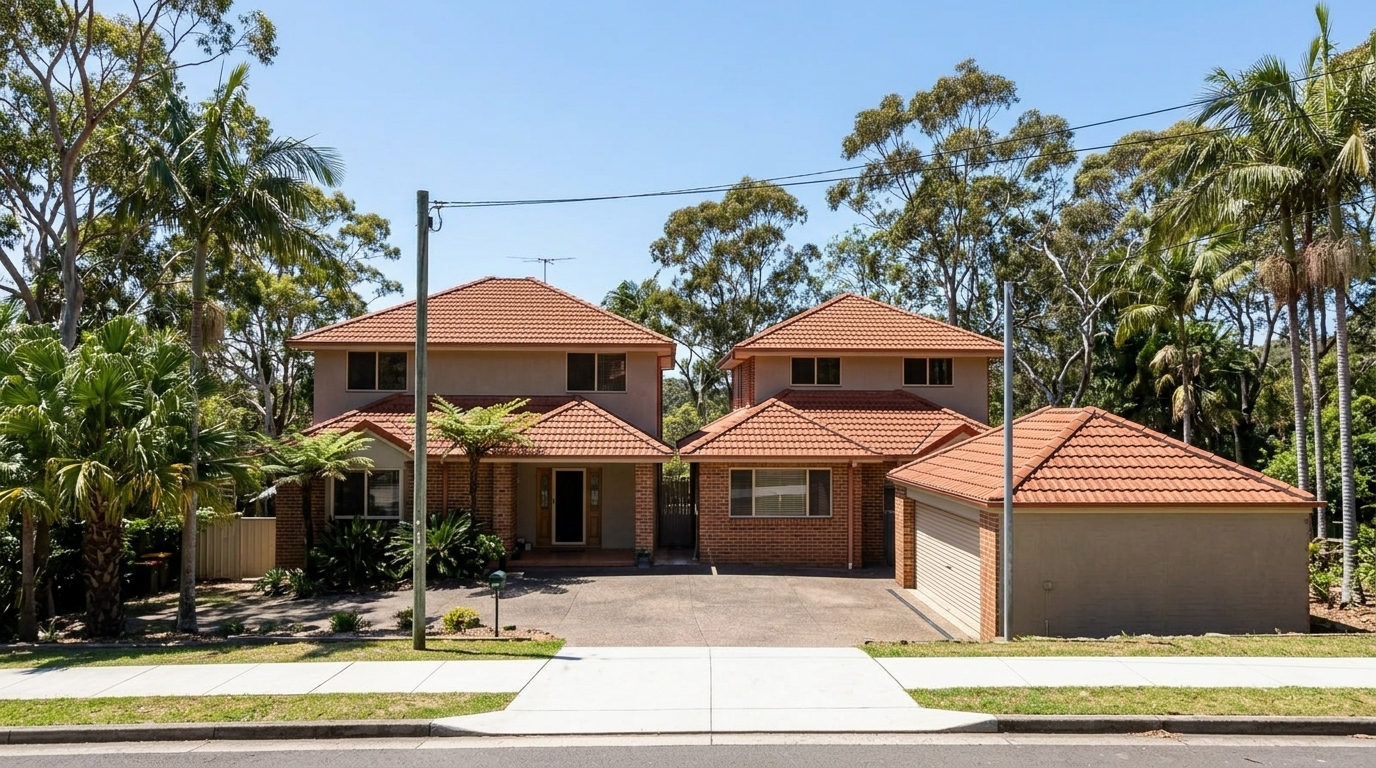
Why Blackwall Deserves a Spot on Your Shortlist
Blackwall sits on the western shore of Brisbane Water on the Woy Woy Peninsula. At barely 1.2 km², this compact pocket isn’t the first suburb most first-time investors look at on the Central Coast, but it offers multiple entry points — from sub-$600K townhouses to mid-$900K houses — and has recorded 106% price growth over the past decade.
The Rip Bridge spans the channel between Blackwall and Daleys Point, with bushland of Blackwall Mountain rising behind it and water on both sides. There are no high-rises, no shopping strips, no train station. Blackwall has waterfront living, tree-lined streets, and a tenant pool that spans Sydney commuters, downsizers, families, and holiday-makers. The population is around 1,941 and roughly one in four residents rent, so Blackwall already has an established rental culture that first-time investors can work with.
Know Your Entry Points: Property Types and Price Brackets
The housing mix is simple: 65% separate houses, 21% townhouses and semi-detached homes, and just 2% apartments, according to the 2021 Census. That low-rise character is part of the appeal.
Under $700K: Townhouses and villa units. Two-bedroom units have sold for $570,000 to $760,000 across 2024 to 2026. A unit on Warwick Street sold for $570,000 in October 2024; another on Wallaby Street hit $760,000 in April 2026. These cluster around Warwick Street, Warrigal Street, Gallipoli Avenue, and Memorial Avenue.
$700K to $950K: Larger townhouses. Three-bedroom townhouses with more space and, in some cases, courtyards or water glimpses. Recent sales include 1/56 Commonwealth Avenue at $840,000 and 3/27 Warrigal Street at $945,000. Strata fees are a factor, but so is the lower maintenance burden.
$940K to $1.2M: Entry-level houses. Standard three-bedroom homes on blocks of 450 to 700 m²: 48 Warwick Street ($950,000), 79 Memorial Avenue ($955,000), 311 Blackwall Road ($1,050,000), and 26 Springwood Street ($1,150,000). These are freestanding houses on their own land, no strata, with room to add value over time.
The waterfront along Orange Grove Road plays in a different league (multimillion-dollar deep-waterfront homes), but for the investor starting out, the inland residential streets are accessible.
The Numbers That Matter: Growth, Yield, and Rental Demand
Blackwall has a strong long-term growth record. AusPropertyInsights tracks a 10-year compound annual growth rate of 6.9% and a 36-year CAGR of 6.3%, showing consistent demand across decades rather than a short-term spike. More recently, property.com.au and realestate.com.au report an annual house growth rate of 8.0%. Prices have more than doubled over the past decade, and the market is currently assessed as near fair value: not overheated, not undervalued, moving in line with its long-term trend.
On the rental side, RealEstateInvestar reports a vacancy rate of 1.30%. Only 13 rental properties are typically available, and the median house rent of $650 per week has risen 18.18% year-on-year. Townhouses rent for a median of $550 per week.
Gross rental yield for houses sits around 2.70%. That is not a high cash-flow number. Blackwall’s returns come from capital appreciation rather than weekly rent, which is typical of Sydney-adjacent suburbs. The trade-off is a market with a proven long-term trajectory and a tenant base that keeps vacancy low.
What Tenants Want: Lifestyle and Amenity
Understanding why someone rents in Blackwall matters for the investment case. The suburb doesn’t compete on amenity density (there is no cafe strip), but it competes well on lifestyle.
Brisbane Water is the main draw: a public boat ramp, fishing, and boating as part of everyday life. Blackwall Mountain Reserve rises from the surrounding lowlands, with bushland trails and a lookout platform offering views over Ettalong, Wagstaffe, Lion Island, and Barrenjoey Head. For families, Wallaby Reserve provides a natural playground with wooden climbing equipment and swings shaded by paperbark trees.
Proximity to nearby hubs extends what Blackwall offers: Ettalong Beach is a 5-minute drive (markets, cafes, cinema, ferry), Woy Woy is a 6-minute drive (supermarkets, retail, train station), and Umina Beach is about an 8-minute drive for surf and sand. HolidayCo describes it as “the perfect balance of calm and convenience.”
The Commuter Factor
The Central Coast’s ongoing popularity with Sydney buyers — people relocating for lifestyle and relative affordability — creates a steady base of demand under the rental market.
Woy Woy Station is a 6-minute drive north. It is one of the busiest stops on the T1 Central Coast & Newcastle Line, with trains reaching Sydney CBD in roughly 70 to 75 minutes. For tenants commuting two or three days a week, that is workable. Bus Route 53 runs approximately every 20 minutes, connecting Blackwall to the station in 6 to 11 minutes; Routes 70, 71, and 72 also service the suburb. By car, Sydney is about 81 km, roughly 79 minutes via the M1; Gosford, the region’s main employment hub, is about 15 km south via Brisbane Water Drive.
Ferry services add a lifestyle advantage. Woy Woy Wharf connects to Empire Bay across Brisbane Water, and the Palm Beach Ferry from nearby Ettalong Beach links the Peninsula to Sydney’s Northern Beaches. For tenants who value weekends on the water or a scenic alternative to the train, these are drawcards that inland suburbs do not have.
For an investor, a property within easy reach of the bus network — especially Route 53 — will appeal more readily to commuter tenants.
Your First-Time Investor Checklist: 8 Steps Before You Buy
1. Set your budget and get pre-approved. Entry points start around $570,000 for a two-bedroom townhouse. Know your borrowing capacity. First-home buyer stamp duty exemptions in NSW apply in full up to $800,000, with concessional rates on purchases between $800,000 and $1,000,000, as confirmed by Revenue NSW. These apply if you plan to live in the property; for pure investors, standard stamp duty applies. At Blackwall’s median house price of around $1,215,000, most house purchases would fall into the concessional band rather than the full exemption.
2. Research the street-level market. Prices vary by street. An inland house on Warwick Street might sell for $950,000; Orange Grove Road waterfront runs into the millions. The NSW Valuer General records 537 transactions. Study recent comparable sales on your target streets.
3. Choose the property type that fits your strategy. Townhouses: lower entry price, lower maintenance, strata fees to budget for. Houses: higher entry price, more land value, no strata, and they represent 65% of Blackwall’s stock.
4. Calculate your numbers. A house returning $650 per week generates roughly $33,800 per year gross. Factor in council rates, water, insurance, and property management (typically 7 to 8% of rent). At a 2.70% gross yield, Blackwall leans toward capital growth over cash flow.
5. Check the vacancy rate. At 1.30%, Blackwall’s vacancy is tight. For context, the Central Coast average sits at 0.78% and the NSW average at 1.02%, per RealEstateInvestar. Blackwall is slightly looser than the wider Coast but right at the state average — still a healthy rental market where well-priced properties lease quickly. Only 13 rental listings are typically available.
6. Assess tenant appeal. Properties near the bus network and a short drive to Woy Woy Station appeal to commuters. Family-friendly streets near Wallaby Reserve, or those with water access and proximity to the ferry network, add further drawcards.
7. Get a depreciation schedule for newer properties. A tax depreciation schedule on a modern townhouse or recently renovated property can improve after-tax cash flow and is often overlooked by first-time investors.
8. Engage local expertise. Around 45 agents are active; top performers achieve 1.9x higher sale prices and 1.3x faster sales, with commission averaging around 2%. A local property manager who knows the Peninsula is valuable for setting the right rent and finding quality tenants.
Looking Ahead
Blackwall suits a patient approach. It has a 36-year track record of consistent appreciation, a waterfront location, and a tenant base kept steady by the long-running migration of Sydney buyers toward the Central Coast. RBA rate cuts from 2025 have improved affordability across the region, and infrastructure investment — including the Woy Woy foreshore improvements — continues to add amenity value. For a first-time investor with a 5-to-7-year horizon, Blackwall offers an entry into a Sydney-adjacent market with a long and consistent growth history.
Frequently Asked Questions
What’s the minimum I need to invest in Blackwall?
The most accessible entry point is a two-bedroom townhouse, with recent sales starting around $570,000. With a 20% deposit, that means roughly $114,000 plus stamp duty. Budget approximately $21,000 to $23,000 for a pure investor. If you plan to live in the property initially, NSW first-home buyer stamp duty exemptions apply in full up to $800,000, with concessional rates available on purchases between $800,000 and $1,000,000. At Blackwall’s median house price, most house purchases qualify for the concession rather than the full exemption.
Is Blackwall a good place for my first investment property?
Blackwall suits a first-time investor: multiple entry points, a 6.9% 10-year CAGR with an 8.0% annual house growth rate, a 1.30% vacancy rate, and a diverse tenant pool. The market is assessed as near fair value (neither overheated nor undervalued), so you are buying in line with the long-term trend.
What rental yield can I expect in Blackwall?
Gross rental yield for houses is approximately 2.70%, with median rent at $650 per week. Townhouses rent for a median of $550. These are growth-market yields. Blackwall’s returns have historically come from capital appreciation rather than cash flow.
Which streets offer the best value for a first-time investor in Blackwall?
Inland residential streets (Warwick, Warrigal, Gallipoli, Memorial, and Commonwealth) are where townhouse developments cluster and entry-level houses sit in the $940,000 to $1.05 million range. These offer more accessible price points than the premium Orange Grove Road waterfront.
How long do properties take to rent out in Blackwall?
With a vacancy rate of 1.30% and only around 13 rental properties available, the market is tight. Well-priced properties in good condition tend to lease quickly, supported by steady demand from professionals, families, and downsizers.
Is Blackwall popular with tenants? What type of tenant rents here?
Blackwall attracts Sydney commuters, local workers, downsizers, and families drawn to quiet streets and outdoor living. Water access, Blackwall Mountain Reserve, ferry connections, and proximity to Ettalong Beach and Woy Woy make it appealing to tenants who prioritise lifestyle.
How does Blackwall compare to nearby suburbs like Woy Woy or Ettalong Beach for investment?
Blackwall is more residential and quieter than both. Woy Woy has the station and supermarkets but more density. Ettalong Beach has the cafe strip and ferry but typically higher prices. Blackwall sits between them, often more affordable, with the mountain reserve and Brisbane Water foreshore.
What government schemes or grants can first-time investors access in Blackwall?
NSW stamp duty exemptions and the First Home Owner Grant are for owner-occupiers, not pure investors. Many first-timers start as investor-occupiers (living in the property before converting to a rental), which unlocks stamp duty exemptions up to $800,000 or concessional rates on purchases up to $1,000,000. For pure investors, the tools are depreciation schedules, negative gearing, and the federal 5% deposit guarantee scheme, which, as of October 2025, is available to all first home buyers with a minimum 5% deposit, no income caps, and no Lenders Mortgage Insurance.
What are the ongoing costs of owning an investment property in Blackwall?
Budget for Central Coast Council rates, water, landlord insurance, and property management (7 to 8% of rent). For townhouses, add quarterly strata levies. Land tax may apply if the property is not your principal residence and your total holdings exceed the NSW threshold.
What’s the outlook for property prices in Blackwall and the Woy Woy Peninsula?
Forecasts suggest 4% to 6% annual growth across 2025 to 2027, supported by rate cuts and the structural trend of Sydney-to-Coast migration. Infrastructure improvements, Woy Woy Road upgrades, and public transport enhancements are adding value. Blackwall’s 36-year CAGR of 6.3% provides the long-run context: steady appreciation through multiple cycles.