
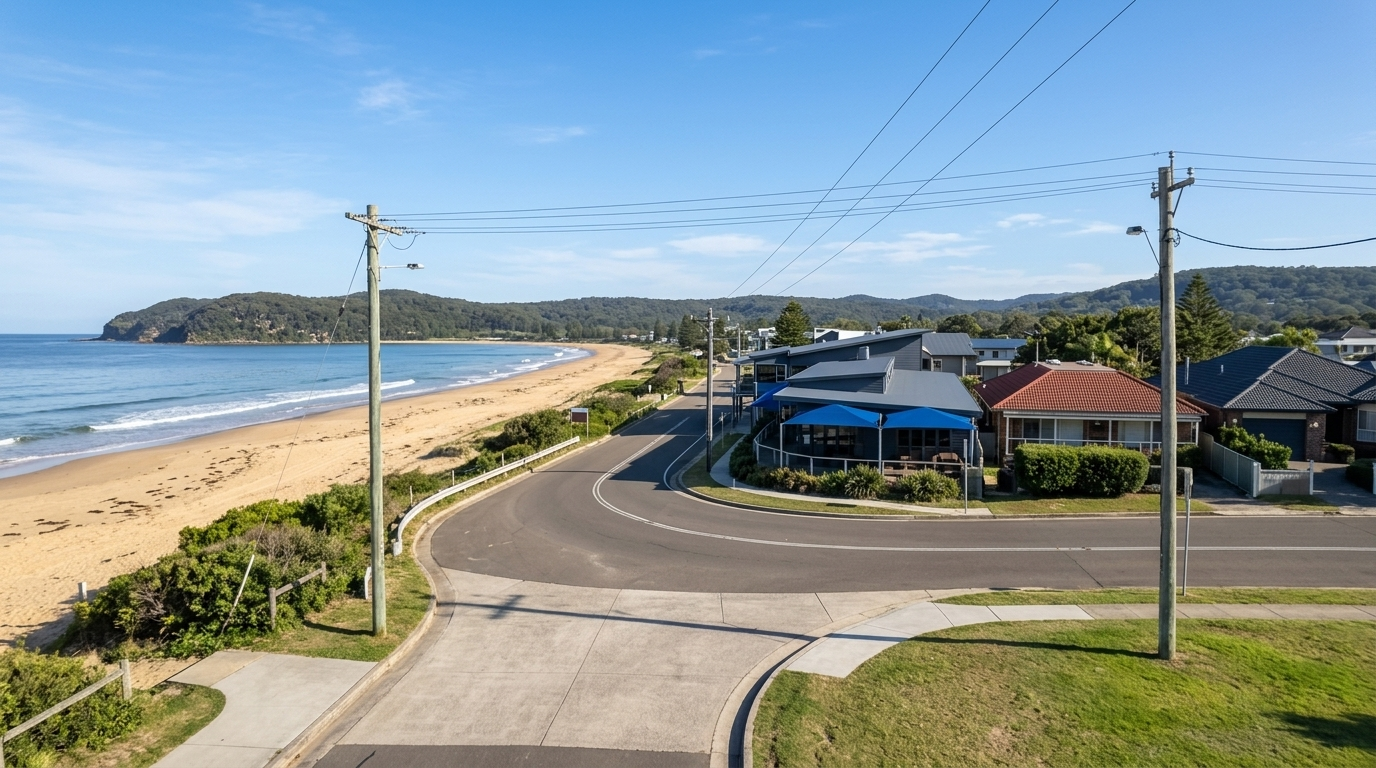
Every property investor eventually stares at the same two numbers: the rent arriving each week and the direction the value is heading. In Umina Beach, you rarely have to treat those as an either-or decision.
Umina Beach sits on the Woy Woy Peninsula, about 80 km north of the Sydney CBD. The 2021 Census recorded a population of 17,372 and a median age of 44, a mix of families, retirees and newer sea-changers. That mix shows up in the property data too.
Capital growth has been the stronger of the two over the past year. Houses have added around 10% over the past 12 months, according to OpenAgent. The rental side is quieter but just as useful for the right investor, with a vacancy rate near 1.07% and rents climbing faster than unit prices. Umina Beach lets you lean toward growth, lean toward income, or hold a bit of both, depending on the property type and how long you plan to own it.
Yield and capital growth: what they actually measure
Gross rental yield is the simplest measure of income. Take the annual rent, divide it by the purchase price, and multiply by 100. A $935,000 townhouse renting at $630 a week returns $32,760 a year, which works out to a 3.5% gross yield.
Capital growth is the other side of the ledger: the increase in the property’s value over time. It shows up when you sell or refinance, not in your bank account each week.
The two often pull in different directions. A high price relative to rent pushes the yield down, which is exactly what happens in a beach market where buyers are paying for land and lifestyle. Yield pays you while you hold. Growth pays you later. Your own timeline decides which one deserves the bigger weight.
Umina Beach’s capital growth story
Umina Beach’s median house price sits around $1.24 million, with 10.1% growth over the past 12 months, per OpenAgent. Houses have delivered most of that growth.
The five-year picture is even more telling. Cotality data published by the Sydney Morning Herald shows Central Coast house values rose 45.1% over the five years to late 2025, and Umina Beach has been one of the stronger performers within that trend.
What is driving it? The steady arrival of Sydney sea-changers and downsizers, the normalisation of remote work, and a maturing set of local amenities. Woolworths, Coles, Aldi and Bunnings all anchor the shopping strip, and the foreshore improvements along The Esplanade are now complete.
Property type matters here. Units have stayed moderate over the past year while unit rents rose about 5.8%. The longer-run picture is stronger: OnTheHouse reports unit median values rose about 26.3% over the past five years. Recent sales underline the spread. 174 The Esplanade sold for $7.2 million in July 2025, 214 The Esplanade for $6.4 million in October 2024, and 38 Kingsview Drive for $2.15 million in June 2026.
Umina Beach’s rental yield story
Median weekly rents sit around $650 for houses and $550 for units, per OpenAgent. Unit rents have moved fastest, up 5.8% over the past year.
The broader rental market is tighter than those headline figures suggest. AreaSearch data from the NSW Rental Bond Board shows a suburb-wide median rent of $615 a week in the March 2026 quarter, up 3.4% year on year, with roughly 2,008 active rental bonds and 129 new bonds in the quarter.
Vacancy sits around 1.07%, according to Real Estate Investar. In practical terms, that means a well-presented property in the right spot tends to rent quickly.
Published gross yields run about 2.58% for houses and 3.50% for townhouses, per Real Estate Investar, while units sit around 3%. These are not double-digit income plays. Umina Beach’s rental case is dependable tenant demand and low vacancy, not a huge headline yield.
Who is renting? Young families, retirees, sea-changers, commuters using Woy Woy station, and a steady seasonal holiday trade around the beach. About 34.1% of occupied dwellings were rented at the 2021 Census, a meaningful share of a tightly held suburb.
Where houses, townhouses and units sit on the spectrum
Houses sit at the growth end. A median near $1.24 million, 10.1% twelve-month growth, $650 a week in rent, and a gross yield around 2.6%. You are buying land and beach proximity, and the value does most of the work.
Townhouses are the balance option. A median near $935,000 with rents around $630 a week gives a gross yield of about 3.5%, per Real Estate Investar. A recent wave of townhouse construction has added modern stock, so buyers can pair that yield with newer, lower-maintenance builds.
Units are the lower-entry, cash-flow-leaning pick. The median unit price sits around $940,000, and entry-level stock rents from the low $400s a week. Unit rents have risen while unit prices stayed moderate, which tilts the equation toward income for the right purchase.
There is also a beachfront option. Properties positioned for short-stay demand around The Esplanade and the patrolled beach can lean on holiday letting for income, a niche that suits the suburb’s family-beach draw.
Matching your strategy to your goals
If you need cash flow now, look at units and townhouses. Vacancy is around 1.07% and unit rents have risen 5.8% in a year while unit prices stayed moderate. That combination is what income investors usually want.
If growth is the priority, houses and land near the beach are the play, supported by 10.1% twelve-month growth and the broader 45.1% five-year Central Coast trend.
If you want a blend, a townhouse is the natural middle. Its 3.5% yield covers more of the holding costs than a house, while you still hold a stake in a market that has appreciated strongly. A well-located unit or a house with strong rental appeal can do the same job, pairing holding income with a stake in Umina Beach’s growth.
Holding period matters as well. Growth compounds over a longer horizon, and yield is what keeps the property affordable to hold while that compounding does its work. Match the property to how long you actually plan to stay in the position.
Conclusion: the balanced Umina Beach playbook
Umina Beach lets you set your own emphasis. Buy a house for growth, a unit or townhouse for income, or a townhouse for the middle. Both levers are real: roughly 10% house growth and a 45.1% five-year house-value trend on one side, and a 1.07% vacancy rate, rising rents, and 2.6% to 3.5% gross yields on the other.
The decision comes down to your goals and your timeline. Stone Real Estate can help you match the right Umina Beach property to both.
Frequently Asked Questions
What is the difference between rental yield and capital growth in Umina Beach?
Rental yield is the income you receive each year as a percentage of what you paid. Capital growth is the rise in the property’s value over time. Yield pays you while you hold, and growth pays you when you sell or refinance.
What is the median house price in Umina Beach right now?
The median house price is around $1.24 million, with 10.1% growth over the past 12 months, per OpenAgent.
What rental yield can I expect from a Umina Beach investment?
Houses run about 2.6% and townhouses about 3.5%, according to Real Estate Investar. Units sit around 3%, based on the $550 a week unit rent against the roughly $940,000 unit median.
What are the median weekly rents in Umina Beach?
Houses rent for about $650 a week and units about $550 a week, per OpenAgent. The suburb-wide median was $615 a week in the March 2026 quarter, up 3.4% year on year, per AreaSearch.
Is Umina Beach a good suburb for capital growth?
It has delivered solid growth in recent years. Houses grew about 10.1% over the past 12 months, and Central Coast house values rose 45.1% over five years, supported by sea-changers, remote work and amenity investment.
What is the vacancy rate in Umina Beach?
Around 1.07%, per Real Estate Investar, alongside about 2,008 active rental bonds. A rate that low points to strong tenant demand.
Are houses or units a better investment in Umina Beach?
It depends on your goal. Houses are growth-leaning, while units offer a lower entry point and stronger relative rent growth. Neither is universally better, which is why your objective should set the filter.
Who typically rents in Umina Beach?
Families, retirees, sea-changers, commuters using Woy Woy station, and seasonal holiday renters near the beach all feature in the tenant mix.
How do I calculate gross rental yield for a Umina Beach property?
Multiply the weekly rent by 52, divide by the purchase price, then multiply by 100. A $935,000 townhouse at $630 a week works out to about 3.5%.
Does Umina Beach suit a cash flow strategy or a growth strategy?
Both. Units and townhouses suit cash flow, houses suit growth, and a townhouse can split the difference for a balanced holding.
What is driving demand for Umina Beach property?
Sydney sea-changers and downsizers, remote work, major retailers, the beach lifestyle and Woy Woy rail access all feed demand.
Should I buy a townhouse or a house in Umina Beach?
A townhouse suits balance and yield at about 3.5%. A house suits land-driven growth at around 2.6% yield with stronger capital upside. Let your holding period decide.