
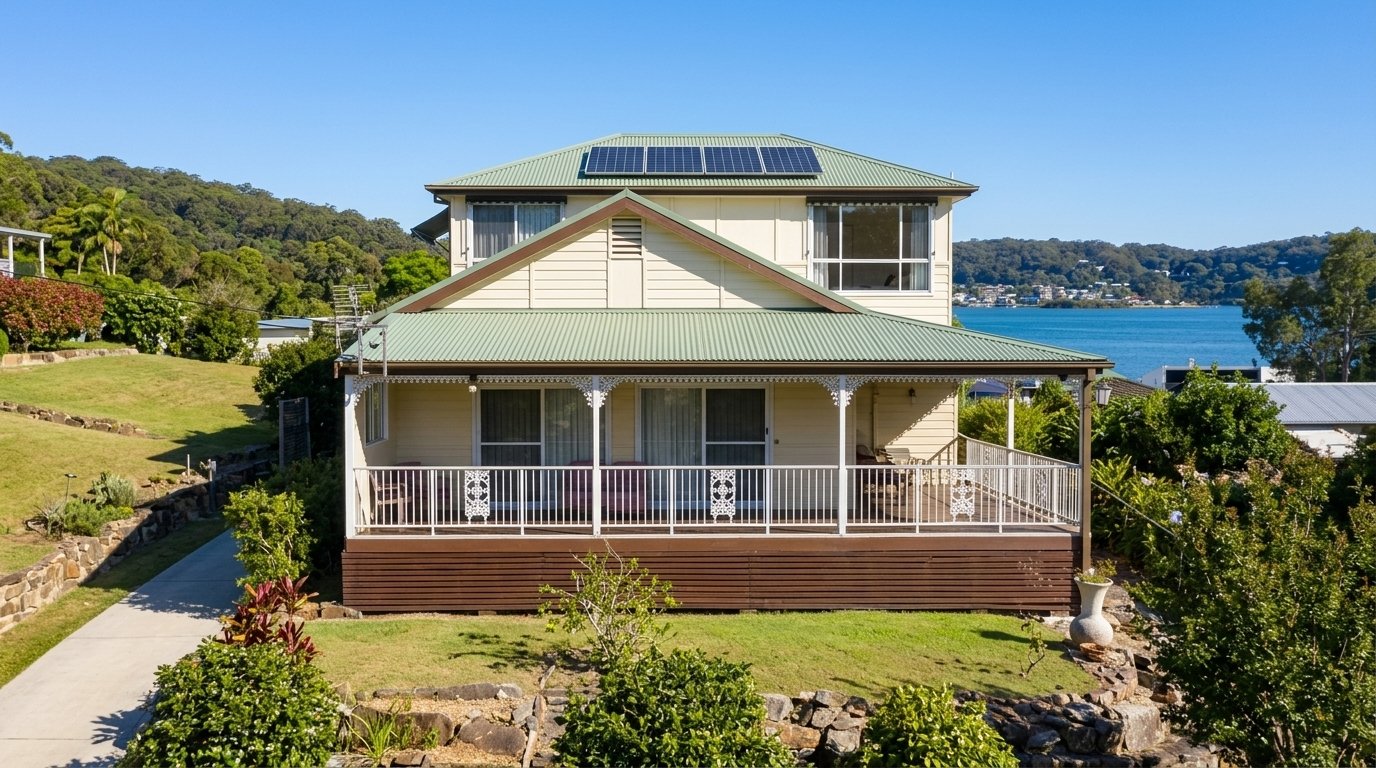
Over the past decade, house prices in Blackwall have more than doubled, climbing 106.48%, an annual clip of 8.7% per year. The suburb is tightly held: homes rarely change hands and values reflect genuine scarcity. If you bought five or ten years ago, what your home is worth today probably bears little resemblance to the number on your mortgage statement. And if your loan hasn’t been looked at in a while, that gap is exactly why now might be the time.
The lending landscape has shifted. The Reserve Bank began cutting rates in early 2025, and the Central Coast market has been in a gradual recovery phase, with Gosford house prices growing approximately 8.4% and Wyong 5.8% over the past year. Homeowners who locked in fixed rates during the COVID era, or who have been riding out variable-rate increases, may not hold the best deal available today. With the median Blackwall house listing around $1,215,000, local homeowners are sitting on leverage they may not fully appreciate. The question is not whether Blackwall property has performed. It’s whether your mortgage has kept up.
The Equity Picture
Equity is the foundation of any refinancing decision. When your loan-to-value ratio drops below 80%, Lenders Mortgage Insurance, which cannot be transferred between loans, drops away. The rates available to you improve, because the bank is taking on measurably less risk.
For a median Blackwall house at $1,215,000, 20% equity is about $243,000. If you bought in 2020 or 2021, there is a good chance you have already crossed that line. For context, the median weekly household income in Blackwall sits at $1,449. The scale of equity growth here is driven by price appreciation rather than accelerated repayments.
Consider Springwood Street. Number 32 sold for $685,000 in June 2022. Four years later, number 26 went for $1,150,000, a 68% gain on the same street. On Warwick Street, number 40 sold for $717,000 in October 2020, and number 48 settled at $950,000 by April 2026. Number 14 Warwick Street, on a 650-square-metre block, traded at $1,113,000 in October 2025. These are standard residential blocks that have appreciated steadily. A mortgage taken out at 90% LVR in 2021 could now sit at 70% or lower on market movement alone. That means better rates, fewer fees, and the option to access equity for a renovation or a second purchase without tipping back into LMI territory.
The Rate Cycle: Why Timing Matters Right Now
If you haven’t reviewed your home loan in two years, you are probably paying a loyalty tax. Lenders count on inertia, knowing most borrowers will not switch even when the maths says they should. As Wisebuy Home Loans puts it: “A lot of Central Coast homeowners took out their mortgages when rates looked very different. If you’ve held the same loan for a few years and haven’t revisited it, there’s a reasonable chance you’re on terms that no longer serve you.” A broker who can compare across 60 or more lenders will almost always find a rate below what a single-branch relationship offers, because competition has moved on while your rate has not.
The Central Coast house market has grown 45.1% over five years. That matters for refinancing because bank valuations on the Peninsula tend to come in at or near market. In a suburb where comparable sales are plentiful, your home’s value is easier to verify. Across the broader Central Coast, vacancy rates have fallen below 0.5% in both Gosford and Wyong, well under the healthy benchmark of 2 to 3%.
Six Clear Signs It’s Time to Refinance
Your equity has passed 20%. The single most common trigger. If you bought before 2022, run the numbers. Crossing this threshold removes LMI and shifts you into the lender’s lowest-risk pricing tier.
Your fixed rate is about to expire. Many Central Coast borrowers locked in rates around 2% during 2020 and 2021. When those terms roll off, the default reversion rate can be a shock. Refinancing at expiry, rather than accepting whatever your lender offers, lets you capture competitive rates on your own terms.
You’re planning a renovation. Blackwall’s housing stock is largely mid-century: single-storey homes on 450 to 700 square metre blocks. A kitchen or bathroom update, or an extension, can change how you live in the home. Equity accessed through a refinance funds that work at mortgage rates, well below what a personal loan would cost.
You want to buy an investment property. The Central Coast rental market is tight, with vacancy below 0.5% regionally and Blackwall houses renting for a median of $650 per week, up more than 18% over the past year. Using Blackwall equity as a deposit works when both the equity base and the rental return are strong.
Your loan features no longer fit. An offset account, a redraw facility, the ability to make extra repayments without penalty. These may not have mattered when you took out the loan. As your financial position changes, the features can matter as much as the rate.
It’s been more than two years since you reviewed. Lending competition shifts constantly. A rate that was sharp in 2023 may be ordinary today. Treating your mortgage like a set-and-forget utility costs you money.
How to Approach Refinancing
The process runs six to eight weeks from application to settlement. It starts with a conversation, not a commitment, and a mortgage broker is the most efficient place to begin.
You will need proof of income, proof of address, proof of employment, bank statements covering three to six months, your current loan statement, and a council rates notice. Self-employed applicants should add two years of tax returns and business financials. Having these ready avoids the back-and-forth that drags out approval times.
Costs matter. Discharge, application, and valuation fees on a typical refinance might total between $500 and $1,200. Against the saving from a 0.5% rate reduction on an $800,000 loan, roughly $4,000 a year, the upfront cost is recovered inside twelve months. The Census median monthly mortgage repayment of $2,024 reflects the 2021 rate environment; many Blackwall borrowers who took out loans around that time are now on terms that look very different.
A broker who understands Blackwall’s property landscape is worth more than a generic online tool. The suburb spans entry-level houses around $940,000 to waterfront homes on Orange Grove Road that have traded at $6.9 million. A local broker knows that a standard Warwick Street block and an Orange Grove Road waterfront command different valuations, and how bank valuers assess each. That knowledge secures an accurate valuation where a remote assessor working from desktop data might undervalue a home whose street-level comparables don’t capture its actual position.
Your Next Move
Blackwall houses have more than doubled in value over ten years, delivering an average annual growth rate of 8.7%. If you bought here before 2022, you almost certainly have more equity than you think. If your loan hasn’t been reviewed since before the RBA’s 2025 cutting cycle, you are almost certainly on a rate that can be improved.
The six-trigger checklist is a practical filter: if one or more applies to you, a conversation with a broker will tell you whether the numbers justify a switch. A 0.5% rate reduction on a typical Blackwall mortgage saves thousands a year, and the equity you have built gives you options that go well beyond a lower repayment. With Central Coast vacancy rates below 0.5%, an investment property funded through equity is a genuine option. Review your mortgage the way you review any significant recurring cost: methodically, periodically, and without assuming last year’s deal is still the right one.
Frequently Asked Questions
How do I know if I have enough equity to refinance my Blackwall home?
Divide your outstanding loan balance by a current estimate of your property’s value. Below 80% is the sweet spot, because LMI drops away and lower-rate tiers open up. A bank valuation may differ from a market appraisal, but in Blackwall, where comparable sales on streets like Warwick and Springwood are plentiful, valuations tend to be well supported by recent data.
Will refinancing cost me money upfront in Blackwall?
Yes, but less than staying put. Discharge, application, and valuation fees typically total $500 to $1,200. On an $800,000 mortgage, a 0.5% rate reduction saves about $4,000 in the first year, recovering the upfront cost within months.
Can I refinance if I’m on a fixed-rate loan in Blackwall?
You can, but weigh the break cost. Fixed-rate loans carry a fee based on the difference between your contracted rate and the current market rate. If your fixed term is close to expiring, waiting and refinancing at expiry often avoids the fee. If you do nothing, you roll onto your lender’s standard variable rate, which is rarely competitive.
What’s the difference between refinancing with my current lender and switching for my Blackwall home?
An internal refinance reprices with your current lender. An external refinance moves to a new one. Your current lender has little incentive to offer their best rate unless they know you are shopping around. A broker who compares across 60 or more lenders gives you visibility of the full market.
How does Blackwall’s property market affect my refinancing options?
Rising values improve your LVR, unlocking better rates and removing LMI. Blackwall’s tightly held character and the volume of recent comparable sales mean bank valuations tend to align with market reality.
Can I use refinancing to fund a renovation on my Blackwall home?
Yes, through a cash-out refinance. You borrow against your equity and fund improvements at mortgage rates, well below personal loan rates. In Blackwall, where much of the housing stock dates from the mid-20th century, a kitchen or bathroom renovation can improve daily life and strengthen resale position.
Is it harder to refinance if I work remotely or commute to Sydney from Blackwall?
Not at all. The Central Coast to Sydney commuter is a standard borrower profile. Employment stability and income consistency matter, not proximity to an office. Provide your payslips and bank statements and the assessment proceeds normally.
What documents do I need to prepare for a refinancing application in Blackwall?
Recent payslips, proof of address, proof of employment, three to six months of bank statements, your current home loan statement, and a council rates notice. Self-employed applicants should add two years of tax returns and profit and loss statements. Having documents ready before you speak to a broker can take weeks off the timeline.
How long does refinancing take from start to finish in Blackwall?
Most refinances run six to eight weeks. Week one covers documents and lender comparison. Weeks two to four involve application, credit assessment, and valuation. Weeks five to eight cover loan offer, acceptance, and settlement via a conveyancer. Delays most often come from incomplete documentation.
Should I refinance my Blackwall home to buy an investment property elsewhere on the Central Coast?
It works when the numbers support it. Using Blackwall equity as a deposit avoids saving a separate cash deposit, and the Central Coast rental vacancy rate sits below 0.5% with rents rising. Getting the loan structure right matters; cross-collateralisation can limit flexibility later.
What’s the first step if I think I should refinance my Blackwall property?
Book a no-obligation review with a mortgage broker who knows the Central Coast market. Bring your latest loan statement and a rough idea of your income and expenses. The conversation tells you whether your rate is competitive, whether your LVR qualifies you for better products, and what the savings would look like. An annual mortgage health check costs nothing and is the simplest way to avoid paying more than you need to.