
Every property investor asks the same question before they commit: will this suburb hold its value and grow over time? The suburbs that reliably do both tend to share a short list of traits. They have finite supply, a lifestyle people keep wanting, practical amenity, a stable community, and a sales history that confirms the pattern.
St Huberts Island is a compact canal estate within Brisbane Water on the NSW Central Coast, and it demonstrates all five traits at once. It is a small island connected to the mainland at Daleys Point by a single bridge, and it is home to about 1,080 people, according to the 2021 Census. It is fully built out, bounded by water and conservation land, and built around a waterfront lifestyle that cannot simply be reproduced in the next suburb over.
Scarcity and supply: an island that cannot be expanded
The island covers about 0.6 square kilometres, and most of that is not house land. Wikipedia records the suburb’s compact footprint. The zoning split shows how little is residential: roughly 64.7% is recreational waterways, 17.8% is environmental living land, 15.4% is national park and nature reserve, and only about 2.2% is zoned for low-density residential housing, per Landchecker. The developable footprint was locked in when the estate was built in the 1970s, and it has not grown since.
There are about 510 private dwellings on the island, of which 448 are occupied, and 434 of those occupied homes, 97%, are separate houses, according to the 2021 Census. Another 66 dwellings sit unoccupied, roughly 13% of the total, consistent with the island’s role as a holiday and second-home destination. Add the single road in and out across the Helmsman Boulevard bridge, and the supply picture is simple: no one is adding stock. When the number of homes is permanently fixed, buyer competition focuses on what already exists.
The lifestyle that creates demand
Water access is central to the island. Many homes have their own pontoon and direct canal frontage, so the boat, kayak and paddleboard sit at the back door. The internal canals are calm and sheltered, so they suit beginners and families, while Brisbane Water opens up a run to Saratoga, Davistown and Broken Bay for longer days on the water, as StMate describes.
That lifestyle is hard to find at the same price and distance nearby, and demand for it holds up across market cycles. Remote and hybrid work has added to that demand: buyers who can log in from anywhere increasingly value a waterfront setting over a shorter commute, a trend visible across the Central Coast.
Amenity, connectivity and liveability
For a suburb that feels removed from everything, St Huberts Island is well connected. Ettalong Beach, Umina Beach and Woy Woy are each about a five-minute drive away, so cafes, restaurants, supermarkets and the weekend Ettalong Markets are within easy reach, as StMate notes. Ettalong also has waterfront dining and the Diggers Club, and a 35-minute ferry runs from Ettalong Wharf to Palm Beach.
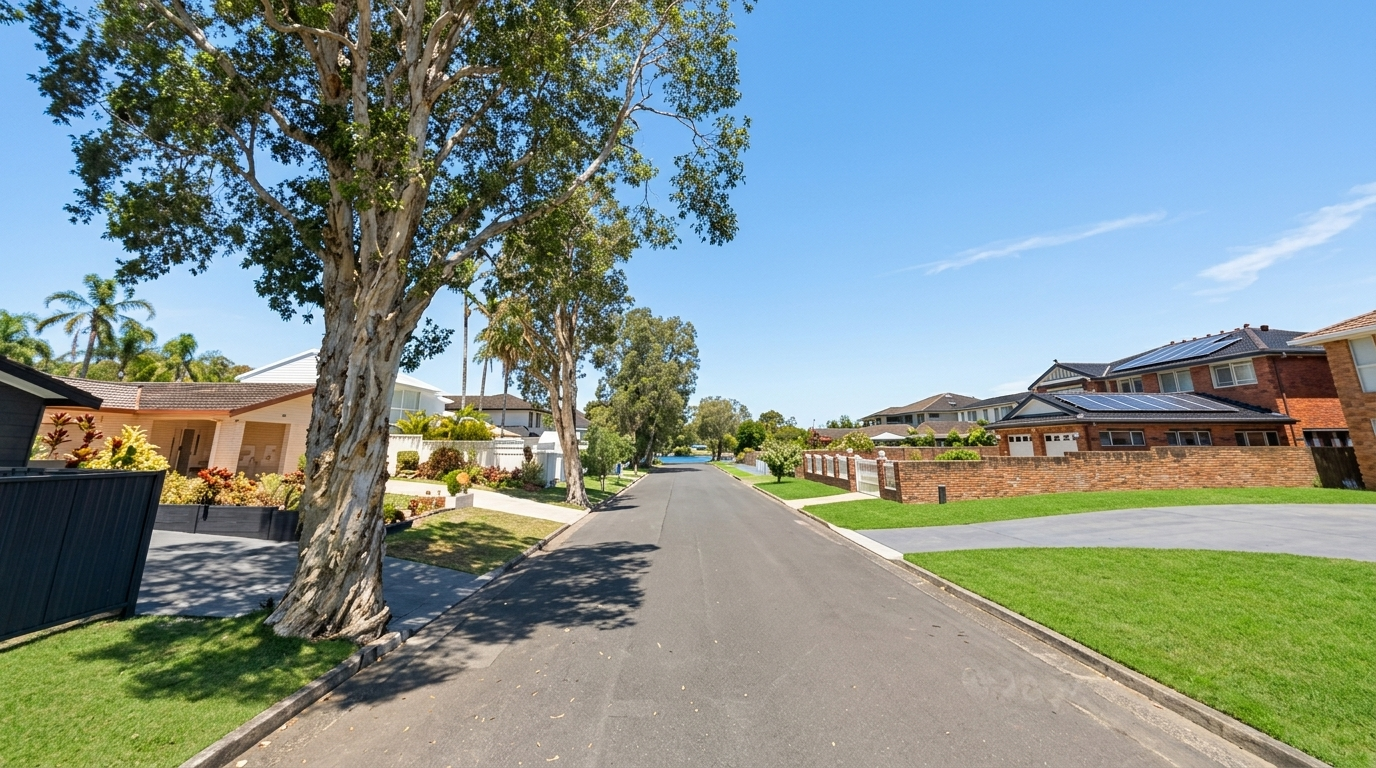
Sydney is about 90 minutes away by car, or you can catch the train from Woy Woy station. Busways routes 59 and 64 link the island to the station, per Wikipedia. On the island itself, the streets are quiet and low-density, with 20 residential streets, many carrying nautical names, and no through-traffic, so walking and cycling around the water is part of daily life.
Community strength and stability
Property markets behave better where people stay put, and St Huberts Island is built for that. The median age is 58, and the dominant household is a couple without children who own their home outright, according to Census and Landchecker data. With only about 6 to 8% of its roughly 510 dwellings changing hands each year, this is a tightly held suburb where sales tend to be considered decisions rather than rushed ones.
The community has organised itself for decades. The St Huberts Island Residents Association (SHIRA) has been active since 1976, and it maintains the palm-lined entry statement and runs the annual St Huberts Day gathering at Long Arm Reserve, as the association’s own records show. A long-term population keeps turnover low, and low turnover supports stable values.
The numbers: market performance and growth
The sales record is detailed. Across 400 recorded transactions in the NSW Valuer General dataset, the overall median sits at $1.13 million, per the NSW Valuer General sales data. Premium canal-front homes reach far higher, topped by a record $6 million at 21 Long Arm Parade in October 2024.
Recent sales include $4.85 million at 9 Boyd Close, $4.25 million at 29 Cuttlefish Parade and $4 million at 36 Mercator Parade, while 2025 and 2026 added $3.4 million at 13 Mercator Parade in December 2025 and $3.05 million at 5 Mooring Place in April 2026, per NSW Valuer General sales records. Over the long term, a typical canal-front block that changed hands for about $800,000 to $925,000 in 2012 has been selling in the $2.5 million to $3.6 million range more recently, close to a tripling over the decade, per the same NSW records.
Independent market snapshots point the same way. StMate records a median sale price around $1.95 million for a four-bedroom house and compound growth of about 6.8% a year across four years, with a typical range from $1.39 million entry-level to $3 million premium. RealestateInvestar puts the median house listing price near $2.4 million, with 5.21% growth over one year and 10.29% over two. Street-level data shows the same premium: Cuttlefish Parade carries a median near $2.9 million and Beachfront Parade near $1.96 million, according to Microburbs.
The rental and holiday-stay angle
Rental demand here is selective but strong. The median asking rent sits around $875 a week, up 10.75% over the year, and vacancy is very low at about 0.74%, per RealestateInvestar. Because so many homes are owner-occupied, rental stock is limited and rents stay firm.
There is also a short-stay dimension. Waterfront homes are popular as premium holiday stays, particularly through the warmer months, so an investor with the right property can combine long-term capital growth with holiday-season income, a common pattern on the Central Coast.
What St Huberts Island teaches about good suburbs
The case for St Huberts Island comes down to five things. Finite supply, because the island is physically complete and cannot be expanded. A lifestyle that keeps drawing buyers, because living on the water never goes out of favour. Practical amenity, with beaches, shops and transport minutes away. A stable community that owns and stays. And a sales history that confirms it.
When all five traits meet in one suburb, it tends to hold its value. St Huberts Island brings them together, which is why it answers the question of what makes a suburb a good investment.
Frequently Asked Questions
What makes st-huberts-island a good investment?
Finite supply is the foundation: a single bridge, a fully built-out island, and only about 2.2% of land zoned residential, per Landchecker. That sits under strong waterfront lifestyle demand, owner-occupier stability, and a sales record showing sustained capital growth.
What is the median house price in st-huberts-island?
The NSW Valuer General data records an overall median of $1.13 million across 400 sales, per the NSW sales records, while current snapshots put the median listing and sale price between about $1.95 million and $2.4 million, per StMate and RealestateInvestar. Premium canal-front homes run into the $3 million to $6 million range, and entry-level and dry blocks have traded under $1 million, per NSW Valuer General records.
How strong has capital growth been in st-huberts-island?
Canal-front blocks have roughly tripled over a decade, and independent snapshots show 5.21% growth over one year and 10.29% over two, per RealestateInvestar. StMate records compound growth of about 6.8% a year across four years, as detailed here.
What rental return and demand can investors expect in st-huberts-island?
The median asking rent is about $875 a week, up 10.75% over the year, with a gross yield around 1.89% and vacancy near 0.74%, according to RealestateInvestar.
Is st-huberts-island good for holiday and short-stay rental?
Yes. Waterfront homes with pontoons and water views are popular as premium holiday stays, with steady demand through the warmer months, a common pattern on the Central Coast.
How limited is the supply of homes in st-huberts-island?
Supply is effectively fixed at around 510 dwellings, with 434 of the 448 occupied homes, 97%, being separate houses, per the 2021 Census. Only about 2.2% of land is zoned residential, per Landchecker, and there is no greenfield scope.
How far is st-huberts-island from Sydney and how do you get there?
Sydney is about 90 minutes by car, or you can take the train from Woy Woy station, which Busways routes 59 and 64 connect to, per Wikipedia. A 35-minute ferry also runs from Ettalong Wharf to Palm Beach.
What shops, beaches and amenities are near st-huberts-island?
Ettalong Beach, Umina Beach and Woy Woy are each about a five-minute drive away, with the weekend Ettalong Markets, waterfront dining and supermarkets, as StMate notes. The island itself has a boat ramp and Long Arm Reserve.
Who lives on st-huberts-island?
It is a mature, established community with a median age of 58, dominated by couples without children who own their homes outright, per Census and Landchecker data. A residents’ association has been active since 1976, as SHIRA’s records show.
What kinds of properties are available in st-huberts-island, canal-front vs dry blocks?
Detached houses dominate. Deep-water canal-front homes with private pontoons trade at premium prices, Brisbane Water frontage adds another layer, and interior dry blocks offer a more affordable entry point for buyers who want the island lifestyle without the waterfront price tag.