
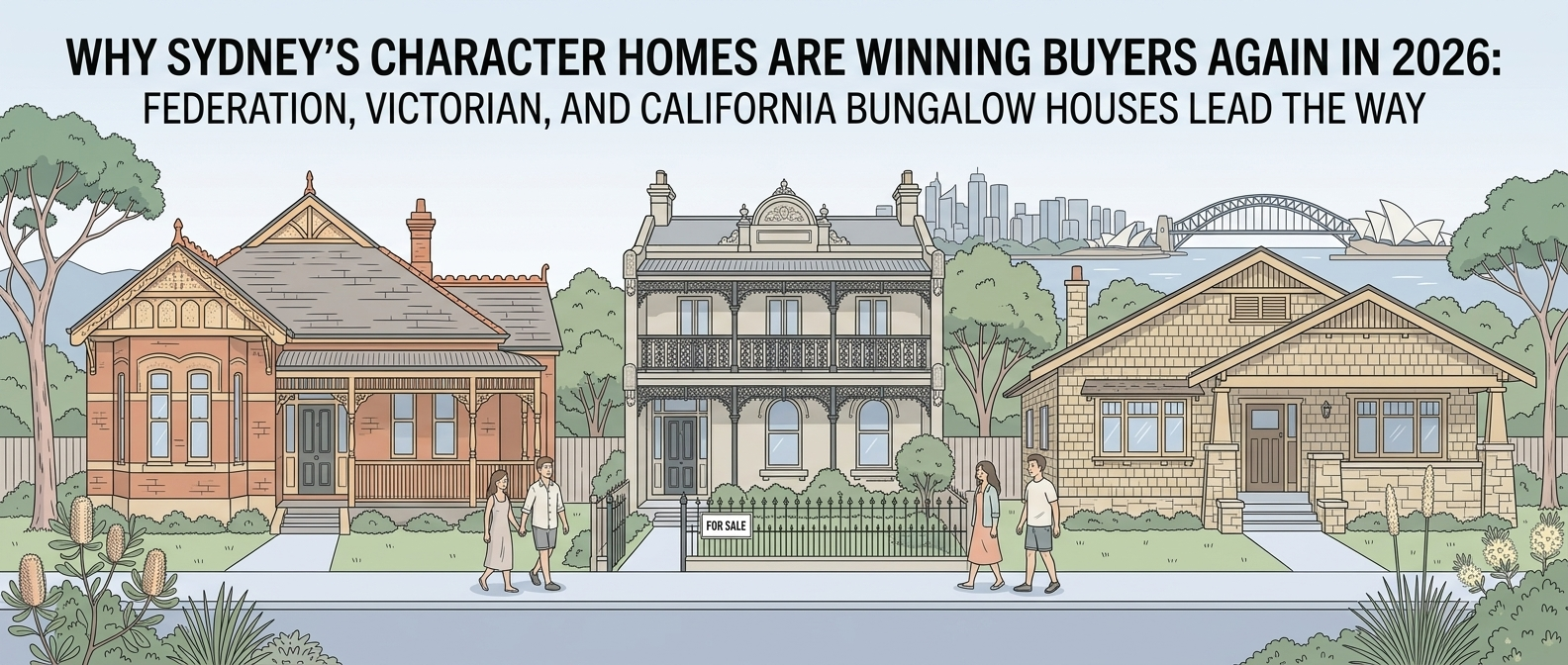
Federation and Victorian houses and terraces, along with the ever-popular California bungalow, are drawing fresh buyer attention through 2026, even as the wider Sydney market cools. Well-presented, well-located character homes keep producing competitive auctions and over-reserve results, and a measurable heritage premium now sits behind the best of them. Restoration has become a mainstream lifestyle story, with owners reviving century-old homes for modern family life. This guide covers what defines each style, where they are strongest, and what buyers are paying.
A Century of Character: Federation, Victorian and the California Bungalow
Victorian homes are the grandest of the three: ornate, with high ceilings, decorative detailing and the classic terrace forms that line the inner west. Federation homes, from the 1890s to the 1910s, lean into Queen Anne character, with red brick, timber verandahs and decorative timberwork. The California bungalow arrived a little later and spread quickly, with standard house plans rolled out across new estates helping make the style a familiar sight in suburb after suburb.
The bungalow grew out of the American Arts and Crafts movement and arrived in Australia around the 1910s. The earliest example appeared in Rosebery in 1916, when a bungalow imported from Pasadena, California was assembled as a display home.
Defined by low-pitched gabled roofs, wide eaves, timber floorboards, decorative leadlight and front verandahs, the style took hold because it was practical and affordable. Architectural historian Professor Julie Willis says bungalows “embodied the dream of home ownership” for a rising middle class.
Why 2026 Buyers Are Coming Back to Period Homes
While the wider Sydney market has been soft through 2026, with high-end houses down 10.7 per cent from their peak, well-presented period homes keep producing competitive auctions and over-reserve results. Craftsmanship and streetscape character are a big part of the appeal, along with a steady run of nostalgia and “past meets present” coverage through the property pages this year.
Restoration has gone mainstream. A former Block couple’s 1883 North Sydney terrace and an ex-Love Island builder’s 138-year-old Petersham terrace were both profiled as consumer lifestyle stories, not just market news.
Low-rise character housing is also being celebrated as a way to add homes “without erecting skyscrapers that might distort the area’s character”.
The Suburbs Leading the Character Revival
Haberfield is the standout whole-suburb case study. Established in 1901 by Richard Stanton as Australia’s first planned garden suburb, the entire suburb is heritage-listed, protecting its Federation and Californian bungalow streetscapes. With a median house price of about $3.2 million and about 79 per cent owner-occupation, with 48.6 per cent owned outright and 30.5 per cent purchasing, stock is tightly held and well-presented homes sell strongly.
The bungalow heartlands are Haberfield, Willoughby and Epping, with Artarmon also featuring in listings. The inner west, spanning Petersham, Stanmore, Leichhardt, Annandale and Marrickville, holds dense rows of Victorian terraces and Federation homes. The lower north shore (North Sydney, Neutral Bay, Mosman) and the east (Paddington, Randwick, Bondi Junction, Maroubra) carry much of Sydney’s best period stock.
Current listings show the spread: five standout California bungalows in Northwood, Lindfield, Cheltenham, Belmore and Richmond, including the 1927 “Stratford” in Cheltenham, and five period homes, two in Paddington and one each in Bondi Junction, Randwick and Burwood.
Restored for Modern Living: How Owners Are Reviving Period Homes
The c.1883 North Sydney terrace “The Colchester” shows how far restoration can go. Its owners kept the facade, staircase, mantelpieces, lacework, stained glass and original cedar doors and fireplaces, then merged five small rooms into open-plan living and added a bedroom, bathroom and EV charger. More than 200 people inspected it over a two-week campaign.
The value uplift is clear. A 138-year-old Petersham terrace bought in 2023 for $1.51 million was fully restored and listed in July 2026 with a $2.8 million guide.
Architect-led projects push further again. Leesthorpe in Mosman preserved its Queen Anne detail behind a light-filled rear addition, while a Surry Hills terrace added a living-plant rear facade and eight solar panels covering about 70 per cent of its electricity, with bills under $100 a month. Double-brick bungalows are “still in excellent structural condition”, robust enough for upper-storey additions or rear extensions without significant internal structural work, according to architect James Pilcher.
What Buyers Are Paying: Auction Results and the Heritage Premium
The historic Petersham station master home set the tone. The three-bedroom, two-bathroom house, built in the 1890s for the Irish station master, sold for $2.311 million after 34 bids, opening at the $1.9 million guide and last selling in 2004 for $517,500.
Other 2026 results are just as strong. A renovated Stanmore terrace sold for $2,636,000, about $90,000 above reserve after more than 40 bids. An unrenovated Leichhardt terrace fetched $1,855,000, some $355,000 over reserve with 18 groups registered, and a solid brick Epping bungalow sold for $2.78 million, $380,000 over reserve.
Rare homes command the biggest numbers. The 1886 Annandale house “Highroyd” sold for around $8 million, and a circa 1920s Maroubra bungalow, first offered in 70 years, headed to auction with a $6.5 million guide. Sydney research cited in the Australian Heritage Directory finds heritage listing boosts house prices by around 12 per cent.
Conclusion
In a slower 2026 market, Sydney’s Federation, Victorian and California bungalow homes are winning buyers because they combine enduring craftsmanship, a lifestyle and location premium, and genuine scope for modernisation. The over-reserve auctions, the roughly 12 per cent heritage premium and Haberfield’s whole-suburb resilience all point the same way: this is a durable market trend, not nostalgia alone. Know your style, focus on location and presentation, and treat restoration as a path to value.
Frequently Asked Questions
What is a California bungalow?
A California bungalow is a single-storey home that grew out of the American Arts and Crafts movement and arrived in Australia around the 1910s. The earliest example appeared in Rosebery in 1916, when a bungalow imported from Pasadena, California was assembled as a display home. Signature features include low-pitched gabled roofs, wide eaves, timber floorboards, decorative leadlight and a front verandah, often with a red-brick facade and twin gables. Most are double-brick, which is why so many remain in excellent condition and are straightforward to extend.
Where are the best Sydney suburbs for Federation and character homes?
The recognised bungalow heartlands are Haberfield, Willoughby and Epping, with Artarmon also appearing in listings. The inner west corridor, taking in Petersham, Stanmore, Leichhardt, Annandale and Marrickville, is packed with Victorian terraces and Federation homes. The lower north shore (North Sydney, Neutral Bay, Mosman) and the eastern suburbs (Paddington, Randwick, Bondi Junction, Maroubra) hold much of Sydney’s best period stock. Haberfield stands out as the only whole-suburb heritage case study.
How much do character homes cost in Sydney in 2026?
Prices vary widely by suburb and condition. Haberfield’s median house price sits at about $3.2 million, while Petersham’s median is around $2.14 million and a 1890s home there sold for $2.311 million. A renovated Stanmore terrace sold for $2.636 million, and an unrenovated Leichhardt terrace fetched $1.855 million as an Epping bungalow sold for $2.78 million. Well-located, well-presented period homes routinely sell for hundreds of thousands above reserve.
Do heritage listed homes hold their value better?
Sydney research cited in the Australian Heritage Directory finds heritage listing boosts house prices by around 12 per cent, with a premium found for listed over unlisted houses on the upper north shore. Heritage features such as high ceilings, ornate tiling, timber windows and original floorboards add value to both the home and the streetscape. Haberfield’s median house price of about $3.2 million shows how a fully heritage-listed suburb can command a sustained lifestyle premium.
Can you renovate or extend a heritage home?
Yes, and this is a big part of why the styles remain popular. Double-brick California bungalows are robust enough for upper-storey additions or rear extensions without significant internal structural work, according to architect James Pilcher. The proven approach keeps the facade, staircase, mantelpieces, lacework, stained glass and original joinery, then opens up the rear for modern living, adding bedrooms, bathrooms and even EV chargers.
Why is Haberfield so sought after?
Haberfield is Australia’s first planned garden suburb, established in 1901 by Richard Stanton, and the entire suburb is heritage-listed to protect its Federation and Californian bungalow streetscapes. With a median house price of about $3.2 million and about 79 per cent owner-occupation, stock is tightly held, so well-presented homes sell strongly. The appeal is a lifestyle and location premium, not just the house itself.
What is the difference between Federation, Victorian and California bungalow styles?
Victorian homes, from roughly the mid to late 1800s, are grand and ornate, with high ceilings, decorative detailing and classic terrace forms. Federation homes, from the 1890s to the 1910s, lean into Queen Anne character, with red brick, timber verandahs and decorative timberwork. California bungalows, from the 1910s to the 1930s, are single-storey with low-pitched gabled roofs, wide eaves, leadlight windows and a prominent front verandah. All three share the craftsmanship and solid construction buyers prize today.
How do owners modernise a character home without losing its charm?
The proven formula is to keep the front and open up the back. Restorations preserve the facade, staircase, mantelpieces, lacework, stained glass and original cedar joinery, then merge small rooms into open-plan living and add a contemporary rear extension. Architect-led examples push further: a Surry Hills terrace added a living-plant rear facade and eight solar panels covering about 70 per cent of its electricity, with bills under $100 a month, while Leesthorpe in Mosman paired preserved Queen Anne detail with a light-filled rear addition.
Are character homes a good investment in 2026?
The 2026 evidence points to yes for well-presented, well-located examples. Heritage listing is associated with a roughly 12 per cent price premium, and period homes keep producing over-reserve results. An Epping bungalow sold $380,000 over reserve and a Leichhardt terrace $355,000 over, while a Stanmore terrace drew more than 40 bids. The historic Petersham station master home sold for $2.311 million after 34 bids, having last sold for $517,500 in 2004.
What should first home buyers know about buying a period home?
First home buyers are active in the wider renovated-home market, with a first home buyer couple paying $2.04 million for a renovated family home in Sydney’s south in 2026. Entry points exist across the price spectrum for period homes, from unrenovated inner-west terraces to solid brick bungalows, and buyers often weigh the appeal of original character against the scope to renovate over time. The key is matching the home’s condition and layout to your budget and appetite for restoration.