
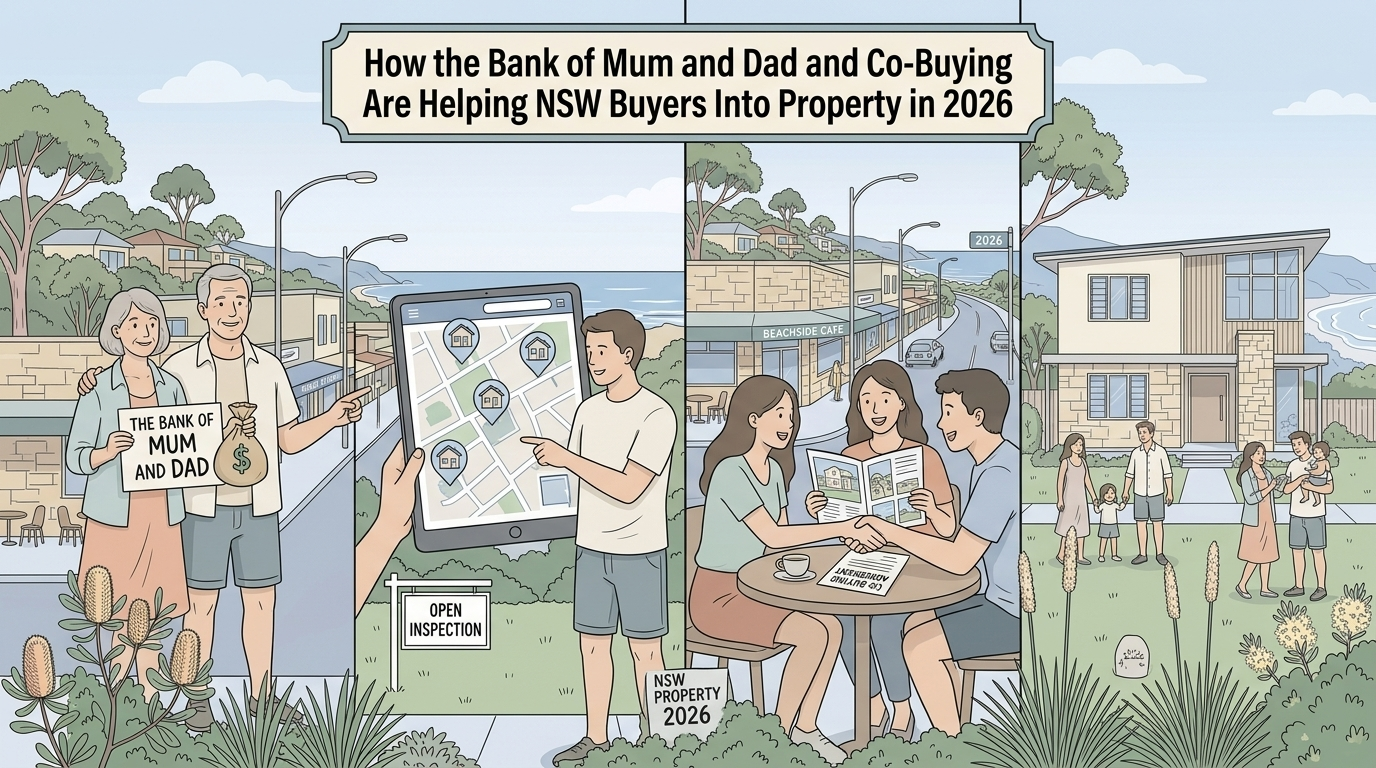
Three in ten Australian homeowners, about 1.8 million people, received financial help from family to buy. That number has made the Bank of Mum and Dad a mainstream, workable route into the NSW market.
Alongside it, co-buying and multi-generational living are growing fast as buyers pool their resources. This guide walks through what family help actually looks like in 2026, the ways to structure it well, and the NSW schemes that stack on top.
How Big the Bank of Mum and Dad Has Become in 2026
Finder’s 2026 Home Loan Report found that 30% of Australian homeowners, roughly 1.8 million people, received financial help from family to buy. About 11% of homeowners got a deposit contribution, 8% had the home paid for outright (about 496,000 households), and 6% had a family member act as guarantor. A further 5% had the entire deposit covered, 5% received help with repayments, and 3% got a lump sum above the deposit. A buyer can receive more than one type of help, so these categories overlap.
In dollar terms the Bank of Mum and Dad is estimated to be worth about $35 billion, enough that if it were a lender it would sit among Australia’s larger mortgage lenders. The generational split tells the real story: 67% of Gen Z buyers received family help, compared with 11% of Baby Boomers. For younger NSW buyers this is now the default on-ramp.
The Ways Families Are Helping Right Now
There are more ways to help than writing a big cheque. Families typically do three things: gift or lend money towards the deposit, go guarantor through a family guarantee loan, or fund professional help such as a buyer’s agent.
A University of Newcastle study of 80 Sydney-area families found the average family transfer was $75,000, ranging from $5,000 to $500,000. Families are realising they do not always have to hand over bigger cash gifts: borrowing against equity, a limited guarantee, or paying for expert guidance can achieve the same entry with a smaller commitment.
A newer trend has parents funding a buyer’s agent instead of cash or a guarantee. It gives young buyers someone to negotiate hard from day one and is described as a more sustainable way to support them.
Co-Buying and Multi-Generational Living Go Mainstream
Co-buying has gone mainstream. ABS data shows households spanning three or more generations rose 21.8% between the 2016 and 2021 censuses. The appetite is strong too: in Buxton’s Victorian State of Living Index, a survey of 364 Victorians across 57 local government areas, 71% of respondents would consider co-ownership, rising to 80% of under-35s, while 57% would consider multi-generational living.
In August 2026 a first-home-buyer couple combined with one buyer’s mother to pay $3.15 million for a three-bedroom Cammeray home that will house three generations. Around Sydney, an upsizing family paid $3.5 million post-auction for an Abbotsford house, and in Pennant Hills a daughter helped her mother buy a $2,365,000 home to move closer to family.
Brokers describe co-buying as a way to boost borrowing capacity, combining parents’ cash with adult children’s loans. One pointed to a $1.6 million dual-living purchase the younger couple could not have afforded alone.
NSW Schemes That Stack With Family Help
Family help and government support work best together. A parent contribution can top up a deposit while NSW concessions cut the upfront costs.
Under the First Home Buyers Assistance Scheme, first-home buyers may pay no stamp duty on homes valued up to $800,000, with concessional rates from $800,000 to $1 million. The full exemption is worth up to about $30,412. There is also a $10,000 First Home Owner Grant for new homes up to $600,000, or $750,000 for a house-and-land package.
Nationally, the 5% Deposit Scheme lets eligible first-home buyers buy with a 5% deposit, or 2% for eligible single parents, without LMI, with no income caps and unlimited places. More than 300,000 Australians have bought or built through it since 2020. The NSW Shared Equity Home Buyer Helper goes further, with the government contributing up to 40% of a new home’s price, or 30% for an existing home, on a deposit as low as 2%.
Setting Up Family Help So It Works for Everyone
The most useful step is simplest: decide upfront whether the money is a gift or a loan, and put it in writing. Around 64% of first-home buyers receiving parental support had no formal written agreement. That is a real opportunity, because a short written agreement makes the arrangement clearer and easier for everyone.
A good agreement covers the basics: whether it is a gift or a loan, what happens if a relationship ends or circumstances change, how repayment works if the home is sold, and any equity share or ownership rights. Getting it right does not cost much. A one-hour consultation with a solicitor and financial adviser runs about $200 to $400.
If you are co-buying, agree an exit plan upfront and choose between joint tenancy and tenants in common so ownership shares match everyone’s contribution.
The Takeaway for NSW Buyers
Family help and co-buying are now ordinary, well-trodden ways into NSW property, and they work best when the arrangement is clear from the start. The three levers are simple: a family contribution, co-buying with someone you trust, and the government schemes that stack on top. Combine them deliberately rather than relying on a handshake.
With 1.8 million Australians already backed by family and more buyers teaming up, this is a route worth planning properly. A local Stone Real Estate agent can help you put the pieces together.
Frequently Asked Questions
What is the Bank of Mum and Dad?
The Bank of Mum and Dad is family financial help towards a home purchase. Parents or relatives might gift or lend deposit money, go guarantor on the loan, or co-buy the property together. It has become a mainstream route into the market: 30% of Australian homeowners, about 1.8 million people, used family help to buy, and the bank is estimated to be worth roughly $35 billion. For many younger buyers it is now the default way to close the gap between savings and a deposit.
How many Australian homeowners have used the Bank of Mum and Dad?
About 1.8 million people, or 30% of Australian homeowners, according to Finder’s 2026 Home Loan Report. The help breaks down as 11% who received a deposit contribution, 8% who had the home paid for outright, and 6% who had a family member act as guarantor. It is also heavily generational: 67% of Gen Z buyers received family help, compared with 11% of Baby Boomers.
How much do parents typically contribute to a home deposit?
A University of Newcastle study of Sydney-area families found the average family transfer was $75,000, with amounts ranging from $5,000 to $500,000. Contributions vary widely by family and by method. A cash gift or loan towards the deposit is the most common approach, but some parents prefer a guarantee or funding a buyer’s agent instead of handing over a large sum upfront.
Is money from the Bank of Mum and Dad a gift or a loan?
It can be either, and the key step is deciding and recording it upfront. Around 64% of first-home buyers receiving parental support had no formal written agreement, which leaves the arrangement open to different interpretations later. Settle whether the money is a gift or a loan before any funds change hands, and write down the terms so expectations are clear on both sides.
How does a family guarantee loan work in Australia?
A parent pledges equity in their own property so their child can borrow with a smaller deposit and avoid LMI. A family equity guarantee can also be limited to a portion of the loan rather than the whole amount, which keeps the parent’s involvement contained. It is a practical way to help a buyer get in sooner without handing over cash.
What is co-buying and how does it work in NSW?
Co-buying is pooling money with siblings, friends, or multiple generations to purchase a property together. Ownership can be set up as joint tenancy or tenants in common. Joint tenancy passes the home automatically to the survivor, while tenants in common allows unequal shares that match each person’s contribution. Whatever the structure, agree a co-ownership agreement and an exit plan before you buy.
How much stamp duty do first home buyers pay in NSW in 2026?
Under the First Home Buyers Assistance Scheme, eligible first-home buyers pay no stamp duty on homes valued up to $800,000, with concessional rates from $800,000 to $1 million. The full exemption is worth up to about $30,412. Vacant land up to $350,000 is also fully exempt.
What NSW government grants can first home buyers get?
The main ones are the $10,000 First Home Owner Grant for new homes up to $600,000, or $750,000 for a house-and-land package, and the Shared Equity Home Buyer Helper, where the NSW Government can contribute up to 40% of a new home’s price, or 30% for an existing home, with a deposit as low as 2%.
Can I buy a house with a 5% deposit in NSW in 2026?
Yes. Through the federal First Home Guarantee, part of the Home Guarantee Scheme, eligible first-home buyers can buy with a 5% deposit, or 2% for eligible single parents, without LMI. There are no income caps and unlimited places, subject to property price caps. More than 300,000 Australians have bought or built through the scheme since 2020.
How do you avoid LMI when buying a home?
There are three main ways. Save a 20% deposit, use a family guarantee where a parent pledges equity, or buy through the 5% Deposit Scheme. Avoiding LMI typically saves around $10,000 to $40,000, which is money that stays in your pocket rather than going towards the insurer’s premium.
Can you get first home buyer benefits if your parents help you buy?
A family gift or loan does not automatically remove grant eligibility. However, NSW First Home Buyers Assistance Scheme eligibility is assessed for both partners in a couple, and prior ownership by either can affect the outcome. Check each buyer’s ownership history before you finalise the structure, so the family contribution and the concessions work together rather than against each other.
What options do first home buyers have without family help?
Plenty. The federal 5% Deposit Scheme, Help to Buy, and the First Home Super Saver scheme all work without a family contribution, alongside the NSW First Home Owner Grant and stamp duty concessions. Around 70% of Australian homeowners bought without family assistance, so the path is still very much open with the right scheme and a consistent savings plan.