
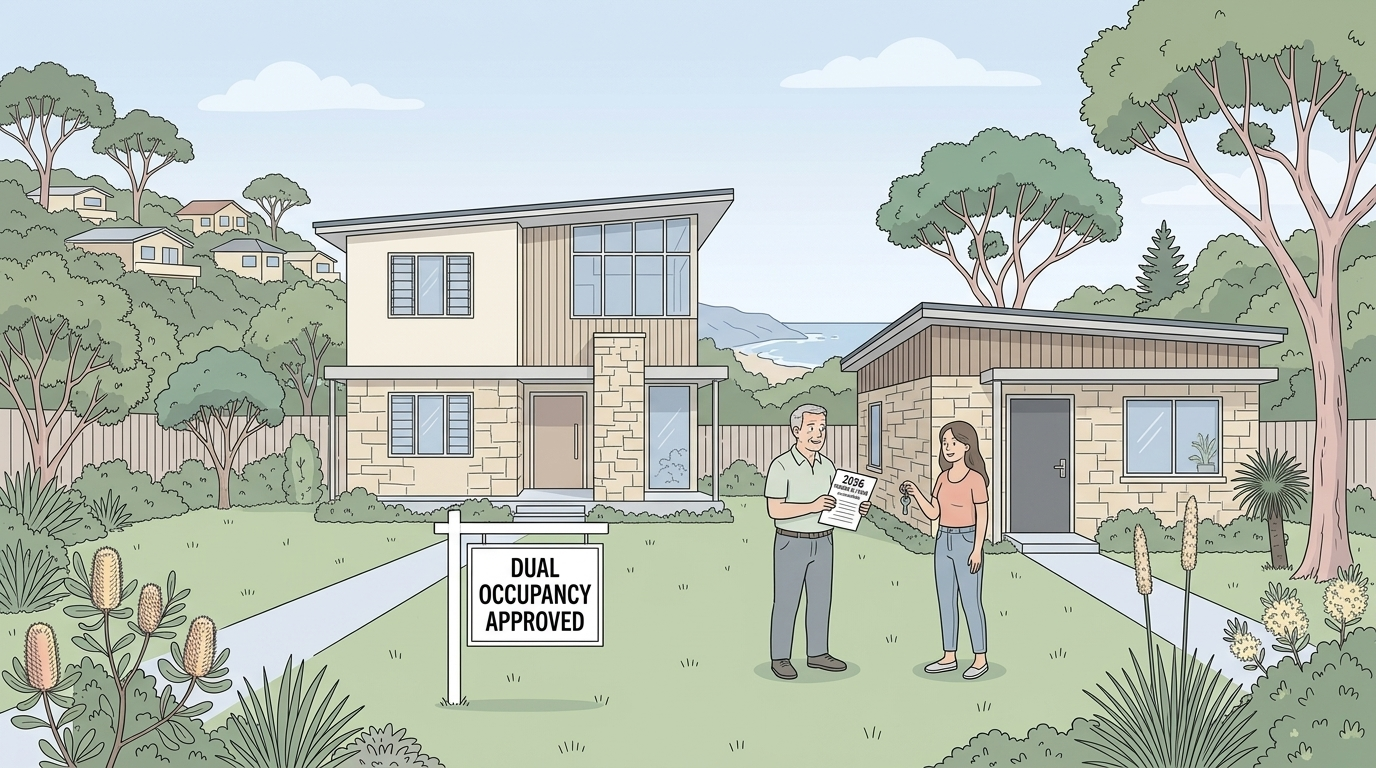
Not long ago, the little building at the back of the block was a granny flat, a quiet room for a relative. In 2026 it is something else entirely. It was 2025’s most searched property term in Sydney, and NSW planning rules now make adding a second dwelling to an ordinary residential block easier than at any point in decades. This guide is for the homeowner or buyer who wants to turn spare backyard space into income and higher resale value. The payoff runs both ways: income now, and value later.
Why Dual Occupancy Is Having a Moment in NSW
Secondary dwellings have moved from a family option into a mainstream income and value strategy. The Housing Industry Association expects builders to produce roughly ten times more granny flats in 2026 than they did in 2022, and NAB data shows granny flat financing through renovation loans rose 21 per cent in 2025, ahead of the previous two years.
Research by Resolve Finance found 49 per cent of Australians expect to house an adult child or ageing parent within a decade, while 12 per cent of homebuyers are very likely to seek a dual-occupancy property. In NSW, that intent sits at 40 per cent.
The NSW Planning Changes That Opened the Door
The NSW Low and Mid-Rise Housing Policy, part of SEPP Housing 2021, expanded where a second dwelling can be built. Dual occupancies are now permitted in R2 low-density residential zones statewide, subject to planning standards, and the policy applies within 800 metres of 171 nominated town centres and train stations across metropolitan Sydney, the Central Coast, the Illawarra-Shoalhaven and the Hunter.
Delivered in two stages over July 2024 and February 2025, it is expected to deliver up to 112,000 homes over five years. NSW has also become the first Australian jurisdiction to formally recognise prefabricated and modular construction, and the Housing Delivery Authority has a 150,000-home planning pipeline. Blocks once locked out of a second dwelling are increasingly eligible, and approvals are faster.
What a Second Dwelling Can Actually Earn
The headline is rental income. Two-bedroom secondary dwellings in Sydney rent for $350 to $600 a week, an annual income of $18,000 to $36,000 depending on location and finish. Because a secondary dwelling uses land the owner already holds, the gross yield on the build cost runs well into double digits: 11.5 to 15.8 per cent, against a typical house yield of around 3.6 per cent.
In Western Sydney the numbers are stronger. A completed two-bedroom granny flat commonly rents for $480 to $650 a week, and a full dual occupancy can return $57,000 to $88,000 a year in combined rent.
The Value It Adds to the Property
A second dwelling does more than produce rent. It can lift the property’s value, because buyers pay a premium for a home that already earns two incomes. Renovation data ranks adding a bedroom or granny flat as one of the fastest ways to a six-figure boost, typically adding $50,000 to $150,000.
In Western Sydney, a completed two-bedroom granny flat commonly adds $180,000 to $260,000 to a valuation, often above the build cost. The space pays for itself in rent while it grows the asset behind it.
Where the Opportunity Is Concentrated
Sydney’s west leads the state’s dual-occupancy activity. Blacktown, Campsie, Harris Park and Seven Hills rank among Australia’s top dual-occupancy locations. Campbelltown, Fairfield, Canterbury-Bankstown, Penrith and Liverpool record the most secondary-dwelling applications in NSW, according to NSW Planning Portal data compiled across 102 councils. Granny flat cost data adds that Blacktown, Penrith and Ryde hold the highest density of investor-led secondary dwellings in Sydney. These areas combine strong rental demand with plenty of established 450 to 700 square metre blocks that qualify.
How NSW Owners Are Using the Space
The flexibility is the draw. A granny flat might be family accommodation today, a rental later, or a downsizing option in the future. One Emu Plains family is knocking down and rebuilding to create a dual occupancy for two grown children plus a granny flat for themselves, giving each household its own space.
Christopher Sarkis, managing director of Homes & Granny Flats, says owners have shifted toward higher-quality, fully self-contained secondary dwellings, changing buyer expectations and lifting resale appeal. A well-positioned second dwelling strengthens cash flow and marketability. The backyard is now a second front door.
The Practical Path to Getting It Built
Getting it built is more straightforward than most owners expect. Most secondary dwellings in NSW, up to 60 square metres on a lot of at least 450 square metres in an R1, R2, R3 or R4 zone, can be approved through a Complying Development Certificate rather than a full DA. That is the difference between a few weeks and a few months.
Cost is transparent too. A standard two-bedroom brick-veneer granny flat in Sydney runs roughly $145,000 to $195,000, and the rent typically recovers the build cost in five to eight years. The checklist is short: confirm the lot size and zoning, design for the local rental market, and fund the build with equity or a renovation loan.
Frequently Asked Questions
How much can I rent a granny flat for in NSW in 2026?
Two-bedroom secondary dwellings in Sydney typically rent for $350 to $600 a week, or $18,000 to $36,000 a year. In Western Sydney, a completed two-bedroom granny flat commonly achieves $480 to $650 a week. Because the build uses land you already own, the gross yield on construction cost runs between 11.5 and 15.8 per cent, well above the 3.6 per cent on a typical house.
How much does it cost to build a granny flat in NSW?
A standard two-bedroom brick-veneer granny flat in Sydney runs roughly $145,000 to $195,000, with prefabricated and modular options starting from about $115,000. At current rents, a typical build recovers its cost in around five to eight years, and the value uplift often exceeds the build cost. Site works, connections and certifier fees sit on top, so get an all-in quote before you commit.
What are the rules for building a granny flat in NSW?
Under the Housing SEPP, a secondary dwelling up to 60 square metres on a lot of at least 450 square metres in an R1, R2, R3 or R4 zone can often be approved through a Complying Development Certificate, and no extra parking is required. It must sit on the same title as the principal dwelling and have its own entrance, kitchen, bathroom and living area. If your block does not meet the CDC standards, a development application through your council is still an option.
What is the difference between a granny flat and a dual occupancy?
A granny flat, formally a secondary dwelling, sits on the same title as the main house and cannot be sold separately, with one principal dwelling plus one secondary dwelling per site. A dual occupancy is two dwellings on one lot, which in many cases can be subdivided into two separately ownable properties via Torrens, strata or community title. A granny flat is an income and value play, while a dual occupancy can become two sellable assets.
Can I subdivide my property into a dual occupancy in NSW?
Attached dual occupancies can generally be subdivided by Torrens, strata or community title where the lot meets minimum size requirements. In Western Sydney those minimums commonly sit around 450 to 600 square metres, with a smaller minimum per resulting lot after subdivision. Detached dual occupancies have their own rules, and zoning is the first thing to check, as not every zone permits it.
Does a granny flat add value to my home?
Yes. A granny flat is consistently ranked among the highest-returning space additions you can make. Renovation data shows adding a bedroom or granny flat typically adds $50,000 to $150,000 to a property’s value. In Western Sydney, a completed two-bedroom build commonly lifts a valuation by $180,000 to $260,000, often more than the build cost. Buyers pay a premium for a home that already earns two incomes.
Which Sydney suburbs are best for dual occupancy in 2026?
Sydney’s west leads the state. Blacktown, Campsie, Harris Park and Seven Hills rank among Australia’s top dual-occupancy locations. On application volumes, Campbelltown, Fairfield, Canterbury-Bankstown, Penrith and Liverpool record the most secondary-dwelling applications in NSW. The common thread is strong rental demand plus established 450 to 700 square metre blocks near town centres and stations.
Can I build a granny flat without a DA in NSW?
Yes. Most secondary dwellings up to 60 square metres on a qualifying lot can be approved through a Complying Development Certificate issued by a private certifier, typically in about two to four weeks. The key requirements are a lot of at least 450 square metres in an R1, R2, R3 or R4 zone, a single-storey build within the 60 square metre cap, and compliance with setback and height standards.
How long does it take to build a granny flat in NSW?
Construction is typically around 8 to 12 weeks for a prefabricated or kit build and 16 to 24 weeks for a custom build, with CDC approval adding roughly two to four weeks at the front. Data puts the average CDC approval in NSW at about 21 days, compared with 84 days for a standard council DA. Most owners go from decision to tenant within a few months.
How do I finance a granny flat in NSW?
Most owners fund a granny flat using equity already held in their property, a home-loan top-up, or a renovation or construction loan. NAB data shows granny flat financing through renovation loans rose 21 per cent in 2025, which tells you how mainstream the strategy has become.
Can I rent a granny flat to tenants who are not family?
Yes. In NSW a secondary dwelling can be rented to any tenant at market rates, and there is no requirement for the occupant to be a family member. The name is a leftover from an older use. This is what turns the space into an income stream, whether you take a long-term tenant or use the dwelling for family today and rent it later.
The two payoffs are the same pair: income now, and value later. If you own a qualifying block, check the zoning and lot size, get a clear picture of local rents and build costs, and use the faster CDC pathway where it applies. NSW’s planning settings have made the spare backyard one of the most productive spaces you can use. Treat your block as a two-income asset, and it will start behaving like one.