
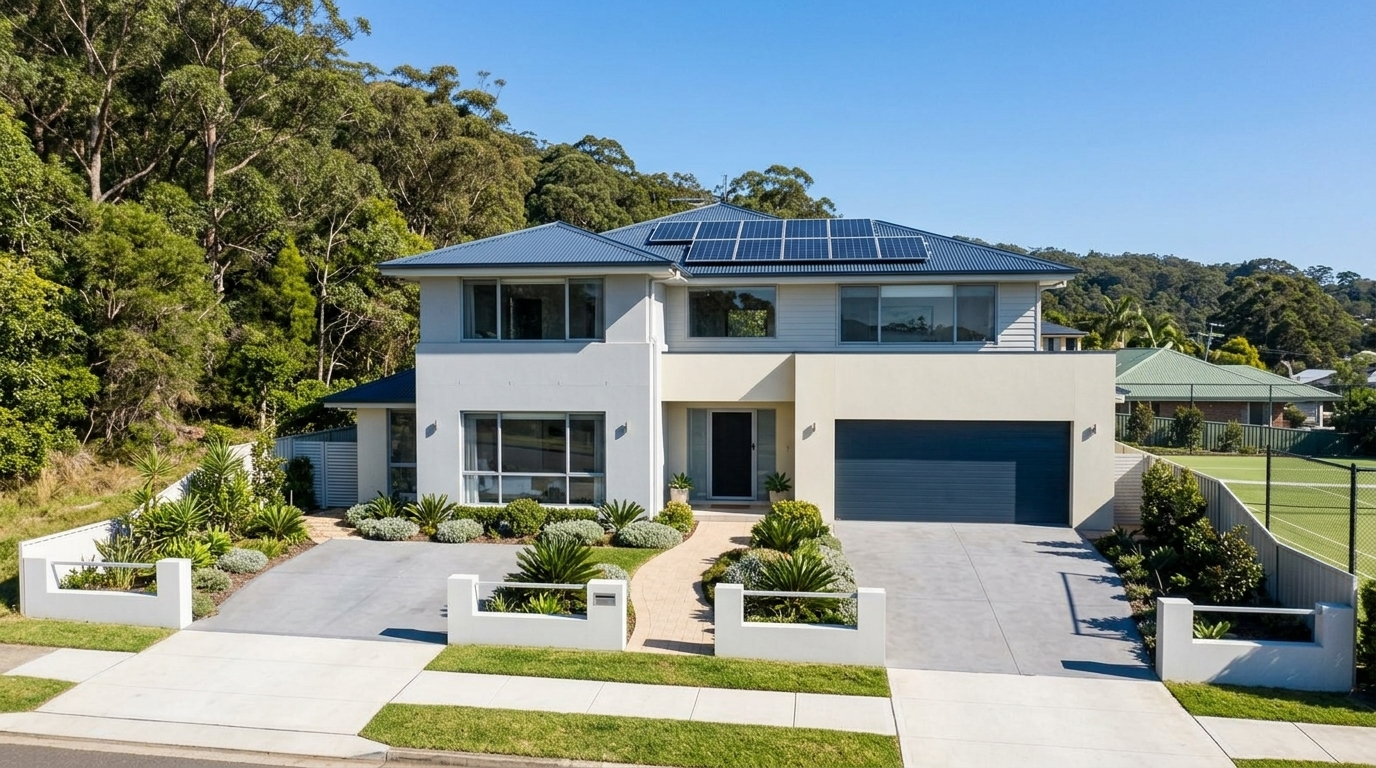
If you bought into Blackwall a decade ago, you’ve had a remarkable run. House prices on this quiet pocket of the Woy Woy Peninsula grew at an average of 8.7% per year over the past ten years, according to WhichAgent. Modest family homes became seven-figure assets, and Orange Grove Road waterfront properties now rank among the Central Coast’s highest-value real estate.
That tailwind has eased. The 12-month growth rate for houses has settled to around 0.7%: a soft landing, not a crash. Stock levels are up 55.56% on last year, giving buyers more choice, and properties are taking longer to transact. Yet 97 properties still changed hands in Blackwall over the past twelve months, according to WhichAgent. The market hasn’t stopped; it’s simply become more selective.
This isn’t a market to worry about. It’s one that rewards realistic pricing, good presentation, and a clear understanding of what your particular slice of Blackwall is worth. Whether you’re on Orange Grove Road with a jetty at the bottom of the garden or on a standard block inland, the principle is the same: price it right, present it well, and buyers will come.
Reading the Room: What “Softening” Actually Means in Blackwall
“Softening” can sound alarming, but in Blackwall it’s really a return to normal conditions after the pandemic-era frenzy. Houses currently spend an average of 73 days on market before selling, while townhouses and apartments move at about 53 days, according to WhichAgent. The average settlement time is 51 days, as tracked by AusPropertyInsights, and well-priced properties are still transacting smoothly.
The broader Central Coast is assessed as balanced, with roughly 60 days on market and about three months of inventory across the region, according to InvestorKit. AusPropertyInsights rates Blackwall as “fair value,” meaning prices are aligned with their long-term trend, neither overinflated nor undervalued. That’s a reassuring sign for sellers who don’t want to feel they’re catching a market on the way down.
The softening is not uniform. Deep-waterfront homes along Orange Grove Road, Rip Road, and Cedar Crescent operate in a scarcity-driven micro-market largely insulated from rate-sensitive buyer sentiment. Inland, on the standard residential blocks along Gallipoli Avenue and Memorial Avenue, price sensitivity is more pronounced. A seller on Gallipoli Avenue faces a different buyer than one on Orange Grove Road, even though both share the 2256 postcode.
The long-term picture is straightforward. Over 36 years, Blackwall has delivered a compound annual growth rate of 6.3%, and over the past decade that rises to 8.7%. Short-term cycles come and go; the appeal of a waterfront suburb 70 minutes by train from Sydney does not.
The Price-It-Right Imperative: Why the First Fortnight Counts
In a booming market, an ambitious asking price might not matter, because FOMO takes over. In a softening market, overpricing carries an immediate and hard-to-reverse penalty.
The first two to four weeks of a listing are when buyer interest peaks. Your property appears in saved searches, pings alert emails, and reaches the largest pool of active buyers it will ever see. If the price is right, they inspect, bid, and transact. If it’s not, they scroll past, and rarely return.
Once a listing passes 30 to 45 days, it begins to look stale. Buyers wonder why it hasn’t sold. Offers tend to come in lower, because the market assumes there’s room to negotiate. A property that might have sold for $1,150,000 in week two can end up at $1,050,000 three months later, not because it’s worth less, but because the psychology has shifted.
This is why agent selection matters enormously. Top-performing agents in Blackwall achieve 1.9 times higher sale prices than the suburb average and sell 1.3 times faster. They know how to price for competition in the critical first fortnight.
The three numbers every Blackwall seller should know before listing: recent comparable sales in your street from the past six months, the current median for your property type, and the average days on market for your segment.
Know Your Segment: Blackwall’s Three Markets
Blackwall is not one market. It’s three, each responding differently to current conditions.
Premium Waterfront. Orange Grove Road, Rip Road, and Cedar Crescent operate in their own world. These are deep-waterfront properties with private jetties, boatsheds, and panoramic Brisbane Water views. Recent sales recorded by the NSW Valuer General include 472 Orange Grove Road at $6.9 million, 464 at $4.4 million, and 456 at $4.065 million. Tightly held and roughly 85% owner-occupied, this segment trades on scarcity. Buyers are chasing a lifestyle available perhaps once or twice a year on a given street. Pricing is about positioning against the few genuine comparables. The Orange Grove Road median is $1,855,000 across all waterfront properties, but the premium deep-waterfront sales comfortably exceed $3 million.
Mid-Range Family Homes. The suburb’s heart: detached houses on 450 to 700 m² blocks along Gallipoli Avenue, Commonwealth Avenue, Springwood Street, Blackwall Road, and Memorial Avenue. Prices run from about $940,000 to $1,500,000, with Gallipoli Avenue’s median at $1,165,000. These buyers are doing the maths carefully: families, commuters, and upsizers. A well-presented three-bedroom on Gallipoli Avenue that achieved $1,175,000 in early 2026 sits alongside a comparable on Commonwealth Avenue at $1,085,000. The difference is often presentation, condition, and the precision of the asking price. Overprice by even five per cent and you risk sitting while the property three streets over sells.
Entry-Level and Downsizer. Townhouses, villa units, and smaller homes along Warwick Street, Warrigal Street, and Wallaby Street occupy the $570,000 to $950,000 band. This is Blackwall’s most accessible entry point, drawing first-home buyers, downsizers, and investors attracted by the suburb’s 1.30% vacancy rate, one of the Central Coast’s tightest, per RealEstateInvestar. Recent sales include a two-bedroom unit on Warwick Street at $570,000 and a Memorial Avenue townhouse at $760,000. Proximity to Woy Woy’s shops, the train station, and Peninsula schools makes these attractive to buyers who value convenience as much as space. Well-priced townhouses sell faster than houses (53 days on average versus 73).
The Agent Advantage
Around 45 agents are active across Blackwall and the Woy Woy Peninsula, and performance varies dramatically. The best achieve 1.9 times higher sale prices than the suburb average. Who you hire has an outsized effect on your outcome.
In a softening market, agent quality compounds. A great agent brings an active database of pre-qualified buyers who missed out on similar properties, and that database is often the fastest path to a sale before your property even hits the open market. Add deep street-by-street pricing knowledge and the negotiation skill to hold price when buyers feel emboldened, and the premium over an average agent becomes clear.
Blackwall’s average commission sits at approximately 2%, according to WhichAgent, which is lower than most Australian suburbs. That means sellers here keep more of their proceeds, and the margin between an average agent and a top performer easily outweighs any fee difference.
Interview at least three agents. Ask for their last six months of sales in your street and neighbouring streets. Ask how many qualified buyers are in their database for your property type. Ask their average days on market, then verify it.
Presentation and Timing: What You Control
Even when the market isn’t doing you favours, two variables are firmly in your hands.
Presentation. Kerb appeal on streets like Orange Grove Road and Blackwall Road creates an instant impression. Professional photography is non-negotiable for online listings. According to LocalAgentFinder, staged homes sell faster: 49% within the first week and 66% within two weeks. In Blackwall, where waterfront glimpses and indoor-outdoor flow are premium features, staging should emphasise exactly those qualities. Open the blinds, clear sightlines to the water or garden, and let the home’s best assets speak. Declutter and depersonalise so buyers can picture their own life there.
Timing. Spring (September to November) is Australia’s peak selling season, with autumn a close second. Blackwall photographs best in spring and early summer, when gardens are lush and Brisbane Water sparkles. Blackwall Mountain and the Rip Bridge are at their best in the warmer months. If you can choose your launch window, aim for when the suburb looks its best.
The Long View: Blackwall Rewards Patience
Zoom out from the monthly noise and the picture is reassuring. Blackwall’s 8.7% compound annual growth over the past decade reflects structural demand that isn’t going anywhere: a waterfront lifestyle on a sheltered estuary, relative affordability compared with Sydney’s $1.75 million house median, and a 70-minute train to the CBD from Woy Woy Station.
The Central Coast has added 45.1% to house values over five years and is approaching its pandemic-era peak, and the recovery is intact. Blackwall’s 1.30% vacancy rate signals persistently tight rental demand, which helps support property values.
The Woy Woy Peninsula remains one of the Central Coast’s most tightly held residential areas. Orange Grove Road’s waterfront homes trade perhaps once a decade. The inland streets are populated by long-term owner-occupiers who value the quiet, the boat ramp, the bushwalking trails on Blackwall Mountain, and the short drive to Ettalong Beach and Woy Woy.
Sellers who price realistically now are not giving value away. They’re transacting in a fundamentally healthy market and setting up their next move on solid terms.
Frequently Asked Questions
Is now a good time to sell in Blackwall or should I wait?
Now is a reasonable time to sell in Blackwall if your price expectations are realistic. The market is active (97 properties sold in the past 12 months) but conditions have moderated from the 2021 peak. Houses spend about 73 days on market on average, and 12-month price growth is around 0.7%. The decision should be driven by personal circumstances: downsizers, upgraders, and those with a clear next step can act confidently. If you are considering waiting, the case is strongest when your property needs seasonal presentation work, or when personal timing (a job change, a school year) points naturally toward a spring or autumn launch. But trying to time the market perfectly is rarely rewarding: holding costs accrue while you wait, and the buyer pool is active right now. Getting your own timing right matters more than chasing a theoretical “perfect” market.
How much is my Blackwall property worth in the current market?
Your property’s value depends on which of Blackwall’s three market segments you’re in, plus your specific street, block size, condition, and any water views. As a broad guide: inland houses on standard blocks trade between $940,000 and $1,500,000; townhouses and villa units sit in the $570,000 to $950,000 range; and premium waterfront properties on Orange Grove Road range from about $2.3 million to $6.9 million. Combine online estimates with recent comparable sales in your street, then get professional appraisals from two or three local agents.
What is the biggest pricing mistake sellers make in a softening Blackwall market?
Overpricing based on peak-market expectations. In Blackwall’s current conditions, the first two weeks of a listing are critical, because that’s when buyer interest peaks. An overpriced listing gets passed over during that window, goes stale, and then attracts lower offers as time drags on. The smarter approach is to price at or slightly below recent comparable sales, which can generate competition and often drives the final price up, not down.
How long does it take to sell a property in Blackwall right now?
Houses in Blackwall average 73 days on market; apartments and townhouses move faster at about 53 days. Well-priced, well-presented properties consistently beat these averages. Expect two to three months for a standard house, and potentially less for a competitively priced townhouse.
Should I sell by auction or private treaty in Blackwall?
Both methods work here. Auctions create urgency and a four-to-six-week timeline, suiting unique waterfront homes or standout family houses where buyer competition is likely. Private treaty with a clear price guide works well for standard homes and townhouses where buyers want the certainty of a known asking price. A local agent who knows your street can give tailored advice.
How much does it cost to sell a property in Blackwall?
Agent commission in Blackwall averages approximately 2%, which is lower than most Australian suburbs. On top of commission, budget for professional photography, online listings, and potentially staging. Interview multiple agents to compare fees, but remember: a slightly higher commission paid to a top performer who achieves a much higher sale price is almost always a better net result.
What features add the most value when selling a home in Blackwall?
Water views, even glimpses, are the biggest value driver, followed by outdoor entertaining areas that capture Blackwall’s coastal setting. Proximity to Brisbane Water, modern kitchens and bathrooms, and off-street parking all add meaningful value. On Orange Grove Road, deep-water access and private boating facilities are the premium features. Across all segments, kerb appeal, natural light, and indoor-outdoor flow consistently translate into higher sale prices.
Who is buying in Blackwall right now?
Blackwall attracts a broad mix: downsizers drawn to the quiet waterfront lifestyle, Sydney commuters seeking relative affordability and a 70-minute train ride to the CBD, first-home buyers targeting townhouses and villa units, and families attracted by the Peninsula lifestyle and local schools including Woy Woy Public School and Brisbane Water Secondary College. This diversity sustains activity even as conditions moderate.
How does Blackwall compare to neighbouring suburbs for sellers right now?
Blackwall offers genuine waterfront access at a lower price point than Ettalong Beach or Booker Bay. It’s less serviced than Woy Woy (no train station or supermarket within its boundaries), but that quietness is part of the appeal. With roughly two-thirds owner-occupation according to the ABS Census, Blackwall is tightly held, meaning less competing stock than higher-turnover suburbs. Sellers benefit from the suburb’s position as a quieter, more affordable entry into Peninsula waterfront living.
What if my Blackwall property doesn’t sell within the expected timeframe?
It’s rarely a reflection on the suburb. Blackwall’s fundamentals are strong: 8.7% annualised growth over a decade, a 1.30% vacancy rate, and enduring lifestyle appeal. Work with your agent to reassess the price against recent comparable sales, review whether the marketing reached the right buyers, and consider whether presentation could be improved. Sometimes a strategic price adjustment, refreshed photography, or a change in selling method resets buyer interest. A property that hasn’t sold yet simply hasn’t found its buyer, not the wrong suburb.