
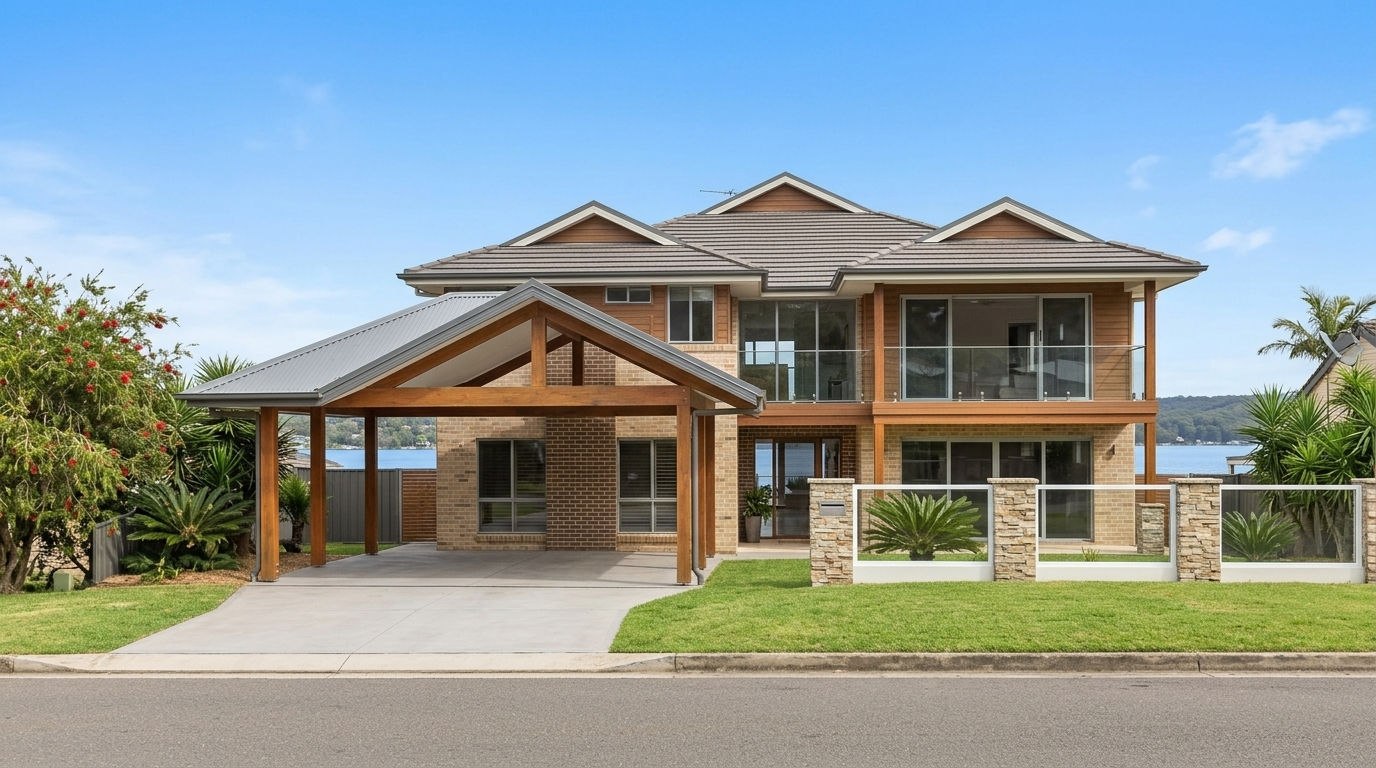
Drive across the Rip Bridge onto the Woy Woy Peninsula and you reach Blackwall, a suburb of tree-lined streets, mid-century homes, and a waterfront stretch along Orange Grove Road. With a population of 1,941 across 1.2 square kilometres, it has the feel of a coastal village about 80 minutes from Sydney’s CBD.
Fishing and boating are part of daily life here. Blackwall Mountain’s bushland trails offer views across to Lion Island, and Orange Grove Road’s waterfront properties command multimillion-dollar prices while inland streets still offer genuine entry points for first-home buyers. If you’re looking to buy in Blackwall, one of the first questions you’ll face is whether to go established (a home with character, a known streetscape, and land you can walk around the day you settle) or to buy new, either a completed townhouse in one of the suburb’s established complexes or a unit bought off-the-plan. Both paths are well represented in Blackwall’s current market, which has recorded a 10-year compound annual growth rate of 6.9% across all property types, according to AusPropertyInsights.
The Case for Established Homes in Blackwall
Established homes are what give Blackwall its character, and they dominate the housing stock: of the 903 private dwellings recorded in the 2021 Census, 585 (a full 65%) are separate houses. Many were constructed mid-century and bring the kind of features that are hard to replicate in a new build: timber floorboards, high ceilings, stained-glass sash windows, and the settled, mature gardens that only decades of growth produce.
Take 302 Blackwall Road, which sold for $1,475,000 in September 2025. Marketed by Ray White Umina Beach as a “Charming Period Family Home with Timeless Character & Modern Comfort,” it is a well-maintained period home with modern updates. These established homes sit on blocks that typically range from 450 to 700 square metres on the inland streets (Memorial Avenue, Commonwealth Avenue, Gallipoli Avenue), with waterfront blocks along Orange Grove Road stretching considerably larger. The streetscape itself is a selling point: inland streets like Commonwealth Avenue offer a uniform, established setting of mostly older-style single-level homes on generous blocks, framed by mature trees and settled gardens.
The financial picture for established houses is clear. Entry-level homes sit around $940,000 to $1,050,000; recent sales include 48 Warwick Street at $950,000 and 79 Memorial Avenue at $955,000. Mid-range homes cluster between $1.15 million and $1.5 million, while larger blocks and premium positions push toward $1.75 million to $2.4 million. Orange Grove Road’s deep-waterfront homes are in a league of their own, with sales recorded between $3.2 million and $6.9 million.
You also get certainty. You know the purchase price on day one, you can settle quickly, and there’s no construction timeline to manage. Blackwall houses spend an average of 73 days on market, according to WhichAgent data, which gives buyers reasonable time to inspect, arrange finance, and negotiate without feeling rushed.
The Case for Off-the-Plan and New Builds in Blackwall
If a low-maintenance, lock-up-and-leave lifestyle appeals, Blackwall’s townhouse market deserves a close look. Townhouses and semi-detached dwellings make up 21% of the suburb’s housing stock (188 dwellings), clustered predominantly along Warwick Street, Warrigal Street, Gallipoli Avenue, and Memorial Avenue. Many are established villa complexes where completed townhouses come up for sale, offering modern floorplans without the wait of a true off-the-plan purchase.
Recent listings paint a clear picture of what’s available. A three-bedroom townhouse at 3/43 Memorial Avenue was listed at $750,000, marketed as “exceptional value” with a ground-floor bedroom and bathroom, sunny courtyard, and low strata, the kind of layout that appeals equally to downsizers, first-home buyers, and investors. Two-bedroom townhouses have sold between $570,000 and $760,000 in the past two years, while three-bedroom examples range from $840,000 to $1.2 million.
Buying new or off-the-plan also opens the door to government incentives that established-home purchases cannot access. The NSW First Home Owner Grant provides $10,000 for new or substantially renovated homes valued up to $600,000 (or up to $750,000 for house-and-land packages), which can apply to off-the-plan townhouses and duplexes at the lower end of Blackwall’s market. Stamp duty concessions through the First Home Buyers Assistance Scheme apply to both new and established homes, with a full exemption on purchases up to $800,000 and a concessional rate between $800,000 and $1 million. In NSW, off-the-plan buyers do not receive a stamp duty discount; instead, owner-occupiers can access a payment deferral of up to 15 months from the contract date (or until settlement, whichever comes first). This is a cash flow benefit rather than a dollar saving, and it is not available to investors.
There’s also a tax consideration that became more urgent after the 2026-27 Federal Budget. From 1 July 2027, established properties purchased after 12 May 2026 lose the ability to offset negative gearing losses against salary income (though they can still deduct losses against rental property income). New builds are exempt from this change and retain full negative gearing benefits, a point that matters considerably if you’re buying with an investment strategy in mind. Full details are available on the Federal Budget website.
Financial Trade-Offs at a Glance
The dollars-and-cents differences between the two paths are worth laying out side by side.
An established house at Blackwall’s entry level, call it $950,000, puts you in a home with land, a backyard, and no strata levies, but with no FHOG eligibility and the full stamp duty calculation on the purchase price. Under the First Home Buyers Assistance Scheme, a $950,000 purchase falls within the concessional stamp duty range ($800,000 to $1 million), so you’d pay reduced duty rather than the full rate. Established homes also offer immediate rental income for investors: houses in Blackwall rent for a median of $650 per week, up 18.18% year-on-year, with a tight vacancy rate of just 1.30%.
A new two-bedroom townhouse priced under $600,000 (such as 2/11A Warwick Street, which sold for $570,000 in October 2024) qualifies for the full stamp duty exemption plus the $10,000 FHOG, and may come with depreciation benefits that boost after-tax returns for investors. Townhouses rent for a median of $550 per week. But you’re buying into a smaller titled lot or a strata complex, with ongoing levies and less autonomy over the property’s exterior. Off-the-plan buyers also face a different risk profile: a 10% deposit held in trust until settlement means your money is tied up while the market can move, and if values dip during construction, your lender may reassess.
The Help to Buy shared equity scheme, where the government takes an equity stake of up to 40% for new builds and 30% for existing homes, adds another layer to the decision for eligible buyers, potentially lowering the deposit hurdle more for new construction than for established purchases. Full eligibility details are on the official Help to Buy site.
What’s Actually Being Built: Development Landscape in Blackwall
Blackwall’s development story is modest and infill-driven, which is worth understanding before you go hunting for gleaming off-the-plan display suites. This is not Ettalong Beach, where more than $200 million in investment has brought five-storey shoptop apartments and multiple large-scale proposals to the suburb just two kilometres away, as documented by The Urban Developer. Blackwall’s planning activity is quieter: dual occupancies on larger lots, small clusters of townhouses replacing older single homes, and the occasional duplex. The Census records just 21 flats in the entire suburb. Apartments are genuinely rare here, so if you’re after a high-rise off-the-plan apartment, you’ll need to look elsewhere on the Peninsula.
One development to watch from a distance is Woy Woy’s TOD SEPP designation, announced in December 2023 and taking effect in May 2024. The Transport-Oriented Development provisions around Woy Woy Station (roughly a 6-minute drive from Blackwall) allow residential flat buildings up to approximately six storeys within a 400-metre radius of the station, as detailed in legal analysis by Mills Oakley. This could reshape the broader Peninsula’s medium-density housing supply over the coming years without directly changing Blackwall’s low-rise character.
Which Path Suits You? Buyer Profiles
First-home buyer: A new or recently completed two-bedroom townhouse priced under $600,000 unlocks the $10,000 FHOG and full stamp duty exemption, making the deposit hurdle substantially lower. Above that threshold, townhouses in the $600,000 to $760,000 range still benefit from the full stamp duty exemption (under $800,000) but miss out on the FHOG. An established entry-level house at $940,000+ stretches further but gives you land, and the long-term capital growth history of Blackwall houses (8.7% annually over the past decade, according to WhichAgent) suggests the premium pays off over time.
Downsizer: A single-level townhouse like the ground-floor-bedroom layout at 3/43 Memorial Avenue offers low-maintenance living without stairs. An established home on a flat inland block with an established garden is equally appealing if you want space for visiting grandchildren and a patch of your own.
Investor: New builds retain full negative gearing benefits post-2026 Budget, plus depreciation. Established homes offer immediate rental income in a market with a 1.30% vacancy rate and house rents that have jumped 18% in a year. Both are viable; the choice turns on whether you prioritise tax treatment or immediate cash flow.
Family: An established three-bedroom house on a 500 to 700 square metre block with a backyard and room to grow is the natural fit. Most Blackwall townhouses are two to three bedrooms and offer less outdoor space.
Waterfront buyer: This one’s simple: established is your only option. Orange Grove Road’s deep-waterfront properties, which have sold from $3.2 million to $6.9 million, are all existing homes. No off-the-plan waterfront product exists within Blackwall’s boundaries.
Making Your Move: Practical Next Steps
Wherever you’re leaning, the best next step is to get on the ground. Attend an open home on Commonwealth Avenue or Memorial Avenue to feel what a 500-square-metre block and a mid-century home with timber floors actually offers. Then walk through a completed townhouse along Warwick Street or Memorial Avenue and compare the finish, the space, and the feel of strata living.
If off-the-plan is on your radar, have a solicitor review the contract before you sign, with particular attention to the sunset clause and the schedule of finishes. Speak to a mortgage broker about your grant and concession eligibility; the difference between qualifying and not can be tens of thousands of dollars. And while you’re in the suburb, take the time to walk the Orange Grove Road foreshore, climb Blackwall Mountain for the view, and drop into Ettalong’s markets on a weekend morning. Experiencing the suburb firsthand is the best way to decide which path suits you.
Frequently Asked Questions
What’s the price difference between an established house and a new townhouse in Blackwall?
Entry-level established houses in Blackwall start around $940,000 to $1,050,000 for a standalone home on a block typically between 450 and 700 square metres. Newer two-bedroom townhouses range from $570,000 to $760,000, while three-bedroom townhouses sit between $840,000 and $1.2 million. The lower entry price of a townhouse comes with less land and strata living; the higher cost of a house buys you more space, no strata, and stronger historical capital growth.
Does buying off-the-plan in Blackwall qualify me for the First Home Owner Grant?
Yes, as long as the property you’re buying is new or substantially renovated and valued at $600,000 or under (or up to $750,000 for a house-and-land package). The NSW First Home Owner Grant provides $10,000 for eligible new builds, including off-the-plan townhouses and duplexes that fall within the price cap. It is not available on established homes. The grant can be combined with the stamp duty exemption (full exemption up to $800,000, concessional rate to $1 million) under the First Home Buyers Assistance Scheme, which applies regardless of whether you buy new or established.
How long do established homes take to sell in Blackwall, and what does that mean for buyers?
Houses in Blackwall spend an average of 73 days on the market, while apartments and townhouses average 53 days, according to WhichAgent. For buyers, this means you generally have several weeks to inspect a property, arrange finance, and negotiate terms without the pressure of a fast-moving, auction-dominated market. It also means vendors who have been on the market for a while may be open to reasonable offers.
Are there actually off-the-plan projects available in Blackwall right now?
Blackwall’s new-build market is modest and infill-driven. Most activity consists of dual occupancies on larger lots and small-scale townhouse clusters replacing older single homes. The majority of “new” product available for purchase in Blackwall is recently completed townhouses within established villa complexes along streets like Warwick Street, Warrigal Street, and Memorial Avenue. If you’re looking for a larger off-the-plan apartment development, neighbouring Ettalong Beach (about a 5-minute drive away) has several multi-storey projects underway, with more than $200 million in development investment reshaping its foreshore.
What government grants and concessions can first-home buyers access in Blackwall?
First-home buyers in Blackwall can access the $10,000 First Home Owner Grant (new builds valued up to $600,000, or up to $750,000 for house-and-land packages), the First Home Buyers Assistance Scheme for stamp duty relief (full exemption up to $800,000, concessional rate to $1 million, available on both new and established homes), and the Help to Buy shared equity scheme (up to 40% government equity for new builds, 30% for existing). The federal 5% Deposit Scheme, which waives lenders mortgage insurance, is also available regardless of property type.
Is an established home or a new build better for investment in Blackwall?
It depends on your strategy. An established house delivers immediate rental income (the median rent for houses in Blackwall is $650 per week, up 18.18% year-on-year, with a vacancy rate of just 1.30%) and benefits from a strong long-term growth history of 8.7% annually over the past decade. A new build retains full negative gearing benefits under the post-2026 Budget rules and offers depreciation deductions, but typically commands a slightly lower rent at $550 per week for townhouses. Both are viable investment paths; the choice turns on whether you value immediate cash flow or long-term tax efficiency more.
What should I check before signing an off-the-plan contract for a property in Blackwall?
Before signing an off-the-plan contract for a Blackwall property, have a solicitor review the sunset clause (current NSW protections require the developer to obtain your consent before cancelling under a sunset date), the schedule of finishes, and any strata by-laws and levies if the property is part of a complex. These NSW-wide protections apply to any off-the-plan purchase in Blackwall. Your deposit (typically 10%) is held in trust and protected if the developer becomes insolvent. You also have a 10-business-day cooling-off period after exchange.
How do block sizes compare between established homes and new builds in Blackwall?
Established homes in Blackwall typically sit on blocks ranging from 450 to 700 square metres on inland streets like Commonwealth Avenue and Gallipoli Avenue, with some larger blocks reaching 1,000 square metres or more. Waterfront blocks along Orange Grove Road can be even larger. New townhouses are generally built on smaller subdivided lots or within strata complexes where outdoor space is limited to a courtyard or small garden. If outdoor space, a backyard, or future extension potential matters to you, an established home is the clear choice.
What’s the rental return like in Blackwall for houses compared to townhouses?
Houses in Blackwall rent for a median of $650 per week, with a gross rental yield of 2.70% and a year-on-year rent increase of 18.18%. Townhouses rent for a median of $550 per week, with a slight year-on-year decline of 3.51%. The overall vacancy rate across Blackwall is a very tight 1.30%, meaning both property types lease quickly. Houses deliver the stronger rental income, but the higher purchase price means the yield percentage favours neither type decisively.
Is Blackwall’s property market still growing, and does that affect whether I should buy now or wait?
Blackwall has recorded a 10-year compound annual growth rate of 6.9% across all property types, according to AusPropertyInsights. House prices specifically have grown 8.7% annually over the past decade, per WhichAgent data. With the structural driver of Sydney-to-Coast migration showing no signs of reversing and interest rate cuts widely anticipated, the conditions that have supported Blackwall’s price growth look set to continue. Waiting may mean paying more; buying now locks in a price while the market remains accessible.