
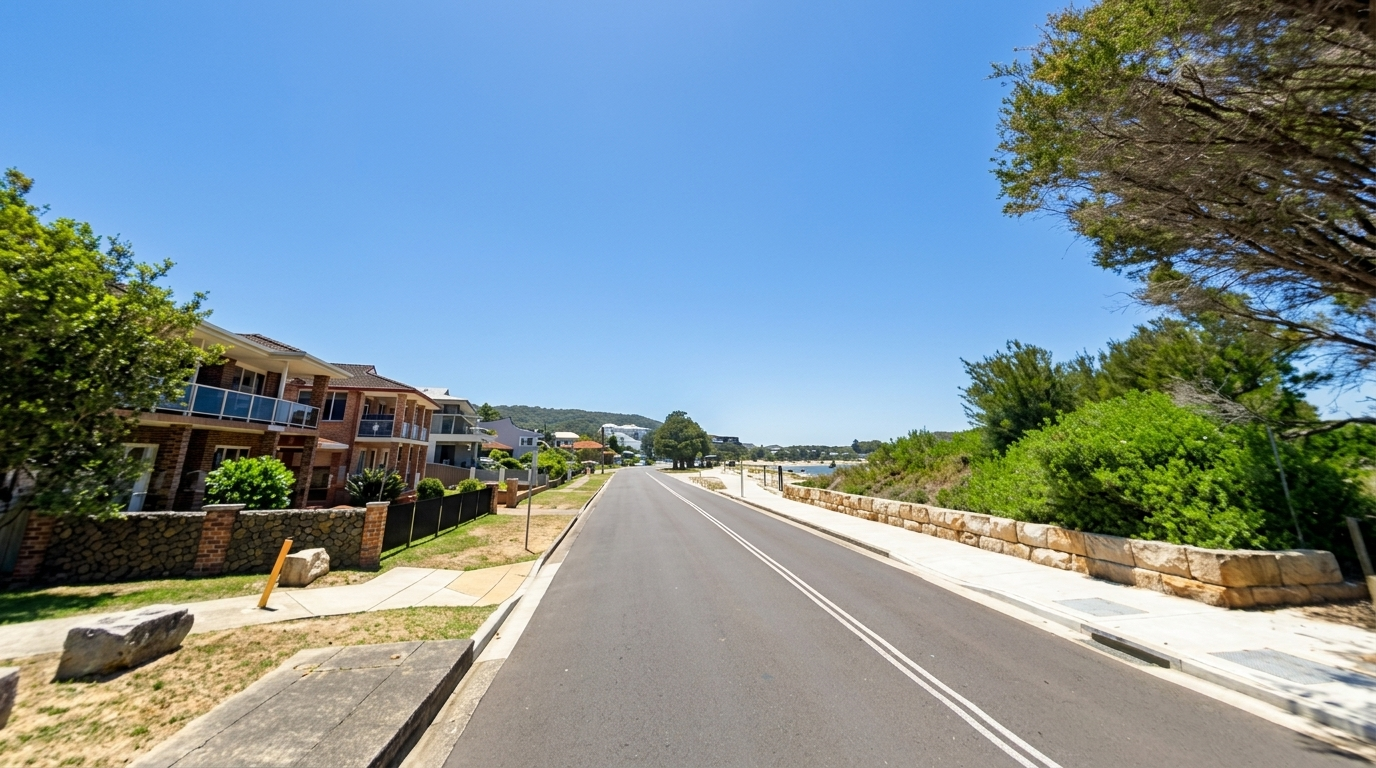
A growth story that changed the investment question
Ettalong Beach has spent most of its life as a quiet holiday town on the Woy Woy Peninsula. For locals it was a flat, walkable pocket of the NSW Central Coast with a calm beach, a weekend market and a ferry across to Palm Beach. Domain’s house price reporting ranks it Australia’s best-performing property market, with median unit prices up 191% over five years.
Investors usually have to choose between rental income and price appreciation. In Ettalong Beach the answer is now growth-led, with a rental market that is catching up quickly. The practical step is to decide how much of each return you want, and choose the property type that delivers it.
The growth side: Ettalong’s capital growth record
The headline belongs to units. The median unit price climbed from $304,000 to $887,500 in five years, an increase of $583,500, according to Domain. The latest 12-month unit growth sits at around 12%, so the run has not stalled, while property.com.au now lists the unit median near $1,030,000. That median now sits above unit medians in Toorak at $875,000, Potts Point and Leichhardt at $860,000, and Bulimba at $830,000.
Houses have been no slouch either. Your Investment Property records a house median around $1.26 million, with annual capital growth of 12.25% in its latest data and 8.33% earlier. A more recent reading puts the house median around $1.32 million after a 7.4% lift over the past year, while HTAG lists a headline house value near $1.405 million. realestate.com.au puts long-run compound growth at 7.0% for houses and 9.5% for units, while annual growth near 17.6% and a five-year rise of 75.4% are tied to the ferry link and a revitalised foreshore.
Across the whole suburb, AreaSearch shows the median rising from about $600,000 to $1,070,000 over ten years, roughly 78.3% in total, while HTAG tracks the decade-long price move at about 101% with rents up close to 62%.
This is not a one-off spike. Domain reporting ties the move to pandemic-era discovery, as Sydney buyers travelled north, liked what they found and decided to stay. The Palm Beach ferry, a revitalised foreshore and a shift toward owner-occupiers also supported the move. OnTheHouse records owner-occupied properties at 59.2% in 2021, up from 57.2% in 2016.
The yield side: a rental market that is quietly catching up
Headline gross yields in Ettalong Beach look modest, and that is the direct trade-off for five years of strong capital growth. Houses sit around 2.56% on HTAG data and up to 3.0% on Your Investment Property figures. Units come in around 2.65% and townhouses around 2.86%, according to realestateinvestar.
The more useful signal is the direction rents are heading. House rents are up 7.9% and unit rents up 8.3% over the year, while HTAG puts overall rent growth at 6.3%. The median weekly rent runs from about $600 on AreaSearch data to $693 on HTAG, with houses around $680 and units around $590. Well-positioned units lease at $750 to $800 a week, local agents told Domain. realestateinvestar puts vacancy at about 1.03%, with roughly 30.6% of the population renting, so tenant demand is real and persistent.
Street-level data adds colour. Domain’s street profile for Springwood Street shows a median rent around $720 a week and a gross yield near 3.4%.
There is also a higher-gear option. Short-stay yields above 5% are within reach for appropriately positioned Ettalong and Umina properties. Buyers willing to manage holiday-style demand can aim for that higher yield.
Balancing by property type: houses, units and townhouses compared
The cleanest way to balance yield and growth in Ettalong Beach is to let the property type do the work. Recent NSW Valuer General sales records show how each asset class splits the two returns.
Houses are the land-led growth play. Sales range from entry-level homes on 518 square metre blocks, like 54 Bourke Road at $915,000, through to 53 Palm Street at $1,320,000 and premium waterfront positions such as 51 Broken Bay Road at $2,850,000. On realestateinvestar figures, houses carry the thinnest yield at around 2.29%, because land value dominates the price, while HTAG and Your Investment Property place house yields a little higher at roughly 2.56% and 3.0%. The spread comes from different datasets.
Units offer the strongest growth and the strongest rental story. A two-bedroom like 1/370A Ocean View Road sold for $740,000, while newer two-bedroom stock such as 402/237 Ocean View Road reached $1,280,000, and premium three-bedroom water-view apartments have cleared $2 million, including 8/108 The Esplanade at $2,500,000 and 9/207 Ocean View Road at $2,000,000. Yields of about 2.65% may look similar to houses, but the $750 to $800 weekly rents on well-located units pull the real cashflow higher.
Townhouses occupy the middle ground. They offer a step up in space and land content from a unit, with yields around 2.86%, and they suit tenants who want lock-and-leave ease without a full apartment. For many investors they are the sensible compromise.
A practical framework for balancing yield and growth
Start with your horizon and your cashflow needs. If you can hold for a decade and do not need the income, lean toward growth assets. If you need the rent to carry the loan from day one, lean toward income. Then measure the outcome through total return, growth plus yield, rather than either metric alone.
A simple gross yield calculation helps. Take annual rent, divide it by the purchase price, and multiply by 100. A $693 weekly rent on a $1.4 million home works out to about 2.57%, close to the HTAG house yield. The same formula on an $887,500 unit renting for $800 a week gives roughly 4.7%, which shows how strong rents can reshape the picture.
Growth-focused buyers should look for land, water proximity and newer stock, while yield-focused buyers should look for units and townhouses near the walkable centre, the ferry, the markets and the dining strip. Both profiles are available in the same suburb, which is the real advantage here.
What supports both returns: the lifestyle fundamentals
The reason Ettalong Beach can offer both returns is that its amenity works for owners and tenants at the same time. The foreshore along The Esplanade is the centrepiece, with a shared path that runs past the beach toward Ocean Beach and Umina. The suburb is flat, easy to walk, and has free parking near the water, comfortable for retirees, families and holiday tenants alike.
Connectivity supports the growth story. The Palm Beach ferry crosses to the Northern Beaches in about 30 minutes, and Woy Woy station puts Sydney Central just over an hour away by train. The Galleria adds more than 50 boutiques and weekend markets, while Ettalong Diggers anchors the community side with waterfront dining and entertainment.
New development is adding supply and lifting the streetscape. Coast Community News reports that planning controls have been amended to enable five-storey shop-top housing along Ocean View Road and The Esplanade, adding high-end apartments and retail at street level. That pipeline supports both values and tenant choice over the years ahead.
Conclusion: Ettalong’s answer to the yield-vs-growth debate
Ettalong Beach is a growth-led market with a strengthening rental tailwind. You will not find a property here that pays a high yield and doubles in value every five years at the same time, and you do not need to. The balance comes from choosing the asset that matches your plan, then holding long enough for the compounding to work.
If your goal is long-term equity, follow the land and the water. If your goal is income today, follow the units and the walkable centre. Both strategies sit within a suburb whose fundamentals, connectivity, rental demand and owner-occupier depth point the same direction. The team at Stone Real Estate Ettalong Beach can help you match the strategy to the street.
Frequently Asked Questions
Is ettalong-beach better for capital growth or rental yield?
Capital growth is the headline story. Units rose 191% over five years and house medians now sit above $1.3 million, while gross yields remain modest in the 2.5% to 3% range. That makes it a growth-first market for investors who also value a strengthening rental story.
What is the average rental yield in ettalong-beach?
Houses sit around 2.56% to 3.0% depending on the source, units around 2.65% and townhouses around 2.86%. These are gross yields, so they compare annual rent to price, and the headline number understates how quickly rents are rising.
How much have unit prices grown in ettalong-beach?
The median unit price rose from $304,000 to $887,500 over five years, a gain of 191%, with a further 12% in the latest 12 months. realestate.com.au puts long-run unit compound growth near 9.5% a year, and property.com.au now lists the unit median around $1,030,000.
Are houses or units the better investment in ettalong-beach?
Houses offer land-led growth and the thinnest yield. Units combine strong growth with deep rental demand and lock-and-leave appeal. The better choice depends on whether you want long-term equity or stronger cashflow.
What is the median weekly rent in ettalong-beach?
The suburb median runs from about $600 to $693 a week depending on the dataset. Houses sit around $680 and units around $590, while well-located units are leasing at $750 to $800 a week.
Why have ettalong-beach property prices grown so strongly?
The move is tied to pandemic-era discovery by Sydney buyers, the Palm Beach ferry, new high-end apartments and a revitalised foreshore, plus a swing toward owner-occupiers, who now occupy about 59% of properties.
What is driving rental demand in ettalong-beach?
Vacancy sits around 1.03%, about 30% of residents rent, and rents are rising around 6% to 8% a year. Lifestyle appeal to downsizers, holiday tenants and Sydney commuters keeps demand steady.
Can I achieve a higher yield with short-stay or holiday rental in ettalong-beach?
Yes, for appropriately positioned properties. Short-stay yields above 5% are available in the Ettalong and Umina area, with positioning, amenity and presentation doing most of the work.
How do I calculate gross rental yield for an ettalong-beach property?
Multiply the weekly rent by 52 to get annual rent, divide by the purchase price, and multiply by 100. A $693 weekly rent on a $1.4 million home is about 2.57%, while an $887,500 unit renting at $800 a week is roughly 4.7%.
What should a growth-focused vs a yield-focused investor look for in ettalong-beach?
Growth buyers should target land, water proximity and newer stock in premium positions. Yield buyers should target units and townhouses near the walkable centre, the ferry, the markets and the dining strip, with short-stay potential.
Is now a good time to invest in ettalong-beach?
The demand drivers are real: rising rents, low vacancy, steady amenity investment and a pipeline of new housing. The better question is which property type matches your strategy, rather than trying to time the market.
How do ettalong-beach yields compare with the national average?
Ettalong Beach’s gross yields of roughly 2.5% to 3% sit a little below the national mid-3% range reported across major markets. The difference reflects the growth and lifestyle premium on offer, partially offset by stronger rent growth.