
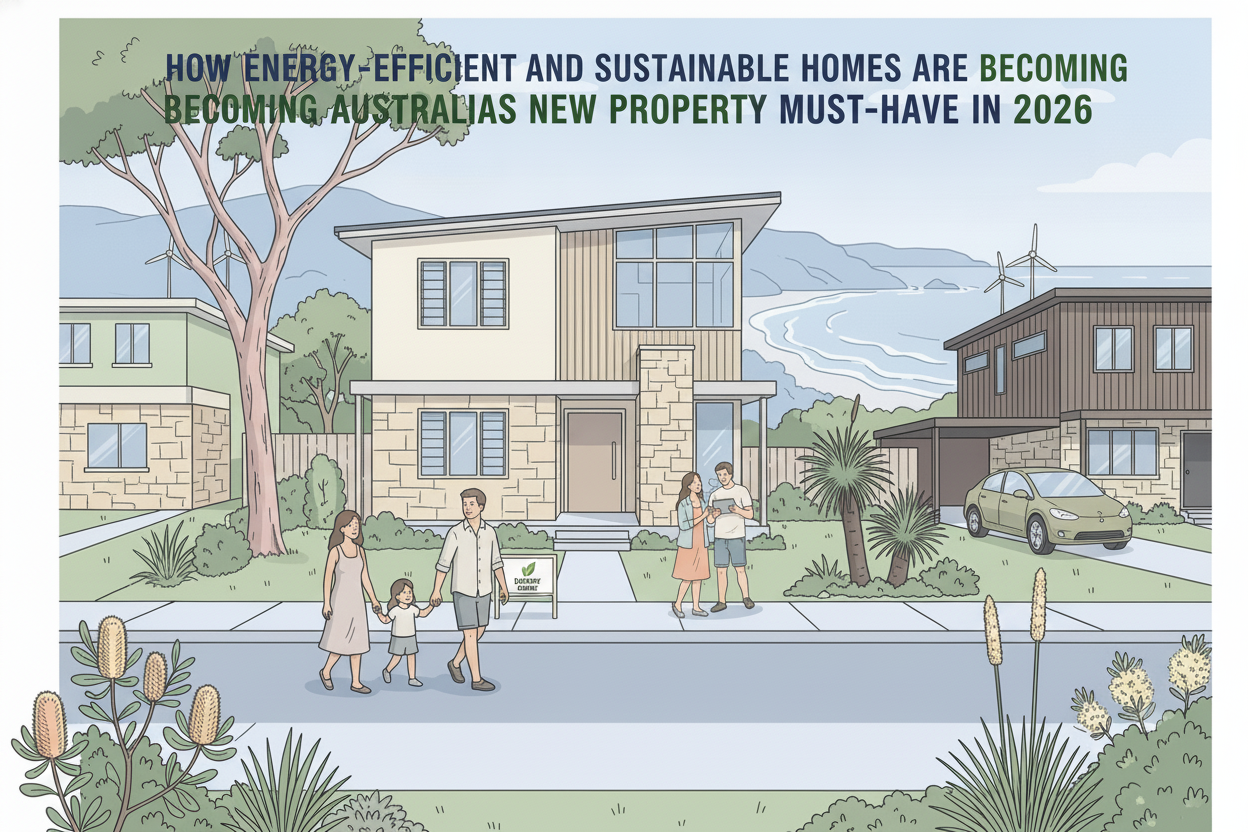
Energy-efficient homes are selling for an average of $118,000 more than non-efficient homes across Australia. That is a 14.5% premium, and it comes from Domain’s 2025 Sustainability in Property Report, the most comprehensive look yet at what green features do to property values. It is not a niche environmental story. It is a mainstream financial shift reshaping how Australians buy, sell, and build homes in 2026.
Rising energy costs have turned efficiency from a nice-to-have into something buyers actively filter for. New building standards now make 7-star NatHERS ratings mandatory for every new home. And the data shows developers, investors, and owner-occupiers are all being rewarded for choosing greener properties.
The Green Premium Has Gone Mainstream
Energy-efficient homes attracting a price premium is no longer up for debate. More than half of all houses sold in 2025 (52.2%) included at least one energy-efficient feature. Nearly 40% of units did too. These represent the majority of transactions in large parts of the market.
Nationally, energy-efficient houses command 14.5% more ($118,000), while units attract a 12% premium ($75,000). Melbourne leads the capitals with a 23.8% premium, roughly $197,000 above a comparable non-efficient home. Perth follows at 16.1% ($118,000).
The highest premiums are not confined to wealthy postcodes. Broken Hill in regional NSW recorded 75.3%, the highest in the country, while South Yarra in inner Melbourne posted 54.8%. Reservoir, where the median household income is $80,132, has an efficient-home price premium of 48%. The takeaway is clear: middle-income households in regional and outer suburban areas are leading adoption because lower running costs matter most when budgets are tight.
Buyer interest reinforces the story. Energy-efficient house listings attract 13.8% more views nationally. In Melbourne the lift is 36.3%, and in Sydney it is 25.8%. As Domain’s Chief of Research and Economics Nicola Powell puts it, energy-efficient homes are “a smart financial choice, particularly given rising energy prices and mounting cost of living pressures.”
What Is Driving the Shift
Three forces are pushing energy efficiency to the centre of the property market: regulation, energy bills, and buyer awareness.
The National Construction Code 2022 made 7-star NatHERS ratings mandatory for all new homes from May 2024. That cut the heating and cooling energy needed in a new home by roughly 25% compared to the old 6-star standard. In July 2026, the scheme expanded to existing homes for the first time in its 33-year history, so buyers and renters can now get an energy performance certificate for older properties.
Energy bills are the second driver. Energy Victoria estimates a 7-star home with rooftop solar and an electric heat pump can save up to $1,473 per year on electricity. It is why eight in 10 buyers now consider sustainability features important when purchasing.
The third force is visibility. Domain and realestate.com.au now include sustainability and eco filters in search tools. Buyers can screen for properties with solar panels, double-glazed windows, and energy ratings. The ACT has become the benchmark: its mandatory disclosure scheme gives the Territory the largest share of energy-efficient homes nationally, and other states are watching.
Developers Are Making More Money by Building Green
For years the standard objection was that green features benefited the homeowner, not the developer. Research from Deakin University has directly disproved that.
The study examined more than 500 homes across five states using verified cost and income data from completed build-to-sell projects. It found developers who embedded sustainability features from the design stage achieved an average 18% return on investment. For every dollar spent on greener features, the benefit to the developer was $1.18.
Some savings are immediate. Avoiding gas-pipe installation cuts construction cost and removes a utility bill for the buyer. Using the NSW Government’s free housing pattern book saves thousands on architects’ fees. Apartments show especially strong economics: one analysis of 20 projects found the average cost of meeting energy-efficiency targets was $6,547 per dwelling, while the potential gain for owners was $21,000 in the first 12 months.
Cadre won the REA Game Changer of the Year Award 2025 for 7-star NatHERS homes with an estimated 500% energy cost saving versus a typical Victorian terrace. Kincaid delivered prefabricated 8-Star NatHERS homes in three months and sold out in three weeks.
The Features That Add the Most Value
Not all green features carry the same weight, and the data now makes it possible to know which ones buyers value most.
Solar panels are the most widespread. Roughly 4.469 million Australian homes, about 41% of all households, now have rooftop solar. Among houses sold in the past year, 37.6% had solar installations, adding an average 2.7% ($23,100) premium.
Double-glazed windows command a $145,000 premium nationally. North-facing orientation is the single most valuable attribute, adding an average $375,500 to a property’s price. It costs nothing at the design stage, but the passive heating and natural light are things buyers notice immediately.
Other features buyers actively seek include correct ceiling and wall insulation, heat recovery ventilation systems, battery storage paired with rooftop solar, and rainwater tanks. Several of these were on display at the 2026 HIA GreenSmart Awards, which showcased Passivhaus-certified homes and 10-star NatHERS residences across the country.
All-electric design is gaining momentum: removing gas eliminates a utility bill, simplifies construction, and future-proofs the home. The NSW Government’s $557.1 million home energy upgrade package, including $480 million in interest-free loans, is helping households fund electrification upgrades.
Sustainable Communities: The Next Frontier
Certification programs that started with individual buildings are being applied to entire masterplanned communities.
The UDIA’s EnviroDevelopment certification covers six elements: ecosystems, waste, energy, materials, water, and community. Constellar in Perth is achieving all six, requiring a minimum 7-star NatHERS rating and 3.5kW of solar on every home. Green Star Communities, from the Green Building Council of Australia, rates communities from 4 to 6 stars.
Ed.Square in South West Sydney, Frasers Property’s 6 Star Green Star community, shows what this looks like at scale. The 991 apartments are 5 Star Green Star certified, EV-ready, solar-powered, and digitally enabled. An on-site embedded energy network with a large solar array powers the community. The Town Centre sits within 400 metres of every home, connected by 3.5 kilometres of cycle paths and 6-plus hectares of open space. Frasers Property’s own renewable energy business, Real Utilities, runs the embedded network.
Orange in regional NSW became the first regional community to achieve 6 Star Green Star, with 300 all-electric, net-zero-ready homes including 20% affordable housing.
Government developers are pushing the market too. Landcom’s Macarthur Heights pilot provided sustainability rebates of up to $15,000 per home, with total rebates exceeding $2 million. Community-scale certification is now viable, and buyers are responding.
What This Means for Buyers, Sellers, and Investors in 2026
For buyers, energy-efficient homes cost less to run from day one. Listing platform eco-filters make it straightforward to compare properties, and the expanded NatHERS scheme means an energy rating certificate is now available for older homes. Buyers considering off-the-plan purchases can ask developers directly about the NatHERS rating the design is targeting.
For sellers, green features drive more views and faster sales. Energy-efficient house listings attract 13.8% more views nationally, rising to 36.3% in Melbourne and 25.8% in Sydney. Green homes also spend 4% fewer days on market on average. Featuring solar panels, double-glazed windows, north-facing orientation, and any available energy rating certificate in a listing can broaden buyer interest and shorten the sales cycle.
For investors, energy-efficient properties offer capital growth premiums and stronger tenant appeal. South East Melbourne has been identified as a key growth corridor, projected to absorb a large share of Victoria’s population growth to 2046. The NSW Government committed $557.1 million to home energy upgrades, including $480 million in interest-free loans. Green lending products with discounted rates for efficient properties are emerging from fintech lenders.
Conclusion
Energy efficiency has crossed from optional to standard in Australian property. Price premiums, buyer demand, developer profitability, and regulatory direction all point the same way. With 1.2 million new homes to be built and the NatHERS expansion bringing transparency to existing stock, 2026 is the year the green premium became permanent. Understanding energy ratings, certifications, and the value of different green upgrades is now core knowledge for anyone in the Australian property market.
Frequently Asked Questions
What is a NatHERS rating and why does it matter when buying a home?
NatHERS (the Nationwide House Energy Rating Scheme) rates a home’s thermal performance on a 0 to 10 star scale, measuring how well the building maintains a comfortable temperature without artificial heating or cooling. Since May 2024, all new Australian homes must achieve a minimum 7-star rating, up from the previous 6-star standard. A 7-star home uses roughly 25% less energy for heating and cooling. The National Construction Code also introduced a Whole-of-Home energy budget score with a minimum of 60 out of 100, accounting for major appliances, solar, and heating and cooling equipment. In July 2026, the scheme expanded to existing homes for the first time in its 33-year history, so buyers can now assess energy performance across the entire market. The rating appears on a consumer-friendly certificate and is increasingly used by lenders offering green home loan discounts.
How much more do energy-efficient homes sell for in Australia?
Energy-efficient houses sell for an average of $118,000 more, a 14.5% premium over non-efficient homes. Melbourne leads capital cities with a 23.8% premium ($197,000), followed by Perth at 16.1% ($118,000). Units command a 12% premium ($75,000) nationally. Individual features add specific value: north-facing orientation adds $375,500 on average, double-glazed windows add $145,000, and solar panels add approximately 2.7% ($23,100). Over half (52.2%) of all houses sold in 2025 carried at least one energy-efficient feature, confirming this is a mainstream trend. The highest suburb-level premiums span both regional and inner-urban locations: Broken Hill in NSW recorded 75.3% while South Yarra in Victoria posted 54.8%, proving the green premium is not confined to any one type of market.
Do solar panels actually increase property value?
Yes. In the past year, 37.6% of houses sold had solar installations. They add an average 2.7% ($23,100) to a home’s sale price nationally. With over 4.469 million Australian homes (roughly 41%) now having rooftop solar, it has become a feature buyers actively search for on listing platforms. Solar pairs especially well with battery storage, allowing households to store excess daytime generation for evening use. Some developers now include solar as standard: the Constellar community in Perth requires a minimum 3.5kW system on every home. The gap between houses (39% with solar) and apartments (6%) remains wide, though new apartment developments are increasingly incorporating shared solar arrays and embedded energy networks.
What are the new building standards for energy-efficient homes in 2026?
The National Construction Code 2022 took effect in May 2024, mandating a minimum 7-star NatHERS rating for all new homes, up from 6 stars. This change alone cuts heating and cooling energy demand by approximately 25%. The Code also introduced a Whole-of-Home energy budget score with a minimum of 60 out of 100, which accounts for major appliances, solar PV, and heating and cooling equipment operating together as a system. From July 2026, the NatHERS scheme expanded to cover existing homes for the first time, giving older-property buyers and renters access to an energy performance certificate. State-level requirements add further layers: NSW’s BASIX system sets water and energy targets, and the ACT’s long-standing mandatory disclosure scheme has made it the jurisdiction with the largest share of energy-efficient homes nationally.
Is it cheaper to run a 7-star energy-rated home?
Yes. A 7-star NatHERS home uses approximately 25% less energy for heating and cooling compared to the previous 6-star standard. Energy Victoria estimates a Victorian household in a 7-star home with rooftop solar and an electric heat pump can save up to $1,473 per year on electricity. When gas appliances are removed in an all-electric design, households also eliminate a second utility bill entirely. These savings accumulate year after year and are a major reason buyers are willing to pay the green premium at purchase. Landcom-certified sustainable homes in NSW have demonstrated annual utility savings of up to $1,300, further confirming the real-world financial benefit.
What is an all-electric home and why are builders moving away from gas?
An all-electric home has no gas connection. Heating, cooling, hot water, and cooking all run on electricity, ideally supported by rooftop solar and battery storage. Builders favour all-electric designs because they are cheaper to construct (no gas pipe installation), simpler to build, and eliminate a utility bill for the occupant. They also future-proof homes as gas connection costs rise and electrification incentives expand. The NSW Government’s $557.1 million home upgrade package includes $480 million in interest-free loans specifically for electrification upgrades. AGL has launched tools like its Electrify Now planner and Battery Rewards Plan, and runs a Virtual Power Plant program that lets households earn credits by sharing stored battery energy with the grid.
What are EnviroDevelopment and Green Star certifications?
These are the two leading sustainability certifications for Australian residential communities. EnviroDevelopment, run by the UDIA, certifies developments across six elements: ecosystems, waste, energy, materials, water, and community. A project must achieve at least four to qualify. Green Star Communities, from the Green Building Council of Australia, rates communities from 4 to 6 stars, with 6 Star representing world leadership in net-zero carbon, public health, and resource efficiency. Projects like Constellar in Perth (all six EnviroDevelopment elements), Ed.Square in South West Sydney (6 Star Green Star, with 5 Star Green Star apartments, EV-ready and solar-powered), and Orange in NSW (first regional 6 Star Green Star community) show these certifications have moved into the mainstream.
Are energy-efficient homes only for high-income buyers?
No. Domain’s research shows middle-income households in regional and outer suburban areas are leading adoption. Suburbs such as Reservoir in Victoria (household income $80,132) have efficient-home price premiums of 48%. Broken Hill in NSW has the highest premium nationally at 75.3%, while South Yarra, a premium inner-Melbourne suburb, sits at 54.8%. The motivation is practical: energy-efficient features reduce ongoing bills, and that benefit is most meaningful when budgets are tight. State programs like NSW’s $480 million in interest-free loans, Victoria’s home upgrade incentives, and the NatHERS expansion to existing homes are all designed to broaden access across income levels and housing types.
How do I find out if a home is energy-efficient before buying?
Major listing platforms Domain and realestate.com.au now include sustainability and eco filters, letting buyers screen for energy-efficient properties. As of July 2026, the expanded NatHERS scheme means existing homes can receive an energy rating certificate: ask the seller or agent if one is available. Look for specific features in listings: solar panels, double-glazed windows, north-facing orientation, insulation, and heat recovery ventilation. If you are buying off the plan, ask the developer directly what NatHERS rating the design is targeting and whether solar, battery storage, or all-electric appliances are included as standard. Developers increasingly view these details as selling points and are happy to provide them.
Are developers actually making more profit from building sustainable homes?
Yes. A Deakin University study of more than 500 homes across five states found developers who embedded sustainability features from the design stage achieved an average 18% return on investment, or $1.18 in benefit for every $1 spent. Savings come from multiple directions: avoiding gas-pipe installation cuts construction costs directly, using free government pattern books reduces design fees, and buyers are willing to pay a premium for the finished product. Apartments show especially strong economics: one analysis of 20 projects found the average per-dwelling cost of meeting energy-efficiency targets was $6,547, while the potential gain for owners was $21,000 in the first 12 months alone.
Will energy-efficient features help sell my home faster?
Evidence suggests yes. Energy-efficient house listings attract 13.8% more views nationally, rising to 36.3% in Melbourne and 25.8% in Sydney. Green homes also spend 4% fewer days on market on average. Buyers are actively filtering for sustainability features on listing platforms, so homes with solar panels, double-glazed windows, and north-facing orientation appear in more search results. Domain and realestate.com.au both offer eco filters that let buyers screen properties by these features, meaning a well-tagged listing reaches a more motivated audience. Including an energy rating certificate in the listing, where available, gives buyers confidence about ongoing running costs before they even inspect. Even a single high-impact feature like solar panels or north-facing orientation can broaden buyer interest and shorten the sales cycle.
What is the federal government doing about sustainable housing?
The federal government has set a target of 1.2 million new homes over five years, with sustainability embedded in the National Housing Accord framework. The Albanese Government’s second term has brought Housing and Cities together under Minister Clare O’Neil. The National Housing Supply and Affordability Council has identified environmentally sustainable housing, built with low-emissions materials and meeting or exceeding 7-star NatHERS, as a core goal in its State of the Housing System report. The Council also calls for expanding the “missing middle” of medium-density homes. The NatHERS expansion to existing homes in July 2026 is a major federal initiative, and the government is working with industry to grow the assessor workforce to meet demand for energy rating certificates across the existing housing stock.