
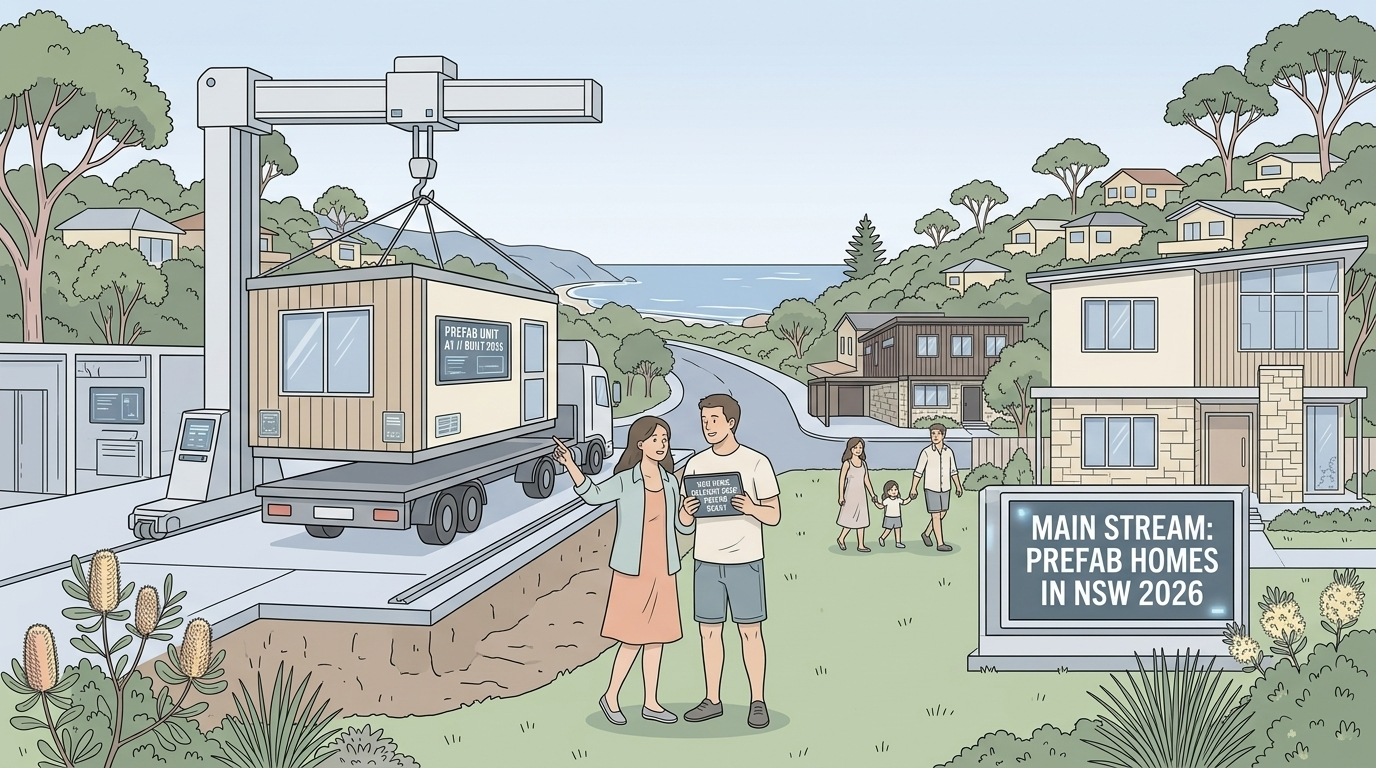
Buying a factory-built home became a realistic plan in 2026. In August, NSW became the first Australian jurisdiction to write prefabricated buildings into law. Weeks later, CommBank became the first major lender to offer finance that matches how factory-built homes are actually made. Builders are delivering finished homes in as little as 20 days. If you have been weighing up whether a prefab or modular home is a workable option for your next purchase, the answer is yes. Here is what changed, how the money works and what you can buy.
NSW writes prefab into the rulebook
In August 2026 the NSW Parliament passed the Building (Approvals and Practitioners) Act 2026, making NSW the first Australian jurisdiction to formally recognise modern methods of construction, or MMC, in law. The legislation defines “prefabricated buildings” and folds them into the building approvals system, with clear rules for their manufacture, supply, transport, delivery and installation. It also introduces staged approvals so owners can move in as early as possible.
The government estimates the changes will save an average of $327,000 in design costs per apartment block and that MMC can cut overall building costs by up to 20% while building homes up to 50% faster. Planning Minister Paul Scully described it as “overhauling another fragmented, duplicative system with one clear set of rules targeted at building more quality homes faster in every corner of the state”. The 2026/27 Budget backs the shift with $32.2 million to modernise the approvals system and a further $1.6 million to set up the MMC regulatory framework and a national certification scheme.
Finance catches up to factory timelines
For years the finance did not fit the build. Traditional construction loans release money in stages as work is completed on your land. A prefab home is mostly made in a factory before it reaches your block, which left buyers facing large upfront payments. That changed on 2 September 2026, when peak body PrefabAUS launched an industry-wide standard form contract for Class 1 prefabricated homes, sponsored by CommBank. The contract ties payment stages to what actually happens, design, manufacture, transport, placement and completion, and it is available to builders, manufacturers, customers and lenders regardless of which bank funds the build.
CommBank also became the first major Australian lender with a dedicated prefab housing policy, letting eligible buyers access progress payments while the home is still being built offsite. Under the policy, customers can access up to 60% of the contract price, or 120% of the land value, in progress payments, rising to 80% of the contract price, or 150% of the land value, for homes from CommBank-assessed prefab builders. Previously buyers often had to fund up to 90% of the build cost themselves. That removes the need for a large upfront payment and delivers a factory build of about 8 to 12 weeks once a contract is signed, compared with 12 to 24 months for a traditional build.
Proof in delivery: homes in 20 days
Metricon, Australia’s largest volume builder, completed two prefabricated homes at Stockland’s Mt Atkinson estate in Truganina in 20 days from slab pour to completion. The main structure went up in four days and about 90% of each home was finished offsite. Both are three-bedroom, two-bathroom homes with a 7-star energy rating.
Melbourne developer-builder Kincaid took the idea into medium density. It delivered five four-bedroom, three-bathroom terraces at Stockland’s Highlands estate in three months, 70 to 85% faster than a typical 10 to 12 month townhouse build. Each carries an 8-Star NatHERS rating, and the homes sold out within three weeks. Up to 80 to 90% of a modular home can now be built offsite, which means the finish you see on the block comes from a factory quality-control process rather than weeks of weather-dependent site work. A building-surveyor buyer puts the quality advantage simply: factory-built homes pass inspections the first time almost twice as often as on-site builds.
Federal money and a push to standardise
The federal government has put real money behind the idea. In May it announced $160 million for prefab, including $40 million for a “kit of parts” construction trial and $120 million for the states and territories to regulate modern construction consistently. A further $39.3 million expands the open-source System 600 kit of parts so different manufacturers can produce compatible components to a common standard.
A national voluntary certification scheme for prefabricated housing is also being developed under the National Construction Code, giving buyers confidence that factory-built homes meet the same standards as any other. The model Australia is adopting is well proven overseas, from Toyota Home in Japan to IKEA’s BoKlok in Sweden, where offsite manufacturing accounts for about 12.6% of new builds in Japan and 45% in Sweden.
Cost, choice and where to start
The price range is broader than most buyers expect. A Money.com.au survey of more than 1,000 Australians found 54% would consider buying or living in a pod-style or prefab home. The entry points are genuinely accessible: Elsewhere Pods’ 4-metre Micro home starts at $50,000, larger family pod homes start at $208,584.50, and Bunnings sells flatpack pod homes from $26,000.
Set those against the national median home price of $903,000 and a median capital-city residential lot of $437,855, and a flatpack or prefab choice can save well over $500,000. NSW already has more than 80 frame and truss manufacturing sites, and the state has opened an expression of interest for an MMC innovation facility tied to the NSW Housing Pattern Book, a collection of architect-designed, pre-approved low- and mid-rise designs that streamline delivery. Two grant programs opened on 29 June 2026 to help manufacturers scale up: the Housing Innovation in Construction Fund, offering $20,000 to $150,000 for established manufacturers adapting modern construction to mid and high-rise projects, and the Housing Innovation Network Grants Program, offering up to $250,000 for small and medium enterprises.
If you are ready to act, start by comparing a prefab build against land plus a traditional build on the same block, then ask your lender about the standard contract and the new prefab lending policies. Booking an appointment with a lending specialist is the quickest way to see exactly how progress payments would work for your budget.
Why this matters for NSW buyers in 2026
The timing matters. NSW is on track to deliver about 258,000 homes over the Housing Accord period, roughly 69% of its 376,000 target, and the national 1.2 million-home goal is now expected to land in the December quarter of 2030. Prefab still accounts for only about 5 to 8% of construction, but peak body PrefabAUS sees room to grow that share to about 30% by 2033, which means the runway for growth is long and the market is only just opening up for everyday buyers. A year ago a NSW buyer did not have this pathway. Today, new law, new finance and proven delivery add up to faster builds, clearer contracts and earlier access to money.
The takeaway
Prefab homes in NSW are no longer a fringe option. Housing Minister Rose Jackson put it plainly: “Prefabricated and modular homes are no longer fringe options. They are central to our housing solutions.” If you are weighing up a new home, check what the new approvals rules make possible and compare a prefab build against the traditional route on your chosen land. The pathway is open now, and it is faster, clearer and easier to finance than it has ever been.
Frequently Asked Questions
What is a prefab home and how is it different from a modular home?
Prefab is the umbrella term for any home built partly or wholly offsite before being transported and assembled on your block. Modular and volumetric homes arrive as whole room-sized modules craned into place, while panelised homes come as wall, floor and roof panels fixed together on site. Up to 80 to 90% of a modular home can be built offsite, which is why these homes reach completion so quickly once they land on your block.
Are prefabricated homes legal in NSW?
Yes, and more clearly than ever. The Building (Approvals and Practitioners) Act 2026 passed in August 2026, making NSW the first Australian jurisdiction to formally recognise prefabricated buildings in law. It integrates them into the approvals system with clear rules for manufacture, supply, transport and installation, and it introduces staged approvals so owners can move in as early as possible.
How much does a prefab home cost in Australia?
Prices span a wide range. Elsewhere Pods’ 4-metre Micro home starts at $50,000, larger family pod homes start at $208,584.50, and Bunnings sells flatpack pod homes from $26,000. Against the national median home price of $903,000 and a median capital-city residential lot of $437,855, a flatpack or prefab build can save well over $500,000. Your total depends on size, finish and land.
How long does it take to build a prefab home?
Once a contract is signed, a factory build typically takes 8 to 12 weeks, compared with 12 to 24 months for a traditional build. The fastest examples are even quicker once the site is ready: Metricon completed two homes in 20 days from slab pour to completion, and Kincaid delivered five terraces in three months, 70 to 85% faster than a typical townhouse. The 20-day figure measures slab to handover only and does not include the design, documentation, planning and factory manufacture that happen beforehand, while the 8 to 12 week figure covers the full factory build from contract signing.
Can you get a home loan for a prefab house?
Yes. CommBank became the first major Australian lender to introduce a prefabricated housing policy that lets eligible customers access progress payments while the home is being built offsite, reducing the need for large upfront payments. It works alongside the new industry-wide standard contract so payment stages line up with how prefab homes are actually built, from design and manufacture through to placement and completion.
What is the new PrefabAUS standard contract?
It is an industry-wide standard form contract for Class 1 prefabricated homes, launched on 2 September 2026 and sponsored by CommBank. It ties payment stages to factory milestones, design, manufacture, transport, placement and completion, rather than site progress. It is available to builders, manufacturers, customers and lenders regardless of which lender finances the build, giving buyers clearer costs, inclusions and responsibilities.
What is CommBank’s prefab home lending policy?
CommBank is the first major Australian lender with a dedicated prefab housing policy. In practice, eligible customers can access progress payments of up to 60% of the contract price, or 120% of the land value, while the home is still being built offsite, rising to 80% of the contract price, or 150% of the land value, for homes from CommBank-assessed prefab builders. Previously buyers often had to fund up to 90% of the build cost themselves, so the change means far less cash upfront, with payments released against factory milestones rather than site progress. Home Buying general manager Rebecca Markwell said the bank has “introduced changes to our lending policy to better support prefabricated housing, including enabling progress payments during the offsite construction phase”.
Are prefab homes as good quality as traditionally built homes?
Modern factory-built homes are made in controlled conditions and certified under the National Construction Code. The delivery examples set a high bar: Metricon’s pilot homes carry a 7-star energy rating and Kincaid’s terraces an 8-Star NatHERS rating. A national voluntary certification scheme is also being developed, and factory-built homes pass inspections the first time almost twice as often as on-site builds.
Where can I buy a prefab home in NSW?
Options are expanding across the state. NSW has more than 80 frame and truss manufacturing sites and has opened an expression of interest for an MMC innovation facility that will manufacture components matched to the NSW Housing Pattern Book medium-density designs. Suppliers range from national volume builders running prefab pilots to pod and flatpack specialists such as Elsewhere Pods.
Do prefab homes hold their resale value?
There is no long-run Australian resale dataset yet, so the strongest early evidence is demand. Kincaid’s five prefabricated terraces sold out within three weeks of launch, and 54% of surveyed Australians say they would consider buying or living in a pod-style or prefab home. Resale is more a recognised perception than a measured outcome, and the quality story cuts the other way: factory-built homes are National Construction Code compliant, which gives buyers confidence the home will stand up well over time.
What is the NSW Housing Pattern Book and how does it support prefab?
The NSW Housing Pattern Book is a collection of architect-designed, pre-approved plans for low- and mid-rise housing that streamlines delivery. The state’s MMC innovation facility is being set up to manufacture prefabricated components matched to these designs, creating a direct pipeline from design through to approval and construction, and delivering quality, pre-approved designs faster.