
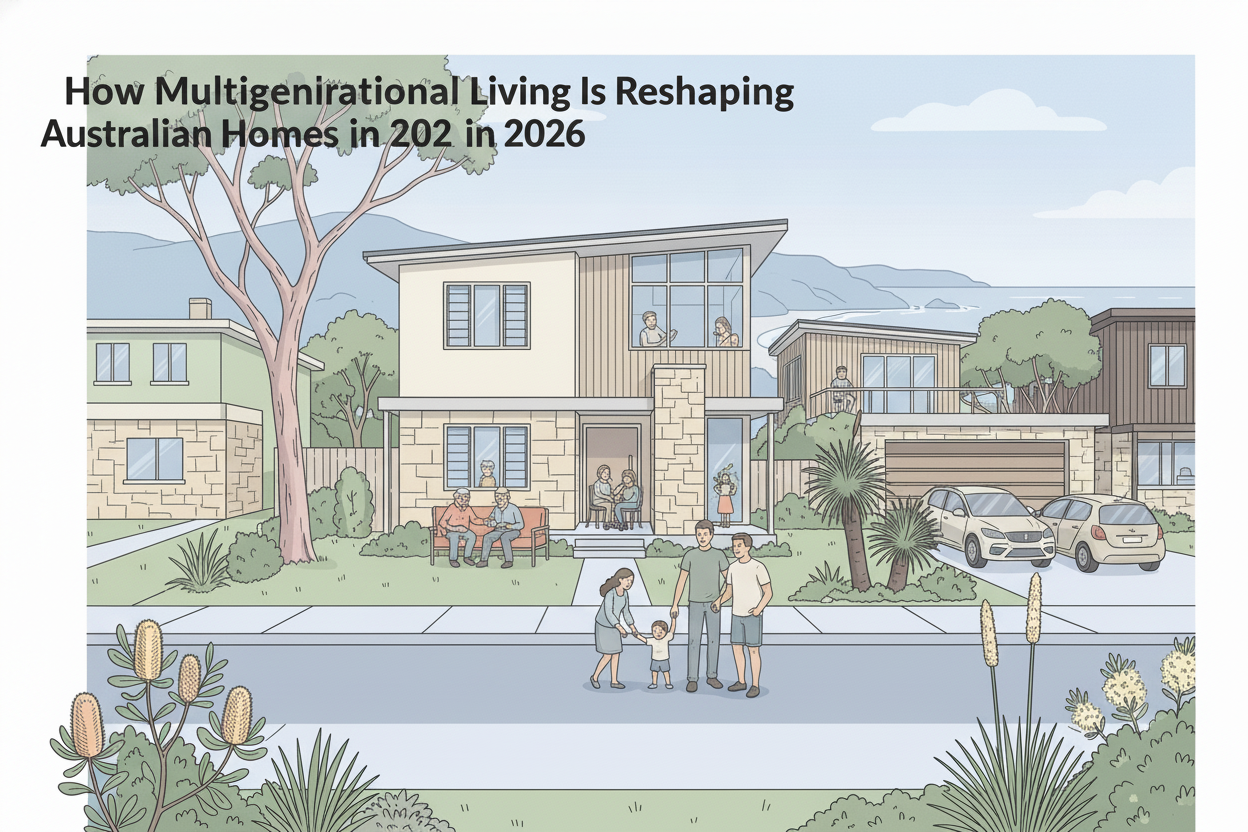
One in five Australians now lives in a multigenerational household. Three-generation households rose 21.8% between the 2016 and 2021 censuses, according to the Australian Bureau of Statistics.
A convergence of housing affordability pressures, an ageing population, and Australia’s cultural diversity is quietly redefining what the family home looks like. Builders are redesigning floorplans. Lenders are rethinking household income. Councils are rewriting planning rules. The multigenerational home is becoming mainstream, and the people buying, building, and renovating right now are the ones driving it.
From Niche to Mainstream: The Numbers
McCrindle found that 57% of Australians are now open to multigenerational living and 65% say the traditional path to home ownership is broken. At the same time, 49% expect to house an adult child or ageing parent within the next decade, according to Resolve Finance.
PropTrack figures show “dual-occupancy” searches surged 385% year-on-year, with “dual-living” interest doubling. In Queensland, granny flat searches climbed 50.1% in the past year.
The “sandwich generation” is most receptive. Among 25-to-34-year-olds, 55% would consider dual occupancy; for 35-to-44-year-olds it is 52%. By state, intent is highest in Queensland at 45%, Victoria at 42%, and NSW at 40%.
PRD Real Estate chief economist Diaswati Mardiasmo says multigenerational living has shifted from “a nice option to have” to “the only way we can make it work.”
What’s Driving the Trend
Sydney’s median house price sits at roughly 16 times average annual earnings, up from five times in 1981. Melbourne is at 10.1 times, Brisbane at 11.3. Home ownership has fallen from 70% to 66% over 20 years. And 36% of non-homeowners say they do not think they will ever afford their own home, according to Finder’s Consumer Sentiment Tracker.
Adult children are staying home far longer. The HILDA Report found 54% of men and 47% of women aged 18 to 29 were still living with parents in 2024. One in three Australians aged 18 to 29 live with parents or in-laws. 70% of 19-year-olds were living at home in 2021, up from 60% in 2006. And 63% of parents with adult children at home are providing financial support, up from 53% a year earlier.
But affordability is only part of the picture. For many migrant families, multigenerational living has been the norm for generations. McCrindle found 71% of Australians who speak a language other than English at home have lived multigenerationally, compared to 39% of English-only speakers. As G.J. Gardner Homes COO Chris Thornton notes: “With an increase of immigration, we see an increase in demand for this type of housing.”
Then there is longevity. KPMG’s Terry Rawnsley observes: “You’ve got older people who maybe can’t get into aged care, aren’t ready for aged care, and you’ve got the sort of mostly Generation Xers who are their children who have the homes that can accommodate this.”
How Design Is Adapting
The James Hardie Modern Homes Forecast 2026, developed with global trend forecaster WGSN, identified multigenerational living as one of four key lifestyle themes shaping Australian home design. Three components stand out: agile zoning, multi-use layouts, and inclusive design supporting mobility and ageing in place.
Neil Hipwell of FutureFlip says his firm is “incorporating features such as separate wings or clearly defined zones within the home, secondary living areas to allow independent day-to-day living, more bedrooms with en suites and attached studios or self-contained areas.”
Popular configurations include dual-occupancy designs with a main house plus granny flat, zoned floor plans with separate wings anchored by a shared kitchen, dual master suites with kitchenettes, and studio attachments over detached garages. In Perth, the Plunkett Homes Woodbridge display home showcases this thinking with a dedicated guest suite featuring its own kitchenette, positioned as a multigenerational centrepiece that buyers can tour today.
Architect Harry Catterns of SAHA reports more than half of the firm’s current projects involve multigenerational or dual-occupancy design. Simon Clark of Sustainable Homes Melbourne emphasises future-proofing: “No unnecessary steps, wider doorways, bathrooms that can adapt. You don’t want to build something beautiful today and then find in 10 years it doesn’t work for someone who needs a frame or a wheelchair.”
Granny Flats and Dual Occupancy: The Planning Reforms
The HIA forecasts granny flat construction will surge tenfold by 2026 compared to 2022 levels. NAB reports renovation loans for granny flats jumped 21% in 2025. On the ground, Brisbane builder Teeny Tiny Homes has seen a 400% increase in inquiries, receiving approximately 16,000 inquiries in 2026 alone.
The regulatory picture varies by state, but the direction is consistent. NSW has a mature CDC fast-track system up to 60 square metres. Victoria’s Small Second Dwelling reforms remove the planning permit for most qualifying projects up to 60 square metres. WA permits up to 70 square metres and has removed minimum lot size restrictions. Queensland has lifted rental restrictions on secondary dwellings, with rules varying by council. South Australia allows 60 to 70 square metres with broader acceptance of secondary dwellings. Tasmania now allows up to 90 square metres.
HIA senior economist Tom Devitt says: “Before they were either prohibited or restricted in a way that made them unviable. As other states join the party, it’ll make a small but material contribution to overall housing supply.” A CEDA report suggests converting one in four standalone dwellings in major cities into dual occupancies could unlock up to one million new homes.
The Financial Picture
Among Australians surveyed by Resolve Finance, 46% said dual occupancy helps improve affordability and 41% saw it as a way to generate rental income. Granny flats typically cost $150,000 to $200,000 for prefabricated and kit homes. In Sydney and Melbourne, two-bedroom secondary dwellings rent for $350 to $600 per week, delivering $18,000 to $36,000 annually.
Lenders are adapting. Switchboard Finance founder Nick Lim says: “Five years ago, a family pooling households was usually a lifestyle decision. Now it’s increasingly a mortgage serviceability decision. One income can’t carry a Brisbane home at current prices, but two or three can, and lenders are starting to assess those structures properly, where they used to penalise them.”
Resolve Finance director Don Crellin puts it simply: “Kids are staying home longer, and parents are living longer. Housing needs to adapt, and so does the way it’s financed.” Already, 12% of homebuyers say they are very likely to seek a property with existing dual occupancy or conversion potential.
Generational Attitudes
AMP research shows a sharp divide: 68% of 20-to-39-year-olds support multigenerational living, versus only 39% of those aged 65-plus.
Privacy is the sticking point. Gen Z (81%) and Baby Boomers (79%) are the most protective of personal space. Both groups would prefer a smaller apartment with complete privacy over a larger shared home. That is why design innovations around zoning and separate wings matter. The homes that work best for multiple generations are the ones that give everyone their own front door, or the feel of one.
For the sandwich generation, those aged 25 to 44, the squeeze comes from both directions: adult children who cannot afford to leave and ageing parents who need care closer to family. They are the most receptive to multigenerational living, with 55% of 25-to-34-year-olds and 52% of 35-to-44-year-olds saying they would consider dual occupancy.
The average age of a first home buyer now sits at 34, with one in five first-home buyer loans going to purchasers aged 40 or older. A Finder survey found Australians believe 31 is too old to still be living with parents, but market realities make that judgment harder to enforce.
What It All Means
Multigenerational living is reshaping Australian homes from the floorplan up. Three forces are converging: housing affordability that makes pooling resources rational, a population living longer and needing care closer to family, and a culturally diverse country where shared households have been common for generations.
The 2026 Census, conducted on August 11, will provide the next definitive picture, and all signs point to continued growth. The HIA’s tenfold construction forecast, PropTrack’s 385% search surge for dual-occupancy properties, and the 400% inquiry spike reported by builders like Teeny Tiny Homes all tell the same story.
For anyone buying, building, or renovating in 2026, thinking about how a home can flex across generations, whether through a dual master suite, a granny flat with its own entrance, or a floor plan with genuine separation of shared and private spaces, is one of the smartest moves in today’s market. At 11 Battersby Street in Zillmere, Queensland, 80% of buyer interest was driven by the secondary dwelling, and the property sold for $1.13 million. Twelve per cent of homebuyers are actively seeking properties with dual-occupancy potential, and that number is only heading up.
Frequently Asked Questions
How many Australians live in multigenerational homes in 2026?
One in five Australians lives in a multigenerational household, according to the ABS. Three-generation households rose 21.8% between the 2016 and 2021 censuses. More recent indicators show further acceleration: Queensland granny flat searches are up 50.1% year-on-year. The 2026 Census was conducted in August and is expected to confirm continued growth when results are released.
Why are more Australian families choosing multigenerational living?
Housing affordability is the primary driver. Sydney’s median house price sits at roughly 16 times average annual earnings, and home ownership has fallen from 70% to 66% over 20 years. Finder’s Consumer Sentiment Tracker found 36% of non-homeowners do not think they will ever afford their own home. Other forces include an ageing population that makes caring for parents under one roof practical, and Australia’s cultural diversity, where multigenerational households have long been the norm. McCrindle found 65% of Australians say the traditional path to home ownership is broken.
What is a dual occupancy home?
A dual occupancy home is a property with two separate dwellings on a single titled lot. This typically means a main house plus a self-contained secondary dwelling such as a granny flat, studio attachment, or purpose-built dual-occupancy design. Each dwelling has its own entrance, kitchen, bathroom, and living facilities. The key distinction from a standard house is the ability for two households to live independently.
How much does it cost to build a granny flat in Australia?
Prefabricated and kit granny flats typically cost $150,000 to $200,000. Custom designs run higher. In Sydney and Melbourne, two-bedroom secondary dwellings rent for $350 to $600 per week, delivering $18,000 to $36,000 annually. NAB renovation loans for granny flat construction jumped 21% in 2025. Brisbane builder Teeny Tiny Homes received approximately 16,000 inquiries in 2026 alone, reflecting how strong demand has become.
What are the planning rules for granny flats in my state?
Rules vary. NSW permits granny flats up to 60 square metres via a CDC fast-track system. Victoria’s reforms remove the planning permit for most qualifying projects up to 60 square metres. WA permits up to 70 square metres with no minimum lot size. Queensland rules vary by council, though rental restrictions have been lifted. South Australia allows 60 to 70 square metres with broader acceptance of secondary dwellings. Tasmania allows up to 90 square metres. Local council requirements still apply everywhere.
What design features make a multigenerational home work well?
The James Hardie Modern Homes Forecast 2026 identifies three components: agile zoning (clearly defined private and shared spaces), multi-use layouts (rooms that adapt as needs change), and inclusive design (wider doorways, no unnecessary steps, adaptable bathrooms). Popular features include dual master suites, separate wings with independent living areas, kitchenettes in secondary spaces, and shared central kitchens. The Plunkett Homes Woodbridge display home in Perth shows these principles in action with a dedicated guest suite and kitchenette.
Are lenders supportive of multigenerational home purchases?
Yes, and attitudes are shifting. Switchboard Finance founder Nick Lim says lenders are “starting to assess those structures properly, where they used to penalise them.” Multiple incomes under one roof can improve mortgage serviceability. Resolve Finance’s Don Crellin notes “housing needs to adapt, and so does the way it’s financed.” More than one in 10 homebuyers are actively seeking properties with dual-occupancy potential.
What is the difference between a granny flat and a dual occupancy?
A granny flat is a self-contained secondary dwelling on the same lot as a main house, typically 60 to 90 square metres depending on the state. Dual occupancy is the broader term covering any two separate dwellings on a single titled lot. They may be attached or detached and may be strata-titled or remain on a single title. Granny flats are one common form of dual occupancy.
Which Australian states have the strongest demand for multigenerational homes?
Resolve Finance research shows intent is highest in Queensland at 45%, followed by Victoria at 42% and NSW at 40%. Western Australia sits at 27%. Queensland granny flat searches surged 50.1% year-on-year according to REA Group. Demand is strongest among the “sandwich generation,” those aged 25 to 44, who are navigating adult children at home and ageing parents needing care.
How does multigenerational living affect property values?
Properties with well-designed secondary dwellings attract a broader buyer pool. According to Resolve Finance, 12% of homebuyers are very likely to seek a property with existing dual occupancy or conversion potential. Rental income from a secondary dwelling can offset mortgage costs. At 11 Battersby Street in Zillmere, Queensland, 80% of buyer interest was driven by the secondary dwelling. The property sold for $1.13 million.
Is multigenerational living common across Australian cultures?
It varies. Among Australians who speak a language other than English at home, 71% have lived in multigenerational households, according to McCrindle. For English-only speakers, the figure is 39%. For many migrant and First Nations families, multigenerational living has been the norm for centuries. What is new is its rapid adoption across the broader population.
What is the James Hardie Modern Homes Forecast?
The James Hardie Modern Homes Forecast 2026 is an annual research report developed with global trend forecasting company WGSN. It identified multigenerational living as one of four key lifestyle themes shaping Australian home design, alongside Creative, Evolved, and Autonomous living. It highlighted agile zoning, multi-use layouts, and inclusive design as the core components for multigenerational homes.