
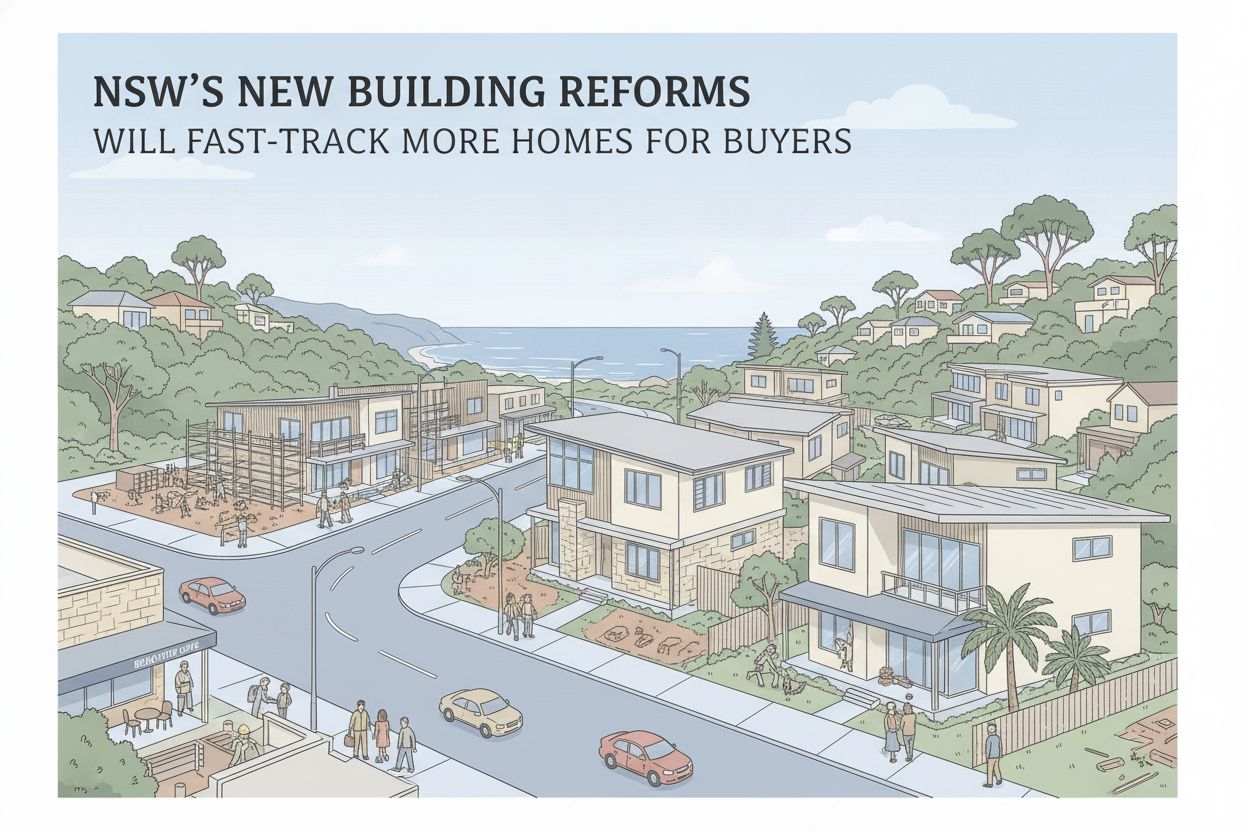
NSW Parliament has just passed the most significant building reform package the state has seen in decades. The Building (Approvals and Practitioners) Bill 2026 cleared Parliament in early August, backed by $32.3 million in Budget funding to modernise building approvals, integrate digital systems, and pilot AI tools for faster processing. This is a coordinated push spanning approvals, construction methods, planning fast-tracks, and financial levers, all aimed at getting more homes to market faster. For anyone looking to buy in NSW, these reforms will directly affect what gets built, how quickly, and at what cost.
The Reform Package at a Glance: What Just Passed and Why
The centrepiece is the Building (Approvals and Practitioners) Bill 2026, which consolidates approvals, practitioner registration, and enforcement into a single framework. It repeals two older pieces of legislation and replaces decades of fragmented certification processes with one streamlined Act. The Bill also introduces stronger integrity measures: certifier penalties jump from $33,000 to $1.1 million for breaches of conflict-of-interest rules, and a new dispute resolution framework through Building Commission NSW reduces the need for costly court proceedings.
NSW needs roughly 75,000 new dwellings per year to meet its 377,000-home target under the National Housing Accord by 2029. It is tracking well short of that. The government has assembled a reform package that attacks the problem from multiple angles: alongside the Bill, there is the Housing Delivery Authority fast-track pathway, the NSW Housing Pattern Book, the $1 billion Pre-Sale Finance Guarantee, the $54 million Faster Assessments Incentive Program for councils, and the removal of the foreign investor surcharge for build-to-rent developments. Each lever removes a different bottleneck, and together they represent the most coordinated supply-side effort NSW has mounted in a generation.
Cutting Red Tape: How the New Approvals System Gets Homes Built Faster
The old approvals system was fragmented across multiple Acts, creating duplication, delays, and unnecessary costs. The new legislation removes the duplication between building and planning legislation. A single set of designs for duplicate apartment buildings now saves an average of $327,000 in design costs per block.
Staged approvals are a quiet but meaningful change. Construction can now begin, and occupants can move in, before every stage is finalised. Minor variations, like changing a door size or installing an external tap, can be approved within the framework without a new planning consent. The whole system is moving into a digital environment on the NSW Planning Portal, with pilot AI tools to speed up licence application processing. Property Council NSW executive director Katie Stevenson described the changes as creating “clearer pathways from design through to completion.” The reforms also strengthen accountability: certifiers now face fines of up to $1.1 million for conflict-of-interest breaches, up from $33,000, giving buyers more confidence that approvals are being handled properly. For buyers, less friction in approvals means homes arrive sooner.
Prefab Goes Mainstream: NSW Leads the Nation on Modern Construction
NSW is now the first Australian jurisdiction to formally recognise modern methods of construction in law. The legislation defines “prefabricated buildings” and sets clear rules for their manufacture, supply, transport, delivery, and installation. This is a significant shift: despite the benefits, prefabricated construction currently makes up less than 5% of new builds nationally, meaning there is enormous room for growth.
This matters because factory-built homes are faster and cheaper. The Commonwealth Productivity Commission found MMC can reduce building costs by up to 20% and build homes up to 50% faster than traditional on-site construction. The government is also inviting MMC operators to partner on a Modern Methods of Construction Innovation Facility to deliver Pattern Book designs at scale, backed by nearly $4 million in innovation grants. Housing Minister Rose Jackson said plainly: “Prefabricated and modular homes are no longer fringe options. They are central to our housing solutions.” For buyers, this means more homes delivered faster, built to consistent quality in controlled factory environments, and at lower cost.
The Fast-Track Authority: 150,000 Homes in the Pipeline
The Housing Delivery Authority, operating since December 2024, has built a pipeline of 150,000 potential new dwellings. It has evaluated more than 1,100 expressions of interest and declared 484 proposals as State Significant, bypassing local council assessment processes and cutting assessment times by roughly one-third.
The pipeline spans approximately 134,000 homes in Greater Sydney and about 16,400 across roughly 50 regional local government areas. While only 14 projects have received final approval so far (about 2,500 homes), another 74 development applications have been formally lodged, representing roughly 26,000 homes. Developers granted State Significant status must lodge formal applications within nine months and commence construction within 12 months of approval, ensuring the pipeline converts to real homes. Active approvals are up 20% compared with 2023, and about 80,000 homes are currently under construction across the state. Planning Minister Paul Scully said the HDA has “far exceeded expectations,” and it is now a permanent fixture.
Making Projects Stack Up: Financial Levers That Get Dirt Moving
Planning approval does not automatically mean shovels in the ground. The government has introduced several financial measures to close that gap.
The $1 billion Pre-Sale Finance Guarantee is a revolving fund over five years where the NSW Government commits to buying up to 50% of homes in a development if pre-sales fall short. Support ranges from $5 million to $50 million per project, covering properties valued up to $2 million each. It has already accelerated more than 540 homes, backing projects including Landream’s $900 million Pyrmont Place development and the Elodie apartments at Westmead.
The 9% foreign purchaser duty surcharge has been removed for build-to-rent and retirement living developments. HIA chief economist Tim Reardon noted that foreign investment increases the total pool of construction capital rather than reallocating existing domestic investment. Separately, almost $54 million in incentive payments have gone to councils that accelerated development assessments, including Wollongong, Lake Macquarie, Blacktown, Cessnock, Parramatta, Port Stephens, Cumberland, and Campbelltown. Katie Stevenson said faster assessment is “one of the most effective ways to accelerate housing supply.”
The state budget has also allocated $6.6 billion to social housing, making it the single largest housing commitment in the package and ensuring that supply growth reaches those who need it most.
The Pattern Book: Architect-Designed Homes on a Fast-Track Pathway
The NSW Housing Pattern Book offers pre-approved, architect-designed home plans with a planning pathway that aims for approval in as little as 10 days. The designs came through an international competition that attracted 212 entries, with winning firms including Other Architects, Officer Woods, Neeson Murcutt Neille, Andrew Burges Architects, and Spacecraft Architects.
The patterns cover low-rise types (semi-detached, terraces, manor homes, row homes) and mid-rise apartments of three to six storeys. Every design is light-filled, cross-ventilated, all-electric, and achieves a 7-Star NatHERS energy rating. The government has subsidised the design costs so builders and buyers can access them affordably. For someone building on a subdivided block, undertaking a dual-occupancy project, or developing a small-scale multi-home site, the Pattern Book compresses a traditionally slow, expensive design-and-approval process into weeks, making architect-designed quality accessible to everyday buyers.
Conclusion
NSW’s reform package is the most coordinated effort in decades to tackle housing supply, and it is already producing results. Consolidated approvals with stronger accountability, formal recognition of prefabrication, a 150,000-home fast-track pipeline, financial guarantees that get projects over the line, council incentive payments, $6.6 billion for social housing, and architect-designed Pattern Book homes with a 10-day approval pathway: these levers are working in concert. More homes are coming. They will be built faster and more affordably. Buyers who understand these changes can make more informed decisions, whether they are looking for an apartment, a house, or a block to build on.
Frequently Asked Questions
What is the NSW Building (Approvals and Practitioners) Bill 2026?
The Building (Approvals and Practitioners) Bill 2026 is legislation passed by NSW Parliament in August 2026 that consolidates the state’s fragmented building approvals, practitioner registration, and enforcement into a single Act. It repeals the Design and Building Practitioners Act 2020 and the Building and Development Certifiers Act 2018, replacing them with one streamlined framework. The Bill makes NSW the first Australian jurisdiction to formally recognise modern methods of construction in law and introduces staged approvals, digital pathways, and a new dispute resolution framework through Building Commission NSW. It also increases certifier penalties from $33,000 to $1.1 million for conflict-of-interest breaches.
How do the NSW building reforms help home buyers?
The reforms help buyers by increasing the supply of new homes coming to market, reducing construction costs, and shortening build times. Faster approvals through the Housing Delivery Authority and the Pattern Book pathway mean more homes become available sooner. The Pre-Sale Finance Guarantee helps projects secure finance to break ground, turning approved-but-unbuilt projects into real homes for sale. Modern methods of construction can make homes up to 20% cheaper and 50% faster to build. The Pattern Book also gives buyers access to high-quality, architect-designed homes that are energy-efficient and affordable.
How does the NSW Housing Delivery Authority fast-track approvals?
The Housing Delivery Authority evaluates major housing proposals and can declare them State Significant Developments, bypassing local council assessment processes and cutting assessment times by roughly one-third. The HDA has assessed more than 1,100 expressions of interest and built a pipeline of 150,000 potential new homes, including 134,000 in Greater Sydney and about 16,400 across approximately 50 regional local government areas. Developers must lodge formal applications within nine months and commence construction within 12 months of approval. The HDA is now a permanent fixture.
What are modern methods of construction and how do they make homes cheaper?
Modern methods of construction refer to the manufacture of building components or entire homes in controlled factory settings before transport and assembly on site. This includes prefabricated panels, modular pods, and fully factory-built homes. The Commonwealth Productivity Commission found MMC can reduce overall building costs by up to 20% and deliver homes up to 50% faster than traditional on-site construction. Factory production improves quality control, reduces weather delays, and cuts material waste. A single set of designs for duplicate apartment buildings saves approximately $327,000 in design costs per block.
What is the NSW Housing Pattern Book and how can it help me build a home?
The NSW Housing Pattern Book is a collection of pre-approved, architect-designed home plans with a fast-tracked planning pathway aiming for approval in as little as 10 days. The designs were created by award-winning architects through an international competition and cover low-rise homes (terraces, manor homes, dual occupancies) and mid-rise apartments. All patterns achieve a 7-Star NatHERS energy rating, are all-electric, and use sustainable materials, with the government subsidising design costs. The Pattern Book is suited to those building on a subdivided block, undertaking a dual-occupancy project, or developing small-scale multi-home sites.
How does the Pre-Sale Finance Guarantee help get more homes built?
The NSW Government’s $1 billion Pre-Sale Finance Guarantee commits the state to buying up to 50% of homes in a residential development if pre-sales fall short, giving lenders confidence to finance projects that might otherwise stall. Support ranges from $5 million to $50 million per project, covering properties valued up to $2 million each. It has already accelerated construction of more than 540 homes, with further approvals set to unlock more than 130 homes in regional NSW. Projects backed include Landream’s $900 million Pyrmont Place development.
How has NSW made it easier for councils to approve homes faster?
The NSW Government has provided almost $54 million in incentive payments to councils that accelerated their development assessment processes through the Faster Assessments Incentive Program. Councils including Wollongong, Lake Macquarie, Blacktown, Cessnock, Parramatta, Port Stephens, Cumberland, and Campbelltown received grants. These payments reward councils for hitting assessment-speed targets, creating a direct financial incentive to process applications faster. Combined with the Housing Delivery Authority pathway, these efforts have helped cut assessment times by roughly one-third and lift active approvals by 20% compared with 2023. Approximately 80,000 homes are currently under construction across the state.
What changes has NSW made to foreign investor rules for housing?
NSW has axed the 9% foreign purchaser duty surcharge for eligible build-to-rent and retirement living developments. The reasoning is that foreign capital is a major source of funding for build-to-rent projects in Australia, and attracting more of it increases the total pool of construction capital rather than reallocating existing domestic investment. HIA chief economist Tim Reardon described the original surcharge as a “policy own goal” that was deterring investment needed to boost housing supply. The change is designed to unlock new large-scale rental housing that would not otherwise proceed, boosting supply for renters and future buyers.
How many homes does NSW need to build and how far behind is it?
NSW is committed to delivering 377,000 new homes under the National Housing Accord by 2029, roughly 75,000 dwellings per year. The state is currently tracking at about 69% of that target, with 12-month building approvals running below 50,000. Approximately 80,000 homes are under construction statewide, and the Housing Delivery Authority has built a pipeline of 150,000 potential homes, though only a portion have reached the construction stage. The reform package is designed to close this gap by accelerating every stage from planning through to completion.
Which NSW councils are approving the most new homes?
Parramatta and The Hills Shire lead NSW in dwelling approvals, according to ABS data for May 2025 to April 2026. Parramatta approved 2,473 dwellings, followed by The Hills (2,348), Sydney (1,854), Canada Bay (1,770), and Wollongong (1,363). Rounding out the top 10 are Bayside, Sutherland, Inner West, Canterbury-Bankstown, and Ryde. Only Canada Bay and Hawkesbury were meeting both their development and building approval targets as of mid-2026. The HDA pathway and Transport Oriented Development reforms have helped high-performing councils accelerate larger apartment projects.
Are prefabricated homes the same quality as traditionally built homes?
Yes, and in many cases they can offer higher quality than traditional on-site construction. Modern prefabricated homes are built in controlled factory environments with quality assurance at every stage, eliminating weather exposure during construction. The NSW reforms maintain the same building standards for factory-built and site-built homes. Pattern Book designs that are compatible with MMC achieve a 7-Star NatHERS energy rating, are all-electric, and use sustainable materials. PrefabAUS executive chairman Damien Crough said the reforms provide “a clearer legislative foundation for modern construction methods while maintaining the rigorous building standards that Australians rightly expect.”
When will NSW buyers start seeing the impact of these reforms?
The reforms are already producing results. The Housing Delivery Authority has a 150,000-home pipeline with projects moving through to final approval. The Pre-Sale Finance Guarantee has accelerated more than 540 homes since launch. Assessment times have been cut by roughly one-third and active approvals are up 20% compared with 2023. The Bill, passed in August 2026, will take effect as regulations and digital systems roll out through 2026 to 2027, backed by $32.3 million in budget funding. The full construction impact will build over the next one to three years, consistent with timelines seen when similar reforms were introduced in Auckland and New York.