
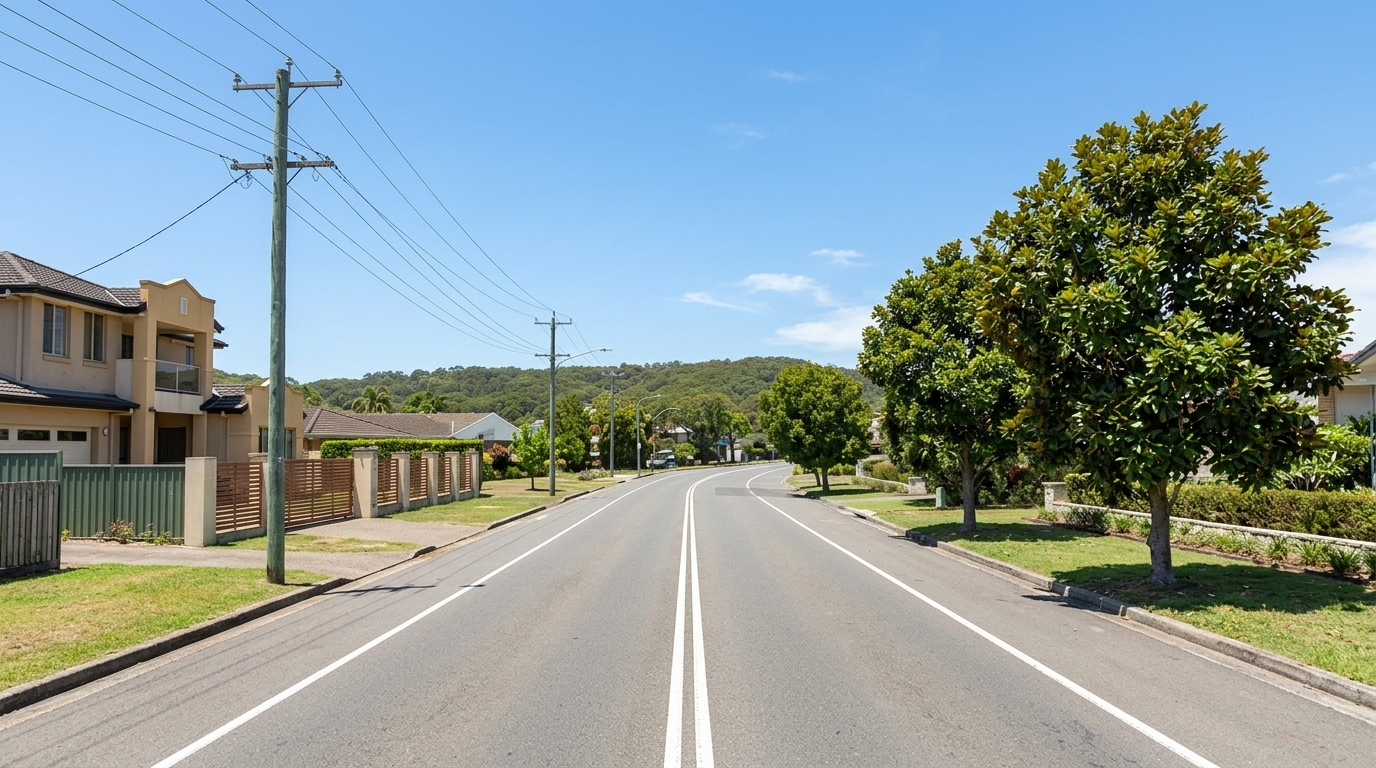
St Huberts Island is not the sort of suburb where the rent-versus-buy decision comes down to a quick spreadsheet. It is a fully built-out canal estate of roughly 510 dwellings, encircled by Brisbane Water and reached by a single bridge on Helmsman Boulevard. The 2021 Census counted 1,080 residents across 448 occupied private dwellings, with a median age of 58, and around one in eight homes sat empty at census time.
Roughly nine in ten homes are owner-occupied, and that share of empty homes points to a healthy presence of holiday and secondary residences, according to Domain. Every block is already built on, the island is bounded by water and conservation land, and there is no room for new supply. You are weighing a scarce, growth-led waterfront purchase against a rental market with a thin pool of listings and rents that keep rising.
The Market at a Glance: What Buyers and Renters Are Actually Facing
Buying and renting on St Huberts Island both sit at premium price points next to the wider Central Coast. The median house price is around $1.9 million to $2 million, with realestate.com.au recording about $1,900,000 and propertyvalue.com.au recording $2,000,000. StMate puts the typical range at an entry point of $1.39 million, a median of $1.95 million and a premium tier of $3 million, while the median listing price currently sits near $2,399,000 according to RealestateInvestar.
Renters face the same scarcity. The current median weekly rent sits roughly in the $845 to $875 range, with YIPM listing $845 and realestate.com.au and RealestateInvestar both around $875. AreaSearch, reporting NSW Rental Bond Board data, records $861 a week in the first quarter of 2026 across about 133 active rental bonds. That compares with $560 a week at the 2021 Census, a useful historical baseline. The number of homes actually available to rent is small. At any given time there are typically four or five rental listings, against roughly sixteen properties for sale, which keeps upward pressure on rents.
The Case for Buying: Scarcity, Waterfront Prestige, and Long-Term Growth
Buying on St Huberts Island is a play on scarcity and appreciation rather than rapid churn. Prices have risen around 108% over the longer term, according to htag, and StMate shows compound growth of about 6.8% a year over the past four years. Over shorter windows, RealestateInvestar records median price growth of 5.21% over one year and 10.29% over two.
The NSW Valuer General data tells the same story. Across 400 recorded sales from 2001 to 2026, the overall median was $1,130,000. Sales in the most recent twelve months have ranged from about $1,030,000 for a compact block on Helmsman Boulevard through to $3,525,000 for a canal-front home on Marina View Parade, with the top of the market reaching $6,000,000 at 21 Long Arm Parade in October 2024, as shown in the property sales record for that home. Waterfront position drives the premium. Premium canal-front homes trade in a $2.5 million to $6 million band, standard canal-front homes sit around $1.8 million to $3.5 million, and dry blocks start from under $1 million.
Turnover is modest, roughly 30 to 40 sales a year, or 6% to 8% of stock. Of the 448 occupied dwellings, 97% are separate houses, many with a private pontoon.
The Case for Renting: What the Rental Market Actually Offers
Renting on St Huberts Island means choosing from a small pool of homes. The median weekly rent sits around $845 to $875, with property.com.au around $875 and AreaSearch, reporting NSW Rental Bond Board data, recording $861 a week in early 2026, up 3.4% year on year. Longer term, rents have climbed strongly, with htag showing growth of roughly 46% over the past decade and RealestateInvestar showing a one-year median rent increase of 10.75%. Fresh rental supply arrives slowly too, with AreaSearch counting only around nine new bonds in the latest quarter.
Gross yields on houses land in a modest band of about 1.89% to 3.3%, depending on the source. RealestateInvestar puts it at 1.89%, htag at 1.91%, YIPM at 3.04% and realestate.com.au at 3.3%. AreaSearch notes that renting the median property costs around $44,772 a year, which implies a gross yield of about 2.5% at a $1,825,000 median. Demand spans long-term tenants who want the waterside lifestyle and holiday renters drawn to the canals, beaches and pontoons. A renter here is choosing lifestyle access over asset ownership in a low-supply market.
The Investor’s Equation: Yield vs Growth
St Huberts Island is a capital-growth market, not a cash-flow one. Gross yields sit in that 1.9% to 3.3% band, well below a cash-flow-focused suburb. The 2021 Census shows the gap: the median monthly mortgage repayment was $2,800, against a median weekly rent of $560, while the median weekly household income was $1,605, per StMate. The wealth here sits in the property itself rather than in high local incomes, and rental income was never designed to fully service a purchase.
That points to the strategy: buying to hold, with the return coming mostly from scarcity and capital growth. The evidence is the 108% longer-term price movement recorded by htag, the 6.8% annual compound growth over four years, and recent sales reaching $6 million. This is a quality-over-cash-flow suburb, suited to investors who want a prestige waterfront asset and are comfortable waiting for appreciation rather than banking a large weekly rent.
Buying to Live vs Renting to Invest: The Rentvesting Angle
For many buyers the smartest move on St Huberts Island is buying to live in it. The lifestyle is the draw. Private pontoons put kayaking, paddleboarding, fishing and boating at the front door, and the calm internal canals are ideal for it. Ettalong Beach and Umina Beach are each about a five minute drive away, and Woy Woy is a 5 to 10 minute drive, while the 35-minute Palm Beach ferry leaves from Ettalong Wharf, as this local guide explains.
The island is purely residential, with no shops or commercial precinct. That is part of its quiet appeal; residents rely on Ettalong, Umina and Woy Woy for dining, the weekend Ettalong Markets and the waterfront Diggers Club. With around 90% of homes owner-occupied and a median age of 58, most owners are living in their asset, which reinforces the buy-to-hold-and-enjoy mindset.
Rentvesting, renting where you live while investing elsewhere for growth, is a valid strategy. On St Huberts Island, the limited rental pool makes buying to live the more natural fit; if you want the waterfront lifestyle and the growth, you generally have to own the home rather than rent it.
What It Costs: Entry Points and Expectations
There is an entry tier and a prestige tier, so investors have genuine choice within a premium suburb. Dry blocks and non-canal homes run from about $840,000 to $1.8 million for detached homes, with recent sales at $840,000 for 59 Helmsman Boulevard and $1,030,000 for 55 Helmsman Boulevard. A compact unit at 1/65 Helmsman Boulevard changed hands for $790,000 in mid-2024. The entry tier extends a little lower for smaller dwellings. Standard canal-front homes run from about $1.8 million to $3.5 million, including $2,400,000 at 7 Mooring Place and $3,400,000 at 13 Mercator Parade.
At the top end, premium canal-front positions reach $2.5 million to $6 million, led by $6,000,000 at 21 Long Arm Parade and $4,850,000 at 9 Boyd Close, per StMate. On the rental side, expect a median around $845 to $875 a week, with YIPM listing $845 and RealestateInvestar $875. Knowing both numbers lets you model your own position, whether you are buying to hold, buying to live, or weighing the rent alternative.
The Bottom Line for Investors
St Huberts Island rewards patient, growth-minded investors who value a scarce waterfront asset. Buying here is a decision about capital growth and scarcity, and renting is a limited-supply option with rising rents and steady lifestyle demand. The right call comes down to what you are chasing: cash flow, or a prestige long-hold.
Waterfront exclusivity, a strong community organised around the residents’ association, and a physical limit on new supply underpin the island’s long-term outlook. If you want to talk through how a St Huberts Island purchase or rental fits your plan, the team at Stone Real Estate is the place to start that conversation.
Frequently Asked Questions
Is St Huberts Island a good place to buy an investment property?
St Huberts Island suits patient, growth-led investors. It has a roughly 90% owner-occupied market, tightly held stock and long-term price appreciation of around 108%, with compound growth of about 6.8% a year over four years. It is a buy-and-hold suburb, not a quick-turnover one.
What is the median house price on St Huberts Island?
The median house price sits around $1.9 million to $2 million, with realestate.com.au around $1,900,000 and propertyvalue.com.au around $2,000,000. StMate records a typical range of $1.39 million at entry, $1.95 million at the median and $3 million at the premium end, while recent sales have run from about $1.03 million to $6 million depending on water access.
What rental yield can investors expect on St Huberts Island?
Gross yields land in a rough 1.89% to 3.3% band depending on the source, from RealestateInvestar at 1.89% to realestate.com.au at 3.3%. This is a growth-led market rather than a high-yield one, so investors should expect modest rental returns alongside stronger capital appreciation.
What is the median weekly rent on St Huberts Island?
The current median weekly rent is roughly $845 to $875, with AreaSearch reporting NSW Rental Bond Board data of $861 a week in the first quarter of 2026. The 2021 Census figure of $560 is a useful historical baseline that shows how strongly rents have moved since.
Is there steady rental demand on St Huberts Island?
Yes, but supply is thin. Only about 10% of dwellings are rented, there are typically four to five rental listings at a time, and around 133 active bonds are in place, with only about nine new bonds recorded in the latest quarter. Demand comes from long-term tenants and holiday renters drawn to the waterfront lifestyle.
Should I buy to live in or buy purely as an investment on St Huberts Island?
For most buyers, buying to live is the natural fit on St Huberts Island. The private pontoons, calm canals and five minute drive to Ettalong and Umina are best enjoyed from inside the home, and a 90% owner-occupied suburb is built for owners. Buying purely as an investment works if you are comfortable with modest yield and long-term growth.
How does St Huberts Island compare with nearby suburbs for investors?
St Huberts Island is wealthier, older and more uniformly premium than its neighbours. Daleys Point is quieter and bushier, while Ettalong Beach is more tourist-facing with more rental stock. St Huberts Island offers the most consistently premium waterfront product of the three.
What types of properties are available on St Huberts Island?
About 97% of dwellings are detached houses. You will find canal-front homes with private pontoons, Brisbane Water-front homes, and dry blocks without water frontage. Prices span four rough tiers, from entry-level dry blocks under $1 million to premium canal-front homes up to $6 million.
Is St Huberts Island better for capital growth or rental income?
Capital growth, clearly. Yields are modest at roughly 1.9% to 3.3%, while longer-term price growth has run around 108% and recent sales have reached $6 million. It suits long-hold investors who prioritise appreciation over cash flow.
Can I earn holiday/short-term rental income on St Huberts Island?
Yes. Waterfront homes on St Huberts Island are popular with short-term holiday renters seeking the canal and beach lifestyle, which can provide owners with a supplementary income stream on top of long-term holding.