
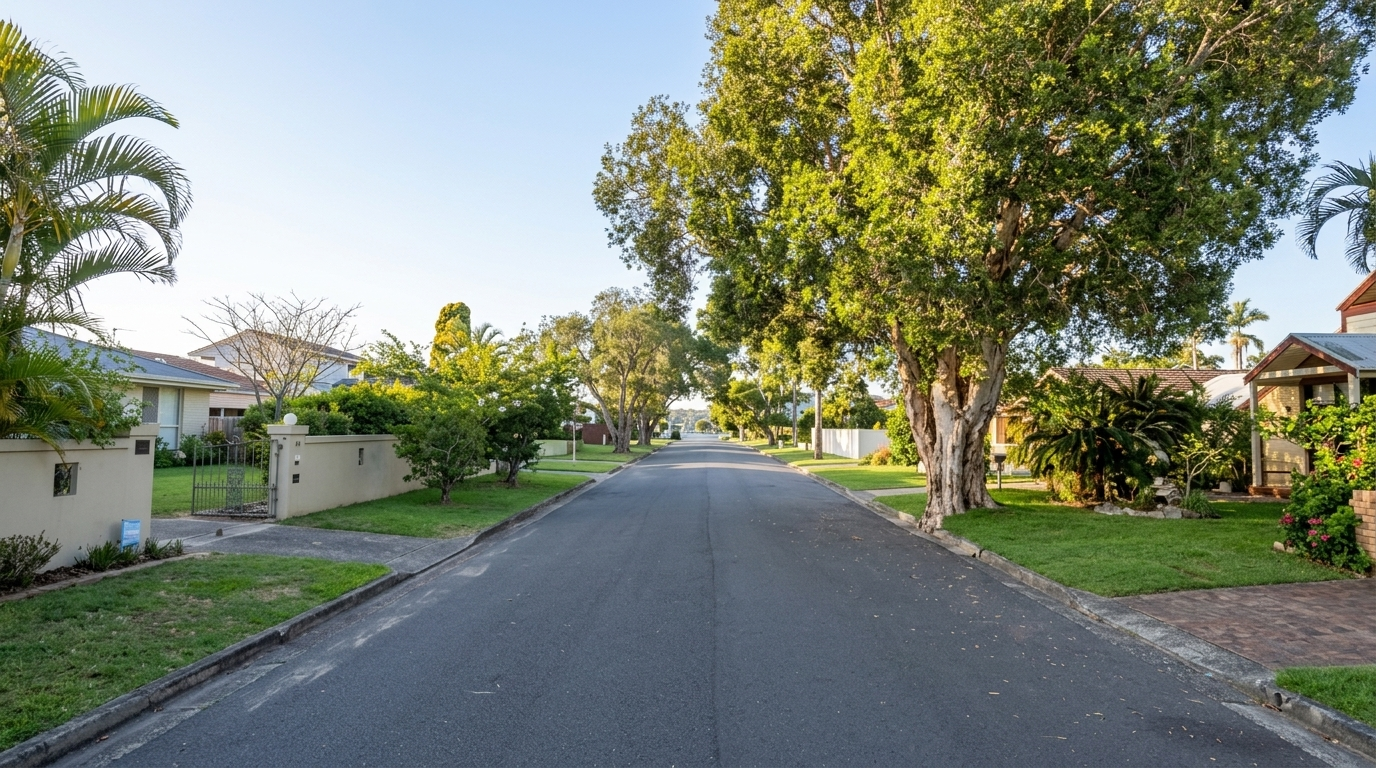
Selling on St Huberts Island is not like selling a standard Central Coast home. You are offering one of roughly 510 private dwellings on a small canal-estate island in Brisbane Water, reached by a single bridge on Helmsman Boulevard, where nearly every home faces an internal canal or the open water. The buyer pool is specific, and the choice between auction and private treaty is a real strategic decision, not a formality.
The island is tightly held and almost entirely houses. The 2021 Census counted 434 separate houses, about 97% of occupied dwellings, with a median age of 58. A share of the island’s homes sat unoccupied at census time, a sign of steady holiday-home and secondary-residence demand.
The two ways to sell, simply explained
Private treaty is the familiar path. You advertise an asking price, buyers make offers, and you negotiate through your agent. There is no fixed finish line, which suits sellers who want room to consider each offer as it arrives.
Auction is the public, time-bound alternative. Buyers bid at a set time and place, and the home sells to the highest bidder provided bidding reaches your reserve. Finder describes both methods in exactly these terms: private treaty for negotiated offers against a price, auction for open competition.
NSW regulates both methods tightly, so you can compare them on strategy rather than uncertainty. Before an auction you set a reserve price in writing, and it is usually not disclosed to buyers. The auctioneer may make a single vendor bid on your behalf and must announce it as such. If bidding falls short of the reserve, the property is passed in and the highest bidder generally gets the first chance to negotiate. Those rules are set out in the NSW Government auction guide.
One difference matters most to sellers. An auction sale is unconditional once the hammer falls, with no cooling-off period, which gives you certainty the moment the campaign ends.
Why an auction often suits St Huberts Island
Auctions earn their keep when a property is hard to value. Finder notes that auctions suit unique or high-end homes with few comparable sales, and that a room of competing buyers will often stretch further than a single buyer in a private negotiation. The public setting and fixed deadline can push bidders past the figure they planned on.
That describes much of St Huberts Island. There is almost no unit stock and only about 30 to 40 recorded sales a year across roughly 510 dwellings. When a one-off deep-water home comes up, there is often nothing recent and identical to benchmark it against. Premium canal-front results spread from about $2.5 million to $6 million depending on block size, finish and water position, which makes many island homes hard to value against recent sales.
Auction also compresses the timeline. LocalAgentFinder explains that a public auction concentrates competition into a fixed campaign of around four to six weeks and creates urgency through a clear deadline. Sales such as 21 Long Arm Parade at $6,000,000 in October 2024 and 9 Boyd Close at $4,850,000 in September 2024 show the wide spread that makes an asking price difficult to set and competitive bidding useful.
Why private treaty is a strong fit for many island sellers
Not every St Huberts Island home needs a bidding war. Finder’s guidance is that private treaty suits sellers without a hard deadline, and homes within a clear band of similar properties. That covers much of the island.
A large share of island residents are long-term owner-occupiers, many owning outright and moving at their own pace, which suits a calm, negotiated process free of campaign pressure. When the home is a standard canal-front or dry block, there are plenty of recent sales to anchor an asking price. Set that price realistically at fair market value and the campaign can still move quickly.
Private treaty is also a mainstream path nationally. Around 45% of new listings went to auction in late 2025, leaving auction a minority route and private treaty a standard, widely used alternative rather than a compromise.
Reading the St Huberts Island market right now
Whichever way you lean, the current market gives you a strong starting point. realestate.com.au puts the median house price at about $1,925,000, based on 18 house sales in the past 12 months, and reports buyer demand up about 11% over the same period. OnTheHouse shows median house value up 7.29% over the past year.
The past 12 months ran from $1,030,000 at 55 Helmsman Boulevard to $3,525,000 at 4 Marina View Parade, according to the suburb’s recent sales. Turnover sits at roughly 30 to 40 sales a year, about 6 to 8% of dwellings, keeping supply tight.
With demand up and supply tight, the decision comes down to the price band and buyer type your property is likely to attract, not to timing.
Matching the method to your property
A simple decision map helps. Premium, one-of-a-kind deep-water homes tend to favour auction because comparable sales are scarce and competition can find the ceiling. Standard canal-front and dry-block homes tend to favour private treaty because recent sales make an asking price easier to set.
Premium results are instructive. 9 Mercator Parade sold for $3,200,000 and 13 Mercator Parade for $3,400,000, both in December 2025, while 21 Long Arm Parade reached $6,000,000 in October 2024. Because these homes differ by water position, a public auction lets the market decide what a distinctive property is worth.
For standard canal-front homes, the comparables are more plentiful. 5 Mooring Place sold for $3,050,000 in April 2026, 20 Marina View Parade for $3,400,000 in September 2025, and 35 Helmsman Boulevard for $2,500,000 in November 2025. That gives a seller evidence to price confidently and negotiate calmly under private treaty.
At the entry level the pattern is clearer still. 55 Helmsman Boulevard sold for $1,030,000 in May 2025, 59 Helmsman Boulevard for $840,000 in February 2024, and the unit at 1/65 Helmsman Boulevard for $790,000 in June 2024. A dry block with a well-supported asking price rarely needs an auction to find its buyer.
The waterfront appeal carries the listing regardless of method. Private pontoons, deep-water access, kayaking, paddleboarding, fishing and direct boating out to Brisbane Water are the hooks that draw buyers to the island. The method you choose is really about packaging that appeal for the right buyer.
Your next step: a local appraisal and a clear plan
Neither method is right for every home, so begin with a current, property-specific appraisal rather than a one-size-fits-all rule. The island’s sale prices run from $790,000 to $6,000,000, so each campaign needs its own plan.
A local appraisal makes the decision concrete. It shows where your home sits in the island’s price bands, which buyers are active now, and whether a four-to-six-week auction campaign or a calm private treaty listing fits better. Stone Real Estate can provide that appraisal and tailor the sale method to your property and timeline.
Certainty starts with the right method
There is no single right answer for every St Huberts Island home. Auction gives competition and a fixed deadline, while private treaty gives negotiation and flexibility. Match the method to your property, timeline and current buyer demand.
The fundamentals are in your favour: a waterfront lifestyle that is hard to find elsewhere on the Central Coast, a median house price around $1.9 million, buyer demand up about 11%, and a tight supply of comparable sales. Choose the method that reflects those strengths and you give your campaign its best chance.
Frequently Asked Questions
What is the difference between auction and private treaty on st-huberts-island?
Private treaty means you advertise an asking price and negotiate offers as they arrive. Auction means buyers bid publicly and the home sells to the highest bidder once your reserve is met. An auction sale is unconditional, with no cooling-off period.
Which sale method gets a higher price on st-huberts-island?
There is no universal winner. Auction often suits unique, hard-to-value waterfront homes where competition can find the ceiling. Private treaty suits homes with clear comparable sales. With a median house price around $1,925,000 and buyer demand up about 11%, both methods can perform.
Is auction common on st-huberts-island?
Turnover is low at roughly 30 to 40 sales a year, so auctions are not an everyday event. Premium waterfront homes often lean toward auction, while private treaty remains a mainstream path for standard canal-front and dry-block homes.
What is a reserve price and how is it set on st-huberts-island?
The reserve is the minimum price you will accept. It is set in writing before the auction and usually not disclosed to buyers. If bidding reaches the reserve, the home sells to the highest bidder.
What happens if a property is passed in at auction on st-huberts-island?
Bidding did not reach the reserve, so the highest bidder generally gets the first opportunity to negotiate. It is a normal part of the process and often leads to a sale shortly after.
Does selling by private treaty take longer on st-huberts-island?
Not necessarily. A realistically priced private treaty listing can move quickly. The timeline is driven by pricing and buyer interest more than by the method itself.
Can a buyer make an offer before an auction on st-huberts-island?
Yes. Sellers may accept a pre-auction offer and bring the campaign forward, keeping flexibility within the auction process.
Which method suits a premium canal-front home with a private pontoon on st-huberts-island?
Consider auction. Scarce, hard-to-value deep-water homes often benefit from competition, as recent results from $3.2 million to $6 million show. A public campaign lets the market find the ceiling for a distinctive waterfront property.
Which method suits a dry-block or entry-level home on st-huberts-island?
Private treaty is a strong default. Dry-block and entry-level homes have more comparable sales to anchor an asking price, as sub-$1.8 million results such as 55 Helmsman Boulevard at $1,030,000 demonstrate.
Do I need a local appraisal before choosing a sale method on st-huberts-island?
Yes. A current, property-specific appraisal and local buyer insight are the best basis for the decision. Stone Real Estate can provide both.
Is there a cooling-off period if my home sells at auction on st-huberts-island?
No. An auction sale is unconditional with no cooling-off period. That gives you certainty once the hammer falls.
How do I choose the right agent for my sale method on st-huberts-island?
Look for local market knowledge and a marketing plan tailored to the island’s waterfront buyer pool. Stone Real Estate can guide the method choice and build the campaign around your property.