
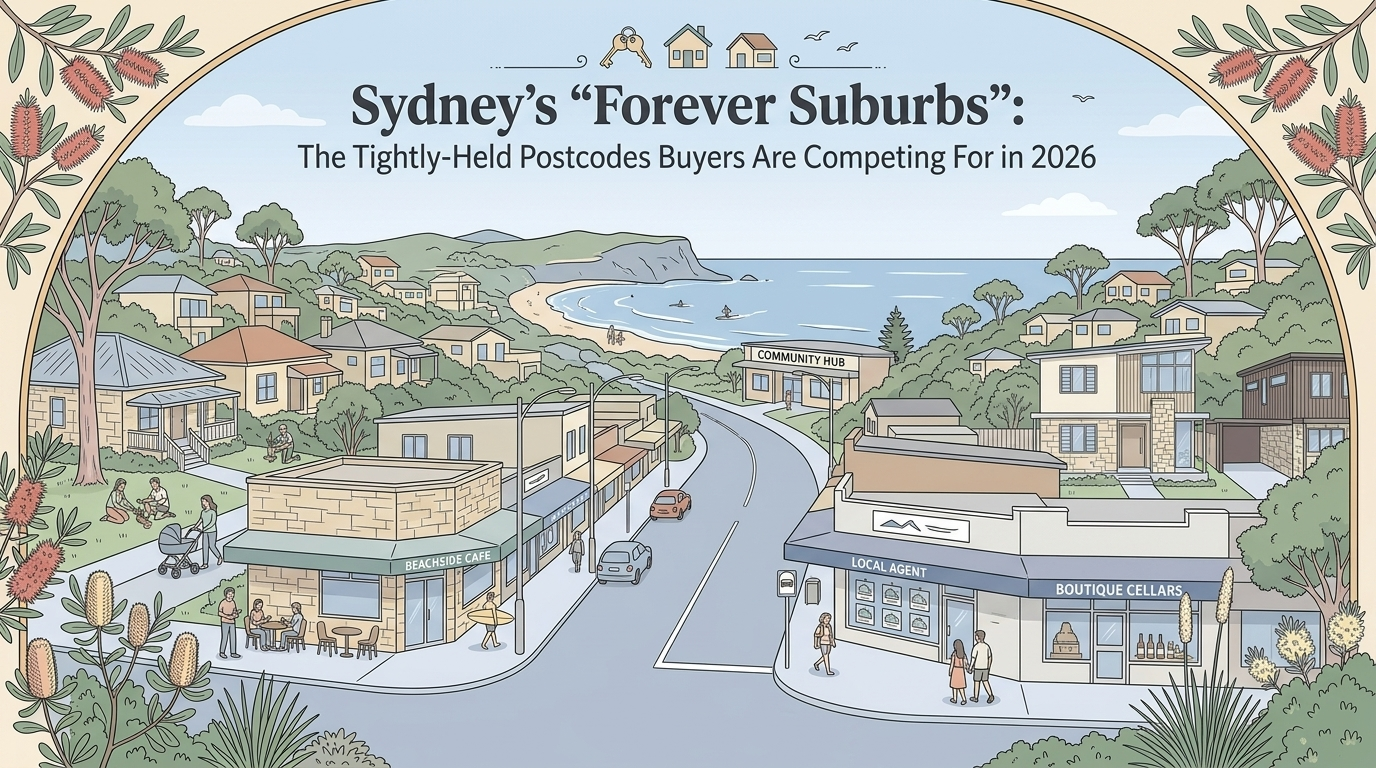
Some Sydney postcodes barely trade. Owners stay for two or three decades at a time, so a single new listing becomes something close to an event. In 2026, even as Sydney house prices ease about 5 per cent over the year, the tightly-held pockets still pull intense competition.
Meredith Bernays and her husband Shane Doyle lived that story from the inside. They bought a semi in Wareemba in 1994, raised their daughter there and only listed the home after three decades. “We’ve always just been happy here. We never really needed to move,” Bernays said.
As REA Group senior economist Anne Flaherty puts it, suburbs that “meet the needs of people at different life stages” hold their residents the longest. Here is what to know when one of these postcodes finally comes to market.
What Makes a Suburb a ‘Forever Suburb’
A hold period measures the years between a home being bought and its next sale, reported either as a median or an average. A long one points to deep-rooted residents rather than churn. Nationally, the average ownership period has stretched to about 11 years, up 23 per cent over the past decade, while Sydney’s median hold period sits at 10.3 years on Cotality’s measure.
The suburbs that clear that mark share familiar hallmarks. Strong schools, especially high schools, anchor families through the schooling years and beyond. Parks, water access, transport and everyday amenity carry the rest, alongside an older median age, a high share of owner-occupiers and housing that lets people age in place. Many of them also clear the bar of a 20-minute neighbourhood, where most daily needs sit within about 800 metres. Buyer interest in that style of living rose from 38 to 43 per cent between 2024 and 2026.
Sydney’s Longest-Held Postcodes, House by House and Unit by Unit
Cotality data on median hold periods for houses sold in the 12 months to June names Bringelly in the south-west first at 28.1 years, ahead of Northwood in the Lane Cove area at 27.3 years and Wareemba in the inner west at 27 years. Each is close to three times the Sydney median.
PropTrack’s table of average years between sales fills in a cluster around the 20-year mark for houses: Hurlstone Park (20.4), Bexley North (20.2), Greenfield Park (20), Dulwich Hill (19.7), Bonnyrigg Heights (19.6), Naremburn (19.3) and North Epping (19), with Croydon, Chipping Norton and Collaroy level at 18.8.
The unit market has its own leaderboard, and it leans toward the harbour and the lower north shore. Cremorne Point leads the country at 18.3 years, then Waverton (17), Abbotsford (15.6), Bronte (15.4), Oatley (15.3), Wollstonecraft (15.1), Beverly Hills and Edgecliff (15), Narwee (14.9) and Cremorne (14.7).
On the national lists, Kirribilli is Australia’s most tightly-held suburb at about 24 years with a median house price near $4.6 million, while Bundeena sits at 22.8 years and Arncliffe at 21.2 years. Wareemba shows the pattern in miniature: 40.5 per cent of its homes were owned outright, against 31.5 per cent statewide.
Why Owners Stay: Schools, Water, and the Stamp Duty Effect
Well-regarded school zones, particularly for high schools, keep families in place through the schooling years and beyond. The typical tightly-held home is a freestanding house built between the 1950s and 1990s, or a low to medium-density townhouse, villa or duplex.
Amenity and lifestyle do the rest. Proximity to water, parks and the harbour, plus a village feel, leaves residents little reason to move. The pull is strongest on the water, where unit owners in places like Cremorne Point say living there feels like a holiday, with harbour views, a waterside walkway and a short ferry into the city. As Cotality head of research Gerard Burg puts it, once you are in, you do not want to leave the area because you enjoy the advantages it offers.
Stamp duty is the financial lock-in. As Flaherty explains, “In more expensive suburbs, the stamp duty cost is so much higher that you have a much greater incentive to hold that property for longer, because it’s a big financial penalty every time you move.” The dollar figures show why: a standard purchase at Sydney’s median dwelling value attracts about $36,000 to $37,000 in NSW transfer duty, a median Paddington house more than $180,000 and the median Bellevue Hill house $671,697. Demographer Mark McCrindle adds the emotional layer: the location becomes part of their identity, whether someone thinks of themselves as an inner west person or a harbourside person.
When a Forever Suburb Finally Lists, Buyers Move Fast
Scarcity turns every listing into a draw. Take Howth at 11 Calvert Parade, Newport, a three-bedroom 1930s beach cottage on an absolute beachfront block that hit the market for the first time in its 90-year history. Comparable Northern Beaches sales were cited between $12.2 million and $17.5 million.
Many quality homes in tightly-held streets sell before they are publicly listed, with agents approaching qualified buyers first. The visible market understates how much demand is really circling.
Buyer enquiry per listing more than doubled over 12 months in Austral (+239 per cent), Rosebery (+233 per cent), Wagga Wagga (+231 per cent), Bathurst (+226 per cent), Leppington (+221 per cent) and Cessnock (+192 per cent).
Policy is adding another reason to hold. The 12 May federal budget moves to abolish negative gearing on established properties bought after that date from 1 July 2027 and replace the 50 per cent capital gains tax discount with inflation indexation, while existing owners are grandfathered and new builds stay exempt. Flaherty calls that grandfathering a very strong incentive for current owners not to sell, and economist Dr Diaswati Mardiasmo notes that people tend to hold when there is so much change happening. Three consecutive cash-rate rises between February and May took the cash rate to 4.35 per cent and, according to Canstar, cut maximum borrowing capacity by about $25,000 for a single average-income earner and $49,000 for a couple, which keeps even more attention on the homes that do surface.
While Sydney house prices sit 7.1 per cent below their February peak, the median still sits around $1.58 million, within 2.5 per cent of its record. Analysts describe it as a correction that is rewarding quality, not a collapse.
Where Demand Is Doubling and Which Streets Pull the Most Views
Over the 12 months to August, Oak Road in Matcham drew the most views per listing at about 12,400, ahead of Millwood Avenue in Chatswood and York Street in Emu Plains at roughly 11,500 each. Picketts Valley Road in Picketts Valley, The Acres Way in Tahmoor, The Ridgeway in Lisarow, Griffin Place in Glebe, Brush Road in Wamberal, Wallamuta Road in Newport and Peach Orchard Road in Fountaindale round out the list.
The common thread is amenity, large blocks and leafy surrounds, often near Central Coast beaches and national parks. The listings themselves lean on the “tightly-held” label, describing Oak Road’s “tightly-held and exclusive enclave” and York Street as “one of Emu Plains’ most tightly held streets.” It ties back to liveability: Sydney scored 97 out of 100 on the 2026 Global Liveability Index, and McCrindle’s Urban Living Index rated Surry Hills, Crows Nest and Waverton highest at 85. Search interest is rising fastest in Cowan (+33 per cent), Kyeemagh (+22 per cent) and Faulconbridge (+20 per cent).
Conclusion
The through-line is simple. Sydney’s forever suburbs are a story of supply and loyalty, where the location, the schools, the amenity and the financial arithmetic all point the same way. When one of these homes finally lists, demand concentrates quickly.
For buyers, that means being ready before the listing appears: finance approved, a clear stamp-duty budget and a willingness to move fast, with an ear to the ground for off-market opportunities. For sellers, a rare listing commands attention in a market that rewards quality. These pockets keep their appeal across cycles, which makes them postcodes worth understanding whether you are buying, selling or simply watching.
Frequently Asked Questions
What are Sydney’s most tightly held suburbs in 2026?
Cotality data puts Bringelly (28.1 years), Northwood (27.3 years) and Wareemba (27 years) as Sydney’s longest-held house markets, each close to three times the city’s median. Nationally, Kirribilli is the country’s most tightly-held suburb at about 24 years with a median house price near $4.6 million, while Arncliffe sits at 21.2 years. PropTrack’s roughly 20-year cluster adds Hurlstone Park, Bexley North, Greenfield Park and Dulwich Hill.
Which Sydney suburbs have the longest average hold periods for houses?
PropTrack’s table of average years between sales is led by Hurlstone Park (20.4), Bexley North (20.2), Greenfield Park (20), Dulwich Hill (19.7) and Bonnyrigg Heights (19.6), followed by Naremburn (19.3), North Epping (19) and Croydon, Chipping Norton and Collaroy at 18.8 each. Cotality’s median-hold measure ranks Bringelly (28.1), Northwood (27.3) and Wareemba (27) highest.
Which Sydney suburbs have the longest average hold periods for units?
Cremorne Point leads the country for units at 18.3 years, ahead of Waverton (17), Abbotsford (15.6), Bronte (15.4), Oatley (15.3), Wollstonecraft (15.1), Beverly Hills and Edgecliff (15), Narwee (14.9) and Cremorne (14.7). The unit market skews toward higher-value inner-city and lower north shore locations with strong amenity and harbour access, where owners describe a permanent holiday feel.
What is the average hold period for a Sydney home?
Sydney’s overall median hold period is 10.3 years, a Cotality measure for houses sold in the 12 months to June. The national average ownership period has stretched to about 11 years, up 23 per cent over a decade, with the typical national holding period running 11.7 years for houses and 10.3 years for units. The tightly-held outliers stretch far beyond those baselines, which is what makes their listings rare.
Why do homeowners stay in tightly held suburbs for so long?
Strong schools, especially high schools, parks and water access, transport links and a village feel keep families in place through the schooling years and into retirement. Residents tend to be older owner-occupiers with homes suited to ageing in place. Demographer Mark McCrindle adds the emotional layer: the location “becomes part of their identity”, whether someone thinks of themselves as an inner west person or a harbourside person.
How does stamp duty make people hold their homes longer?
Every move triggers a fresh transfer-duty bill, so staying put is financially rewarded. As Flaherty puts it, “In more expensive suburbs, the stamp duty cost is so much higher that you have a much greater incentive to hold that property for longer, because it’s a big financial penalty every time you move.” A median-value Sydney purchase attracts roughly $36,000 to $37,000, a median Paddington house more than $180,000 and Bellevue Hill about $671,697.
How did the 2026 federal budget changes affect Sydney’s tightly held suburbs?
The 12 May budget abolishes negative gearing on established properties bought after that date from 1 July 2027 and replaces the 50 per cent capital gains tax discount with inflation indexation, while existing owners are grandfathered and new builds stay exempt. Flaherty says that grandfathering gives current owners a very strong incentive not to sell, and Dr Diaswati Mardiasmo notes that people tend to hold when there is so much change happening. The result is tighter supply and more attention on each listing.
Which Sydney suburbs had the biggest jump in buyer enquiry over the past year?
PropTrack data shows enquiry per listing has more than doubled across a string of NSW suburbs: Austral +239 per cent, Rosebery +233 per cent, Wagga Wagga +231 per cent, Bathurst +226 per cent, Leppington +221 per cent and Cessnock +192 per cent. Most sit outside Sydney’s priciest pockets, with median values in the regional spots around $700,000 to $800,000, reflecting affordability and lifestyle appeal.
Which Sydney streets attract the most views per listing?
Over the 12 months to August, Oak Road in Matcham averaged 12,400 views per listing, ahead of Millwood Avenue in Chatswood and York Street in Emu Plains at about 11,500 each. The top 10 also includes Picketts Valley Road, The Acres Way in Tahmoor, The Ridgeway in Lisarow, Griffin Place in Glebe, Brush Road in Wamberal, Wallamuta Road in Newport and Peach Orchard Road in Fountaindale, streets known for amenity, large blocks and leafy surrounds.
What should buyers do when a tightly held home finally comes up for sale?
Be ready before the listing appears. Have finance approved, know your stamp-duty budget and be prepared to move quickly, because competition concentrates fast when stock is scarce. Local knowledge matters too: many quality homes in tightly-held streets sell off-market before a public campaign, so buyers with early access to qualified listings are better placed to secure the right property when it surfaces.