
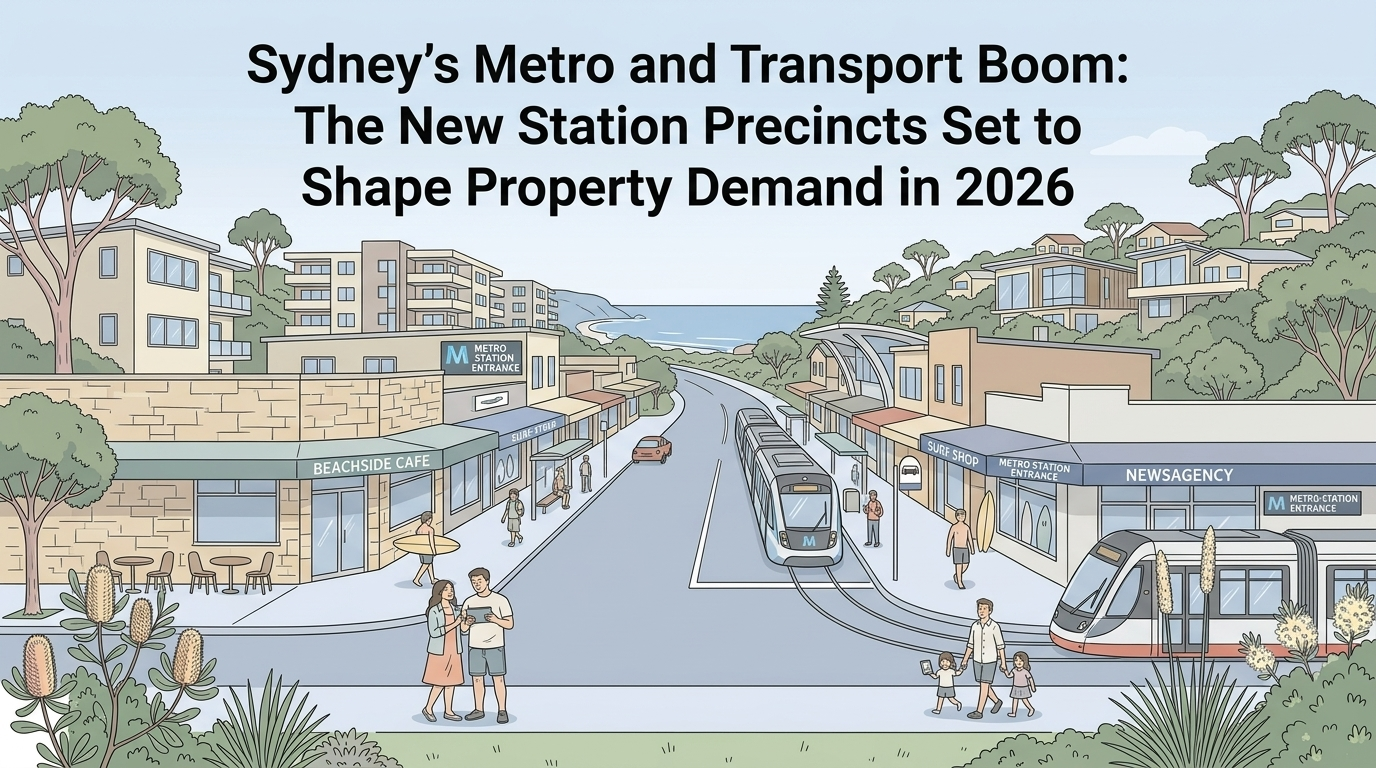
Sydney is building three metro lines at once, and each one arrives with its own wave of rezonings and “integrated station developments” that stack homes, jobs and open space directly around the platforms. All of it sits inside a national transport pipeline valued at $1.02 trillion. That is a lot of money moving into a small number of suburbs. Here is a practical guide to which precincts it will reshape, and how to read the difference between a station that lifts a suburb and one that does not.
Sydney’s Transport Build-Out, At a Glance
That $1.02 trillion figure covers 664 transport projects worth more than $100 million each, and NSW is among the biggest beneficiaries. Four of the ten markets tipped to boom sit in NSW: Bankstown, Parramatta and St Marys in Sydney, plus Raymond Terrace in the Hunter region.
Sydney is delivering three metro lines at the same time: the Southwest extension opening in the second half of 2026, the Western Sydney Airport line in April 2027, and Metro West targeting 2032. When it all connects, the network reaches 46 stations and 113 kilometres of track.
Metro West is the big one. The 24 kilometre line will double rail capacity between Parramatta and the CBD, moving 40,000 people an hour in each direction at morning peak, and cutting Westmead to the CBD to around 20 minutes. Tunnelling is now complete, with tracklaying set to begin at Sydney Olympic Park. As the report’s authors put it, investors seeking long-term growth are well advised to follow the infrastructure trail, and real estate that lies in the path of progress usually has superior rates of capital growth.
The Station Precincts Unlocking New Homes
The government is not just laying track. It is rezononing land around each station so the homes, shops and jobs arrive at the same time as the trains.
At Parramatta, the residential component has jumped from 111 homes to 970 under an $880 million contract, spread across four buildings: a 43-storey build-to-rent tower with 470 apartments, a 29-storey commercial tower, a 24-storey building with 500 student units, and an 8-storey hotel, all around a landscaped park.
Further out, Cherrybrook and Parramatta North have rezonings in place for about 12,000 homes combined: up to 10,000 beside Cherrybrook Metro, where a new town centre, five parks, a community facility and at least 560 affordable homes are planned, and around 2,000 more along the Parramatta Light Rail corridor. In the east, a 168-hectare Edgecliff-Woollahra rezoning plans up to 9,400 homes anchored on Edgecliff station and a proposed new Woollahra station about eight minutes from the CBD, with up to 40 per cent of new dwellings within 200 metres of a station. Bays West opens the harbour foreshore to the public for the first time in more than 100 years and plans up to 8,500 homes. Five Dock has a $1.9 billion, 840-apartment precinct fast-tracked, and Sydney Olympic Park has 490 approved homes with a Homebush proposal for up to 16,100 more behind it. In North Sydney, a vacant 3,132 square metre site beside Victoria Cross station has sold for redevelopment with twin-tower concept plans, another sign of how station-adjacent land is being turned into housing and services.
What the Price Data Shows About the Metro Premium
So what does a station actually add to a price? Domain’s analysis of the Metro North West line gives the clearest answer. Houses within 400 metres of a new station sold for 16.6 per cent more on average than comparable houses further away, roughly an extra $150,000 on a $900,000 home. Units within 400 metres sold for 24.4 per cent higher than apartments 800 metres to two kilometres out.
Some stations did far better. Bella Vista houses recorded 39 per cent premiums, Norwest 23.6 per cent, and Hills Showground 21.4 per cent.
Timing matters as much as distance. Those premiums peaked about one to two years before the line opened, because buyers price the future benefit in early. Academic research across three Sydney transport projects points the same way: heavy rail delivers a 12 to 15 per cent uplift within 800 metres once construction begins, and apartments respond earlier than houses. As Domain’s Dr Joel Bowman puts it, if you want additional value uplift from infrastructure projects, you need to get in nice and early.
The “What Surrounds the Station” Rule
The uplift is not uniform. The strongest gains have flowed to precincts where rezoning, a development pipeline and genuine amenity surround the station, rather than to stations in already well-served or commercially dominated areas.
Look at the same Domain data: Epping, which already had a railway, saw only a 2 per cent premium, and commercial-heavy Macquarie Park saw little house-price uplift at all. As Bowman says, it is not a blanket rule, so you need to choose your location wisely.
Cotality’s spatial analysis adds the same nuance from a different angle: metro catchments already carry a substantial premium, with rents up to 46.9 per cent higher than the Greater Sydney median. Buyers and renters alike are paying for convenience and amenity that already exists.
The practical reading is simple. Precincts with approved rezoning and an active pipeline, think Parramatta, Cherrybrook, Bays West, Five Dock and Edgecliff-Woollahra, are the ones best positioned to convert transport into sustained demand. The key variable, as one guide puts it, is not the station itself but what surrounds it.
The Wider Corridors Worth Watching
The immediate story is the Southwest. The Sydenham to Bankstown line opens in the second half of 2026 with 11 stations and a 28-minute Bankstown-to-Central trip, with Marrickville, Dulwich Hill and Campsie flagged for 8 to 12 per cent growth this year.
The $11 billion Western Sydney Airport line, six stations opening April 2027, anchors St Marys, where the median house sits near $1.1 million and units near $710,000 after roughly 12.5 per cent house price growth in the past year. Box Hill shows the long game: its 2013 rezoning unlocked 9,600 homes, and The Hills Shire is projected to approach 330,000 people by 2041.
City-wide, 67.2 per cent of Sydney residents already live within 800 metres of high-frequency public transport, and buyers pay up to 15 per cent more to be near a central hub. Connectivity is a durable, everyday value driver, not a passing theme.
Frequently Asked Questions
When does the Sydney Metro Southwest open and which suburbs will it affect?
The Southwest extension opens in the second half of 2026, converting 11 stations on the former T3 Bankstown Line between Sydenham and Bankstown. Trains run every four minutes at peak, and a Bankstown-to-Central trip takes 28 minutes. Marrickville, Dulwich Hill and Campsie are the suburbs flagged for 8 to 12 per cent growth in 2026 as the line comes online.
How much do property prices rise near new Sydney Metro stations?
On the Metro North West line, houses within 400 metres of a new station sold for 16.6 per cent more on average, about $150,000 extra on a $900,000 home, while units within 400 metres sold for 24.4 per cent more. Standouts were higher again: Bella Vista reached 39 per cent, Norwest 23.6 per cent and Hills Showground 21.4 per cent.
What stations are on the Sydney Metro West line and when will it open?
Metro West has nine stations: Hunter Street in the CBD, Pyrmont, The Bays, Five Dock, Burwood North, North Strathfield, Sydney Olympic Park, Parramatta and Westmead. The 24 kilometre underground line targets a 2032 opening and will double rail capacity between Parramatta and the CBD, moving 40,000 people an hour in each direction at morning peak. The Bays station will anchor the new Bays West precinct, one of the line’s largest housing opportunities.
Which Sydney suburbs are set to grow most from Metro West in 2026?
The precincts with approved rezoning and a development pipeline. Parramatta has 970 homes above the station, Five Dock has an 840-apartment precinct fast-tracked, Bays West has 8,500 homes planned, Sydney Olympic Park has 490 approved plus up to 16,100 more at Homebush, and Burwood North and North Strathfield are earmarked for up to 18,000 homes each.
How close do you need to be to a metro station to benefit from price growth?
The most consistent uplift sits within 400 metres, where houses recorded a 16.6 per cent premium and units 24.4 per cent. Strong premiums still show up 400 to 800 metres away, but the premium generally fades beyond about 800 metres to two kilometres, especially for units. Walking distance is the benchmark buyers keep citing.
Do you need to buy before a metro line opens to capture the price uplift?
Mostly, yes. Domain found that premiums peaked one to two years before the line opened, because buyers price the future benefit in early. After opening, the new supply arriving around stations tends to stabilise any further premium growth. Academic research across three Sydney transport projects shows heavy rail can deliver a 12 to 15 per cent uplift within 800 metres once construction begins, which is why positioning early tends to capture the strongest gains.
What is being planned for the Parramatta Metro station precinct?
Dwellings have been lifted from 111 to 970 under an $880 million contract. Four buildings between Church, Macquarie and George streets are planned: a 43-storey build-to-rent tower with 470 apartments, a 29-storey commercial tower, a 24-storey building with 500 student units and an 8-storey hotel, arranged around a landscaped park linking to the Powerhouse Museum and the river foreshore.
How many new homes are planned around Sydney’s new metro stations?
Tens of thousands. Parramatta has 970 homes, with a proposed Westmead South precinct of up to 13,000 nearby. Cherrybrook and Parramatta North combine for about 12,000, Edgecliff-Woollahra adds 9,400, Bays West 8,500 and Pyrmont 7,300. Sydney Olympic Park has 490 approved homes plus a Homebush proposal for up to 16,100 more, while Burwood North and North Strathfield are earmarked for up to 18,000 homes each. At Cherrybrook, the plans include a new town centre, five parks and at least 560 affordable homes.
Is the Western Sydney Airport metro line a good opportunity for buyers?
The $11 billion, six-station line opens in April 2027, shortly after Western Sydney International Airport welcomes its first passengers on 25 October 2026. St Marys is the established play: a median house near $1.1 million and units near $710,000, with roughly 12.5 per cent house price growth in the past year. Orchard Hills and the Aerotropolis are longer-horizon greenfield options priced on future growth rather than existing amenity.
Does a new metro station always increase property values in the surrounding suburb?
Not automatically. The uplift depends on what surrounds the station. Precincts with rezoning, development potential and amenity capture the strongest gains, while already well-served or commercially dominated stations see smaller uplifts: Epping managed only 2 per cent and Macquarie Park little house uplift at all. It pays to check zoning and planned development, not just proximity.
Where This Leaves You
The transport build-out is the clearest long-term demand story in Sydney property right now, but the value flows to the buyers and sellers who read the whole picture: the station plus its rezoning, development pipeline and amenity. Three takeaways hold. Act early, because premiums are largely priced in before a line opens. Prioritise proximity within walking distance. And favour precincts where approved homes and town-centre amenity are already committed. Through 2026, Parramatta, Cherrybrook, Bays West, Five Dock and Edgecliff-Woollahra are the ones to watch.