
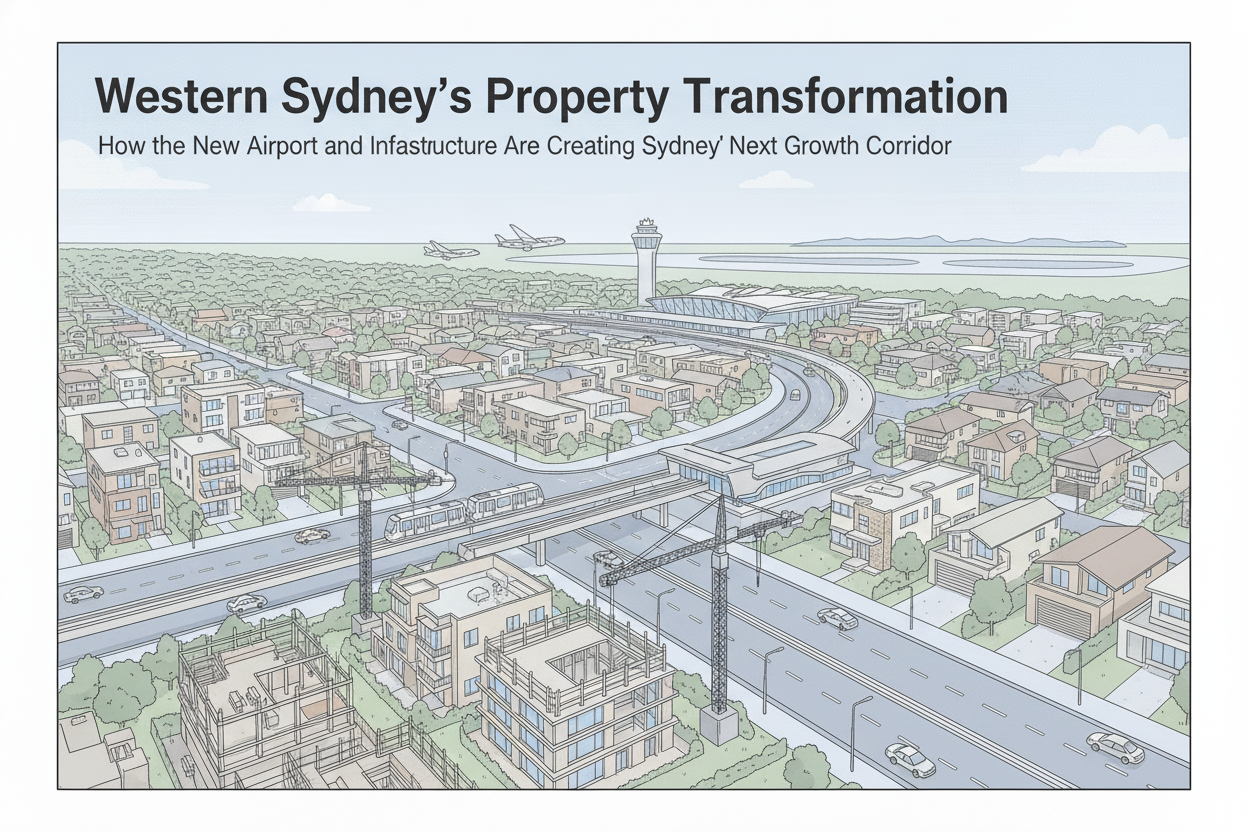
On 25 October 2026, Jetstar flight JQ362 takes off from Western Sydney International Airport bound for the Gold Coast. Air New Zealand follows with Auckland on 26 October, and Singapore Airlines begins Changi flights on 23 November. After that, the airport at Luddenham, 44 kilometres from the Sydney CBD, never closes. No curfew.
Around it sits something bigger: an 11,200-hectare Aerotropolis, Australia’s first new city in a century at Bradfield, a 23-kilometre metro line, and a $31 billion investment pipeline. The corridor is no longer a promise. Here is how the pieces fit together and where the market is already responding.
The Airport Opens in October: What It Actually Unlocks
The airport has been a talking point for years. A confirmed flight schedule changes things. As industry analysts have noted, a major catalyst with a defined delivery timeline attached to a residential market that has not yet materially repriced is a relatively rare combination.
The opening converts speculation into an operating asset. The airport anchors the entire Aerotropolis, and every surrounding precinct has been planned around it. Buyers are now looking beyond infill locations for scale, with Leppington, St Marys, and Picton drawing attention. Japanese investment in Australian residential property surged 46% in FY2025, making Japan the fifth-largest foreign owner of Australian homes, and institutional investors such as life insurers and pension funds are actively seeking Australian real estate yield at scale. Both domestic buyers and international capital are watching this corridor closely.
Bradfield City: Australia’s First New City in 100 Years
Bradfield City Centre sits at the heart of the Aerotropolis, built from scratch with targets of 10,000 new homes and 20,000 jobs. The NSW Government has opened the first Advanced Manufacturing Readiness Facility and broken ground on the Second Building, a 7,000-square-metre facility housing Australia’s first commercial Semiconductor Advanced Packaging Facility. There are only about 13 such facilities worldwide. Technology developed in Australia can now be commercialised onshore.
The combined $300 million state investment targets semiconductors, aerospace, defence, robotics, medtech, and cleantech. The broader Western Parkland City area aims for 200,000 new jobs, supported by a $31 billion pipeline.
Then there is Burrah Park. The $3.9 billion, 280-hectare industrial estate opposite the airport entrance has planning approval. IFM Investors and UniSuper acquired the site for roughly $850 million. DHL Supply Chain has committed to a 24/7 warehouse operation, and the estate is expected to create more than 6,300 ongoing jobs.
The Metro and Transport Spine
The Sydney Metro to Western Sydney Airport line runs 23 kilometres from St Marys to Bradfield, with six new stations: St Marys, Orchard Hills, Luddenham, two within the airport site (terminal and business park), and Bradfield. Twelve metro trains and 14,000-plus construction jobs back the project. The Australian and NSW Governments share the objective of having it operational when the airport opens. When it does, the line transforms the commute logic. St Marys is being reshaped into a multi-modal hub backed by an $11 billion expansion. The Plenitude Wealth/Hotspotting report identified it among 10 national suburbs set to benefit from $1.02 trillion in transport infrastructure.
Further east, Parramatta Light Rail Stage 2 has $2.4 billion committed. The transport spine links residential areas to job hubs along a fast, reliable corridor.
Where Prices and Rents Are Already Moving
Property prices around St Marys have risen roughly 17% over the 12 months to April 2026, with about two-thirds of that growth since October when the First Home Buyer cap was raised to $1.5 million. The rental market is the most competitive in 17 years: rents up about 20%, vacancy around 1%, and properties spending under two weeks on market.
Western Sydney gross rental yields sit between 5.2% and 6.4%, well above the Sydney-wide average. Three-bedroom houses in Blacktown, Mount Druitt, and St Marys rent for $700 to $850 per week. That combination is pulling investors into the corridor at a time when cashflow-positive outcomes are harder to find closer to the city.
Claremont Meadows and St Marys houses are up roughly 75% over the past decade, outpacing Greater Sydney’s average of 58%. Jordan Springs in Penrith has nearly doubled. Local agents report most buyers are now from outside the area, relocating from other parts of Sydney drawn by value and the infrastructure build.
The South West Growth Area: Land, Estates, and New Communities
The South West Growth Area stretches across 10,000 hectares from Glenfield to the Macarthur Urban Renewal Corridor. Austral, roughly 13 kilometres from the airport, and Leppington, with established rail access, are the key suburbs.
New housing communities include Bloombury, Lotus, 18th Avenue, Diluma, Akira, The Crest, Madison Gardens, and Heath Rise. At Menangle Park, the Dahua Group has 4,000-plus homes planned with 1,800 lots sold. Land prices range from $470,000 for a 250-square-metre lot to $999,000 for 6,078 square metres.
In Austral, registered lots trade at roughly $2,270 to $2,440 per square metre, placing small lots in the $695,000 to $745,000 band. Absorption is genuine: builders and owner-occupiers settling at volume, not speculators. Camden and Oran Park represent the mature end of the corridor. Town centres are operating, schools and community facilities have been delivered, and consistent end-buyer demand keeps absorption steady, creating a different profile from the greenfield estates still building out their amenity.
Why Buyers and Investors Are Looking West Now
Sydney’s median house price sits at $1,617,000 and units at $871,000, with a combined dwelling median of roughly $1,290,000. Those numbers make established inner and middle-ring suburbs a stretch. Western Sydney offers entry at lower price points, and the First Home Buyer cap lift to $1.5 million has expanded the eligible buyer pool.
PropTrack data shows a “radical split”: outer western houses have strongly outperformed inner-city units over the past decade. The driver is the mismatch between limited house land supply in the west and abundant apartment stock closer to the city.
Western Sydney yields of 5.2% to 6.4% compare favourably to inner Sydney, with vacancy at 1.3%. Institutional capital is validating the corridor. NAB’s Greater Western Sydney Horizons Report confirms long-term strength, and Frasers Property identifies the Western Sydney Growth Corridor as a “standout”. The buyer mix spans first home buyers, investors, and out-of-area owner-occupiers.
Where the Corridor Goes from Here
The airport opening on 25 October is an activation point, not an endpoint. It is the trigger for a city-shaping transformation that will unfold over decades. The jobs are still building: 200,000 targeted across the Western Parkland City, 6,300 at Burrah Park, and the advanced manufacturing cluster at Bradfield in its early stages. The metro line, once operational, will reshape commuting patterns across the entire corridor, connecting residential communities to employment hubs with a speed and reliability the west has never had.
The corridor offers a range of entry points. Established suburbs like St Marys and Penrith give buyers infrastructure and amenity. Greenfield estates like Menangle Park and Austral offer new housing at lower price points. Investors can find yields above 5% where vacancy is barely measurable. Across every segment, the direction of travel is the same: a corridor-wide transformation with a fixed timeline, a growing employment base, and decades of runway still ahead.
Frequently Asked Questions
How far is Western Sydney Airport from Sydney CBD?
Western Sydney International Airport is at Luddenham, roughly 44 kilometres from the Sydney CBD. It is accessible via the M7 and M12 motorway, with the Sydney Metro to Western Sydney Airport line providing a direct rail connection from St Marys to the airport and Bradfield City Centre.
Will the metro be running when the airport opens?
The 23-kilometre Sydney Metro to Western Sydney Airport line connects St Marys to Bradfield via six stations. A free interim bus service will operate from the airport’s opening day, running every 30 minutes between the airport and St Marys station with a journey time of roughly 30 minutes. The metro line itself is expected to open in late 2027, at which point the interim buses will be phased out. The Australian and NSW Governments share the objective of having the full metro operational as close to the airport opening as construction allows.
Which suburbs are closest to the new airport?
Luddenham is the immediate airport location. Key residential suburbs include Austral, roughly 13 kilometres away, and Leppington, which has an existing railway station. Badgerys Creek and Bringelly sit nearby. St Marys is at the northern end of the metro line and serves as the major transport interchange. Orchard Hills, one of the six new metro stations between St Marys and the airport, is planned as a future commercial precinct.
What is Bradfield City Centre?
Bradfield City Centre is Australia’s first new city in 100 years, built at the heart of the Western Sydney Aerotropolis with plans for 10,000 new homes and 20,000 jobs. The NSW Government has broken ground on the Second Building, a 7,000-square-metre facility housing Australia’s first commercial Semiconductor Advanced Packaging Facility, one of about 13 worldwide. The $300 million state investment targets aerospace, defence, robotics, medtech, and cleantech.
How many jobs will the Aerotropolis create?
The Western Sydney Aerotropolis targets 200,000 new jobs across the Western Parkland City area, supported by a $31 billion investment pipeline. The airport itself will support nearly 28,000 direct and indirect jobs by 2031. Burrah Park is expected to create more than 6,300 ongoing jobs.
What are property prices doing around St Marys?
Property prices around St Marys have risen roughly 17% over the 12 months to April 2026, with about two-thirds of that growth since October when the First Home Buyer cap was raised to $1.5 million. The rental market is the most competitive in 17 years: rents up around 20%, vacancy about 1%, and properties spending under two weeks on market.
What are rental yields like in Western Sydney?
Western Sydney gross rental yields sit between 5.2% and 6.4%, well above the Sydney-wide average. Three-bedroom houses in Blacktown, Mount Druitt, and St Marys rent for $700 to $850 per week. With Sydney’s vacancy rate at 1.3%, these yields are drawing investor interest.
Can first home buyers afford property in the Western Sydney corridor?
Yes. The NSW Government raised the First Home Buyer cap to $1.5 million, opening stamp duty concessions across Western Sydney. In the South West Growth Area, land at Menangle Park starts from $470,000, and registered lots in Austral trade in the $695,000 to $745,000 range. With Sydney’s median house price at $1,617,000, the corridor offers first home buyers an entry point at meaningfully lower levels.
How has Western Sydney property performed over the long term?
Claremont Meadows and St Marys recorded roughly 75% house price growth over the past decade, outpacing Greater Sydney’s average of 58%. Jordan Springs in Penrith has nearly doubled. Performance has been driven by infrastructure investment and limited house land supply channelling demand into the western growth corridors.
What is Burrah Park and why does it matter for property?
Burrah Park is a $3.9 billion, 280-hectare industrial estate opposite the airport entrance. Jointly owned by IFM Investors and UniSuper, it is expected to create more than 6,300 ongoing jobs across freight, logistics, and advanced manufacturing. DHL Supply Chain has committed to a 24/7 operation. The jobs will drive sustained housing demand in surrounding suburbs.
Is now a good time to buy in the Western Sydney growth corridor?
The corridor presents a configuration several market commentators have noted as relatively unusual: a confirmed infrastructure catalyst, the airport opening 25 October 2026, attached to a residential market that has not yet fully repriced against the scale of investment. With $28 billion in committed public infrastructure and strong demand from buyers and renters, the fundamentals are supported by more than sentiment. Individual circumstances and holding capacity always matter, but the direction of travel is clear.