
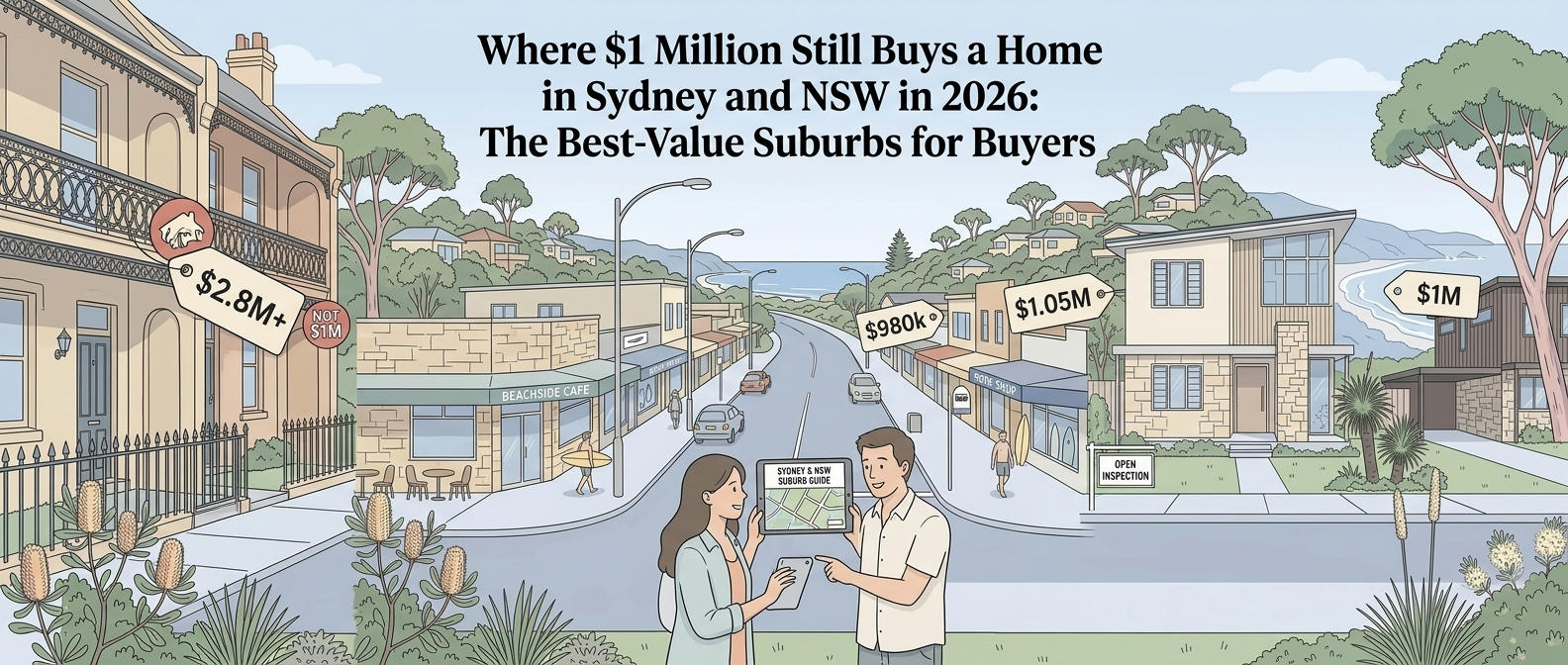
Australia’s national median house price reached $1 million in July 2026, and the typical unit now sits around $700,000. That headline tells you less than it seems. A median is just one point on a distribution, which means half the homes in any given suburb sit below it. This guide maps the Sydney and NSW suburbs and dwelling types where a seven-figure budget still secures a home in 2026, and why this spring is a well-stocked window for buyers.
The $1 Million Benchmark in 2026
Start with the Sydney numbers. As of August 2026, the median Sydney house value sits at $1,494,878, with units at $878,176 and all dwellings at $1,222,718. Those figures are midpoints, not floors. As realestate.com.au senior economic analyst Megan Lieu puts it, “a suburb’s median home price is just one point on the distribution,” so half the homes in any suburb are more affordable than the headline suggests. Across the country only 25 suburbs have every house valued under $1 million, and none are in Sydney. Near-certainty exists closer to home: in Willmot, 98.84% of houses still sit under the million-dollar mark, and in Tregear the share is 98.51%.
Western Sydney and the Blacktown Corridor
The biggest concentration of sub-$1 million houses in NSW runs along the Blacktown corridor in Sydney’s outer west. Willmot leads with a median of $834,000 and 98.84% of houses under $1 million, followed by Tregear ($842,000), Bidwill and Lethbridge Park (both $847,000), Blackett ($846,000), Whalan ($859,000) and Emerton ($860,000). In practical terms, a $1 million budget buys almost any house in Willmot, Tregear, Emerton and Blackett. Industry analysis points to several of these suburbs to lead the next upswing, all still carrying sub-$1 million medians and already posting yearly growth: Hebersham ($972,000, up 7%), Blackett ($880,000, up 7%) and Tregear ($890,000, up 7%). Across the wider Sydney market, Mount Druitt rose 1.0% to $947,930, while St Marys gained 0.8% and Penrith 3.8%, the latter two having just crossed above the $1 million mark.
The Central Coast’s Coastal Value
About 90 minutes north of the CBD, the Central Coast is the standout coastal value pocket. The region’s median house price sits at $1.06 million, but its cheapest suburbs sit well below that mark: San Remo ($807,000), Lake Munmorah ($810,000), Kanwal ($826,050), Charmhaven ($838,400) and Gorokan ($849,000), each posting 10-year growth of between 5.2% and 6.3% a year. On the share-of-suburb measure, 98% of San Remo houses and 97% in neighbouring Blue Haven are valued under $1 million. A budget of $800,000 to $850,000 buys a freestanding home at the northern end of the coast, while $1 million opens up options further south in Berkeley Vale, Killarney Vale, Bateau Bay and Wyoming. Buyers are increasingly looking north rather than west for an ocean-and-lake lifestyle, helped by hybrid working that eases the commute. The growth is already showing, with Wyong the state’s fastest-growing region at +4.3% and a median of $927,426.
Units: Sydney’s Affordability Path
For buyers who want to stay closer to the city, units are the realistic entry point. A new property report names Regents Park ($536,000), Granville ($543,250) and Bankstown ($620,000) as Sydney’s best-value unit pockets, with rental yields up to 6.4%. The shift is measurable: the share of affordable Sydney unit suburbs rose from 36.9% to 50.6% between the second half of 2025 and the first half of 2026, the first time more than half of all tracked unit suburbs have cleared the threshold. Only 11.6% of house suburbs do the same. Parramatta shows the scale, with 97% of its units under $1 million and roughly half under $600,000, while Vineyard and Warwick Farm offer sub-$700,000 options. Closer in, Eastlakes ($770,000), Hillsdale ($780,250), Canterbury ($750,000) and Lakemba ($530,000, with a 5.3% yield) keep inner-ring living within reach.
Regional NSW and Where Demand Is Heading
Beyond the city, regional NSW anchors the value story. Newcastle, the Central Coast and Bathurst all made a national list of the 10 best-value markets this spring, with Newcastle house prices up more than 12% and rents up 7.4%, while Bathurst’s median sits below $700,000 with rents up about 9%. Buyer enquiry, a leading indicator of future resilience, has more than doubled in affordable pockets. House enquiries are up 231% in Wagga Wagga, 226% in Bathurst and 192% in Cessnock, alongside Sydney’s Austral (+239%) and Leppington (+221%). Unit enquiry is climbing just as sharply, up 153% in Mudgee ($526,000), 130% in Armidale ($403,000), 116% in Ropes Crossing ($742,000) and 104% in Riverstone ($908,000), with Central Coast unit demand also firming at +130% in Kincumber and +91% in Wyoming. Senior economist Anne Flaherty says these areas are “likely to be more price resilient compared to other markets.” For spring, sub-$1 million regional listings include Aberdare, listed under $900,000 and 45 minutes from Newcastle, and Lismore Heights in the Northern Rivers at less than $800,000.
Making a $1 Million Budget Work
A $1 million budget starts with a borrowing plan. As a rough rule of thumb, you can borrow about five times your household income, so a couple each earning $100,000 can look to borrow around $1 million. APRA’s debt-to-income caps now limit most lenders to six times a borrower’s gross income, and the 5% Deposit Scheme covers properties up to $1.5 million with no lenders mortgage insurance. Stamp duty is the other lever: the NSW First Home Buyers Assistance Scheme offers a full transfer-duty exemption up to $800,000, with a concessional rate between $800,000 and $1 million. This spring favours prepared buyers, with total listings up 11.3% year on year and a buyer-friendly auction clearance rate of 52.5%, and homes taking 43 days to sell nationally. Analysts describe it as the most workable buying conditions in years.
Frequently Asked Questions
Which Sydney suburbs still have houses under $1 million in 2026?
Willmot, Tregear, Emerton, Blackett, Bidwill, Whalan and Lethbridge Park in the Blacktown corridor, where 96% to 99% of houses remain under $1 million and medians sit in the $834,000 to $860,000 range. These suburbs hold the state’s highest concentration of sub-$1 million houses, so a seven-figure budget stretches furthest here. A $1 million budget buys almost any house in Willmot, Tregear, Emerton and Blackett.
Where can I buy a unit in Sydney for under $700,000?
Regents Park ($536,000), Granville ($543,250) and Bankstown ($620,000) are the best-value unit pockets, with rental yields up to 6.4%. Vineyard and Warwick Farm offer sub-$700,000 options in outer hubs, while 97% of Parramatta units sit under $1 million. In the inner ring, Eastlakes ($770,000), Hillsdale ($780,250), Canterbury ($750,000) and Lakemba ($530,000, with a 5.3% yield) keep a city-fringe budget working.
What can a $1 million budget buy on the Central Coast?
A freestanding home, comfortably. About 98% of San Remo houses and 97% of Blue Haven houses are valued under $1 million, and the region’s cheapest suburbs carry medians from $807,000 (San Remo) through $810,000 (Lake Munmorah) to $849,000 (Gorokan). A budget of $800,000 to $850,000 buys a freestanding home at the northern end of the coast, while $1 million opens up Berkeley Vale, Killarney Vale, Bateau Bay and Wyoming further south. It is one of the few coastal pockets where a seven-figure budget still buys a freestanding house without stretching above budget.
What is the median house price in Sydney in 2026?
About $1,494,878 for houses and $878,176 for units as of August 2026, with all dwellings at $1,222,718, against a national house median of $1 million. Because a median is a single midpoint, roughly half of the homes in any suburb list below it, which is why sub-$1 million suburbs still exist across the outer west and the Central Coast.
How much can I borrow to buy a $1 million home?
A rough rule of thumb is about five times household income, so a couple each earning $100,000 can borrow around $1 million. APRA’s 2026 debt-to-income caps limit most lenders to six times a borrower’s gross income, so budgeting to a comfortable repayment level matters more than the headline loan ceiling.
Do first home buyers pay stamp duty on a $1 million property in NSW?
Not the full amount. The NSW First Home Buyers Assistance Scheme offers a full transfer-duty exemption on homes up to $800,000 and a concessional rate between $800,000 and $1 million, so a purchase at or near the seven-figure mark attracts reduced duty rather than the full rate. For first home buyers, that makes the sub-$1 million suburbs in this guide doubly attractive, since the price clears the assistance threshold while the duty saving can go toward the deposit or moving costs.
Is 2026 a good time to buy a home in Sydney?
Buyers have more leverage than in recent years: total listings are up 11.3% year on year and the auction clearance rate sits at a buyer-friendly 52.5%, while homes are taking 43 days to sell nationally. Analysts describe it as the most workable buying conditions in years, with softer prices opening a window before expected 2027 rate cuts.
Which regional NSW towns offer the best value under $1 million?
Newcastle, the Central Coast and Bathurst are the NSW entries on InvestorKit’s national list of the 10 best-value markets this spring. Newcastle house prices are up more than 12% with rents up 7.4%, while Bathurst’s median sits below $700,000 with rents up about 9%. Wagga Wagga ($802,000) and Cessnock ($739,000) lead the state’s enquiry-demand charts instead, up 231% and 192% respectively.
Which NSW suburbs are seeing the biggest jump in buyer demand?
Enquiry per listing has climbed in Wagga Wagga (+231%), Bathurst (+226%) and Cessnock (+192%), plus Sydney’s Austral (+239%) and Leppington (+221%). Unit enquiry is rising just as fast: Mudgee is up 153% ($526,000), Armidale up 130% ($403,000), Ropes Crossing up 116% ($742,000) and Riverstone up 104% ($908,000). Higher enquiry is a leading indicator these areas are likely to be more price resilient, according to senior economist Anne Flaherty.
Does the 5% deposit scheme cover Sydney properties?
Yes. The expanded 5% Deposit Scheme lets eligible buyers purchase with just a 5% deposit and no lenders mortgage insurance on properties up to $1.5 million, well above the $1 million benchmark at the centre of this guide. That brings a wide range of Sydney units and many sub-$1 million houses within reach for first home buyers, while keeping the upfront cash requirement far lower than a conventional 20% deposit.
Conclusion
A $1 million budget in 2026 is far from the end of the road. It opens a genuine choice of houses in the Blacktown corridor and on the Central Coast, a strong unit play closer to the city, and well-priced regional options from Newcastle to Bathurst. Know your borrowing and stamp-duty position before you look, decide early between house, unit and region, and move with confidence while choice and negotiation power sit on the buyer’s side. When you are ready to look at specific streets and homes, the team at Stone Real Estate can put that local-market knowledge to work.